

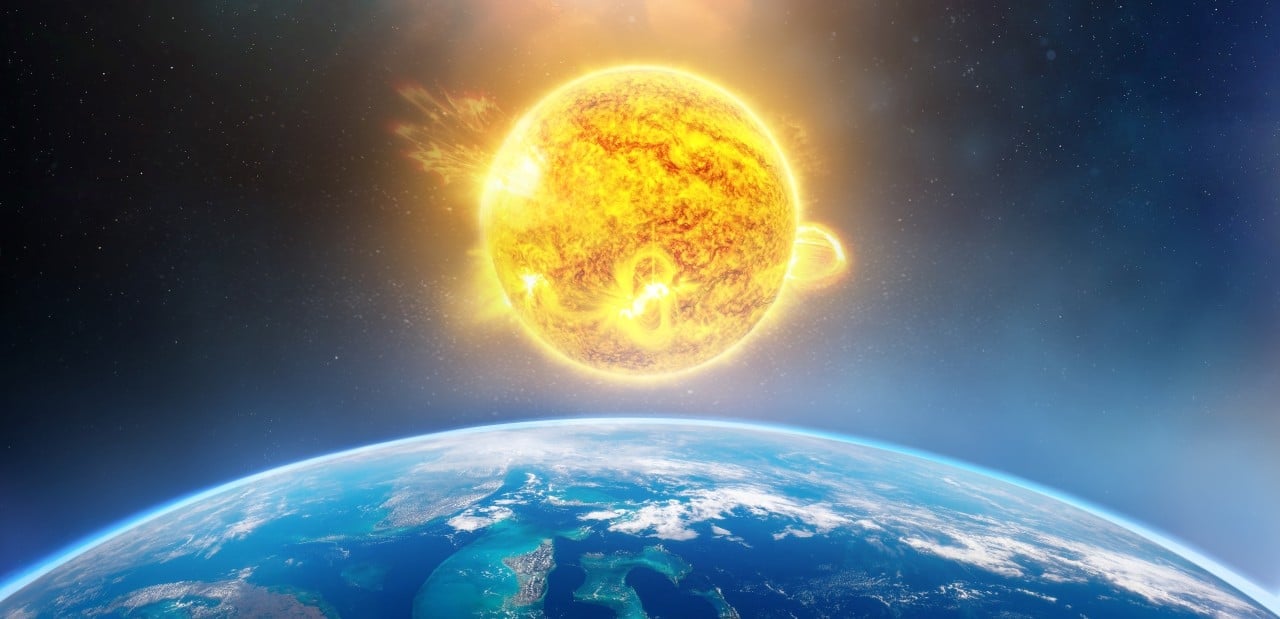
Administração Nacional of Aeronáutica and Espaço (Nasa) identified a sequence of five explosions of maximum intensity on the surface of Sol between February 1 and 4, 2026. The phenomenon released massive volumes of energy into outer space. The main event reached the X8.1 category on the measurement scale. Esse index represents one of the most powerful radiation emissions documented by scientists in recent years.
Administração Oceânica and Atmosférica Nacional (NOAA) issued a warning about the arrival of a coronal mass ejection to our planet. The plasmatic material should collide with the Earth’s magnetic field between February 5th and 6th. The interaction will trigger a G1 class geomagnetic storm. The level is considered light by space meteorologists, but requires continuous monitoring by international agencies to assess fluctuations in intensity.

Atividade extreme in sunspot AR4366
The center of all recent instability has been mapped to the active region called AR4366. The magnetic structure of this area grew rapidly in the days before the events. Essa’s complex configuration created the ideal environment for multiple detonations in a short space of time. Observatórios terrestrials noticed that the spot maintained its ability to emit radiation even after crossing the star’s limb.
The five occurrences registered varying powers within the highest category of the scientific scale. The first detection marked X1.0 on the sensors. The power spike happened shortly after with the X8.1 record. Subsequent explosions maintained the high standard with marks of X2.8, X1.6 and X1.5 throughout the period. Valores above X2 already configure events of great magnitude in the daily monitoring of stellar activity.
Efeitos predicted for the Earth’s magnetic field
The G1 geomagnetic storm warning indicates that the magnetosphere will undergo temporary compression. Loaded Partículas will be able to penetrate the upper layers of the atmosphere. Especialistas applies computer simulation models, such as the Enlil system, to calculate the exact trajectory of the plasma cloud. Current data points to a direct impact on the polar regions of the globe.
The arrival of ejecta generates practical consequences for space- and surface-based technologies. Monitoring agencies detail the main effects expected during the storm’s passage:
- High-frequency radio Ondas faces temporary blockages on transpolar aviation routes.
- Sistemas global positioning devices (GPS) record margins of error at extreme latitudes.
- Redes power distribution systems operate normally without the risk of widespread blackouts.
- Satélites communications handle a slight increase in atmospheric drag in low orbit.
The interaction of solar particles with atmospheric gases also produces luminous phenomena in the night sky. Observadores in the northern hemisphere have a high chance of seeing the aurora borealis. Países as well as Canadá, Suécia, Noruega and northern areas of Estados Unidos have the best visibility conditions. In the southern hemisphere, the south of Austrália and Nova Zelândia may record the occurrence of aurora australis.
Monitoramento continuous by space satellites
Monitoring space weather depends on a network of advanced equipment. Observatório of Dinâmica Solar (SDO) of Nasa has been capturing uninterrupted images of the Sol since 2010. The sensors record the superheated material in bright shades of extreme ultraviolet. The SOHO satellite acts in a complementary way by tracking the expansion of the coronal mass towards Terra. International collaboration between different space agencies allows for comprehensive, real-time coverage.
The classification of eruptions uses a system of letters ranging from A to X. Category X encompasses the most extreme events capable of affecting the planet globally. The number associated with the letter indicates the exact power measured in watts per square meter. An X8.1 explosion releases eight times more energy than an occurrence classified as X1.0. The accuracy of this data guides the issuance of alerts for civil aviation and telecommunications companies.
Ciclo solar 25 exceeds experts’ expectations
The current behavior of Sol reflects the peak phase of solar cycle 25. The period began in 2019 and presents a number of sunspots much higher than astronomers’ initial projections. The frequency of Class X explosions has increased considerably in recent months. Historical Eventos, such as the Carrington storm in 1859, demonstrate the impact of extreme solar flares. Naquela time, telegraph systems suffered short circuits in several parts of the world. More recent Episódios, such as the Canadá blackouts in 2003, reinforce the need for constant vigilance.
Operadores from satellites and space agencies activate safety protocols during these high radiation windows. Naves spacecraft perform guidance maneuvers to protect vital electronic components. Astronautas on board Estação Espacial Internacional receive instructions to remain in modules with reinforced shielding. Rigorous planning ensures mission integrity and continuity of essential services on Terra during peak stellar activity.