

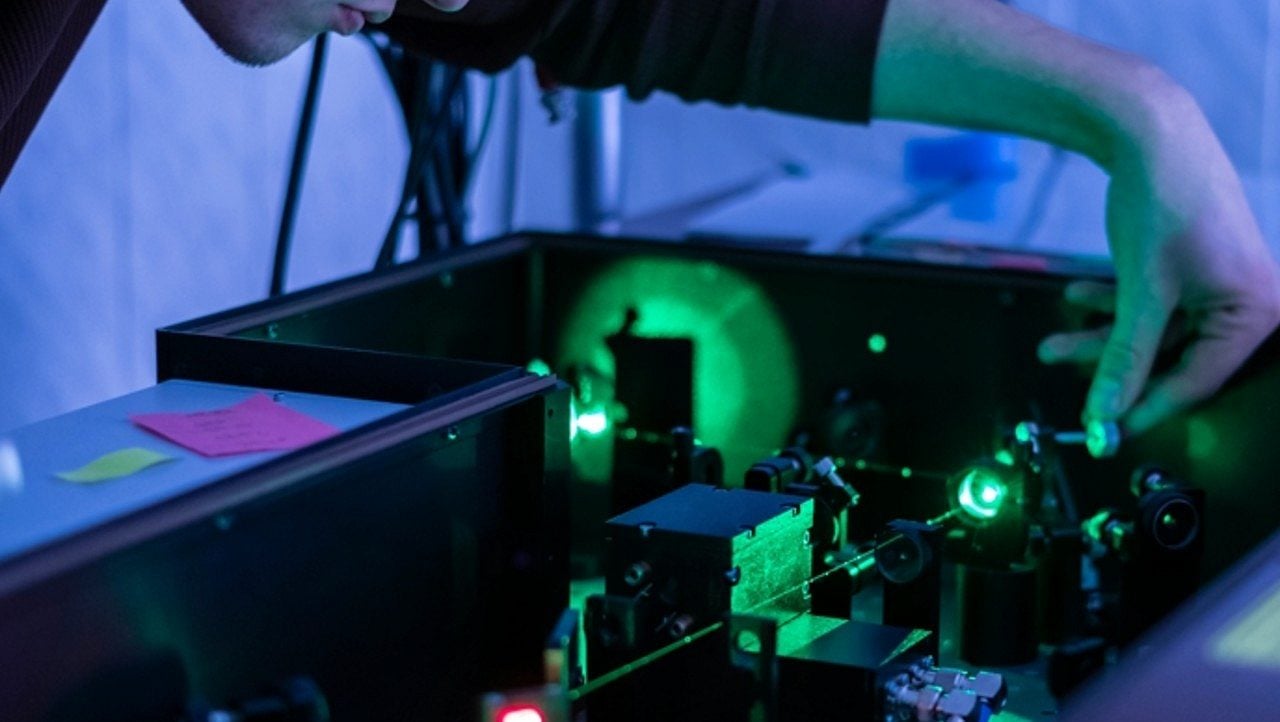
Pesquisadores of Universidade of Oslo investigated what happens when you try to remove part of a light pulse formed by a single photon. The theoretical calculation, published in Physical Review Letters, indicates an unexpected result. Instead of creating two smaller parts or a half photon, the process leads to a complex quantum state.
The work analyzes the impact of an ultrafast optical shutter. Esse device would block the front part of the light pulse. The authors modeled the interaction with a perfect reflector that is removed at a specific instant.
Modelo mathematician defies classical intuition
Fótons are elementary particles. Não have an internal structure that allows division as a macroscopic object. Ainda thus, an optical pulse has extension in time and space. The shutter interferes with this propagation.
Analysis reveals that the resulting state does not correspond to a smaller photon. Ele forms a superposition and mixture of different numbers of photons. Contributions theoretically extend to infinity. Isso arises from the breaking of temporal translational symmetry when the reflector is removed.
- The incident photon interacts with the reflector present before t=0.
- Parte from the front of the pulse is reflected.
- Instantly removing the device changes the electromagnetic field.
- Novas quantum excitations appear as additional photons.
- The global state involves components with zero, one, two or more photons.
Essa description comes from Bogoliubov transformations. Elas relate the creation and annihilation operators before and after the temporal change. The model shows how variation in time transfers energy from the vacuum to the field.
Conexão with dynamic Casimir effect
The phenomenon is related to the dynamic Casimir effect. Fast Mudanças in mirrors or cavities can convert vacuum fluctuations into real particles. In the case of the truncated photon, the sudden change in the reflector produces the same type of excitation.
The researchers highlight that the idealization of instantaneous removal leads to mathematical divergence. The expected number of photons becomes infinite. In more realistic scenarios, with gradual shutter release, the effect may be limited. The time interval must respect parameters such as the photon’s central frequency.
An example in the study considers a frequency of the order of 10¹⁵ hertz. With adequate initial transmissivity, the production of extra photons remains controllable. Mesmo thus, the final state maintains quantum complexity.
Equivalência local despite global complexity
A notable aspect is local equivalence. Embora the complete state is highly complex, it behaves simply in specific regions. To the left of the transition region, it looks like a single photon. On the right, it is equivalent to a vacuum.
The complexity centers on the narrow transition area created by removing the reflector. Observáveis restricted to a region produce results compatible with simple states. The energy associated with the generated photons is located in this transition zone.
Essa property helps understand localization in quantum field theory. Strictly localized Estados may require elaborate internal structure. The study illustrates how manipulating a photon affects the underlying field in profound ways.
Implicações for quantum optics
The work does not propose immediate technological application. Sua relevance lies in clarifying a fundamental problem. Ele shows that trying to rigidly localize a quantum state is costly. The global structure can involve arbitrarily high numbers of photons so that regions appear simple.
The authors, Isak Cecil Onsager Rukan, Jan Gulla and Johannes Skaar, of Departamento of Física of Universidade of Oslo, dated the article May 27, 2026. The study has been accepted for publication in Physical Review Letters.
Future Pesquisas may extend the analysis to multiple photons or other elementary particles. The result reinforces differences between everyday intuition and quantum mechanics. Qualquer intervention in a photon pulse changes the physical state in a non-trivial way.