

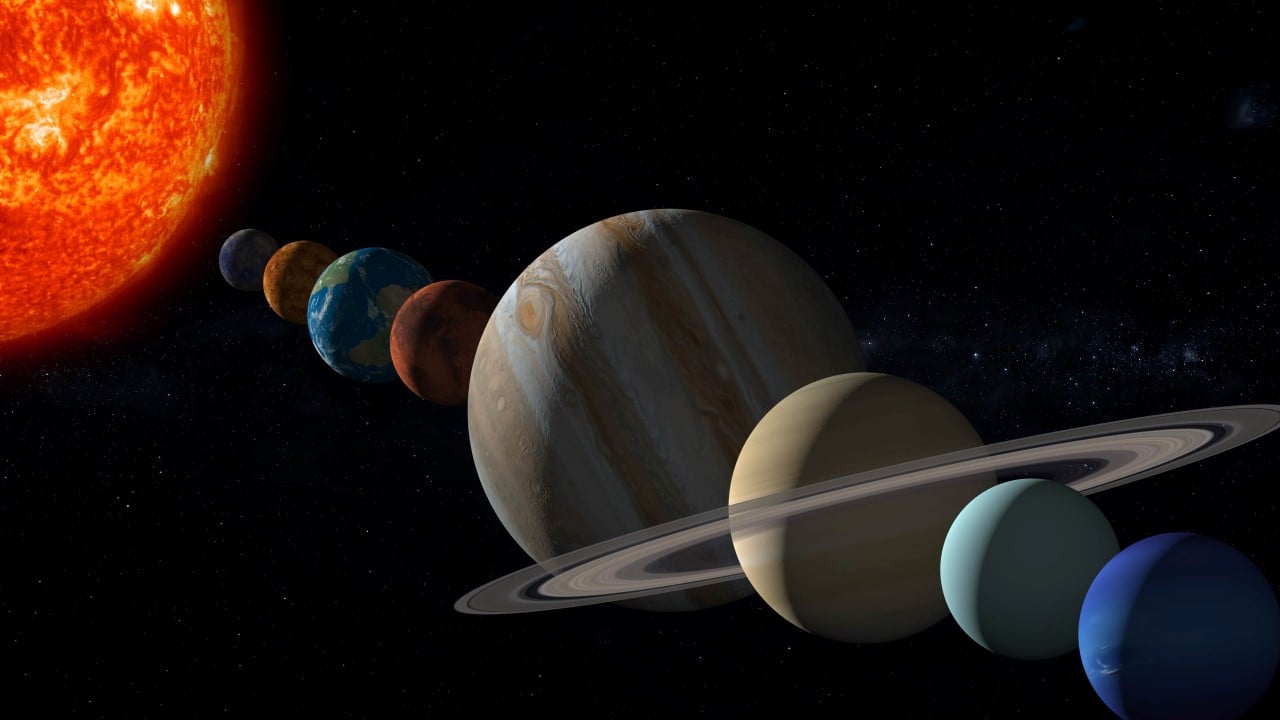
Researchers in the field of astrophysics assess the strong probability that a fifth celestial body of colossal proportions was part of our cosmic neighborhood during the early days of its formation.
For decades, the academic community believed that our planetary system reached a peaceful equilibrium shortly after the initial union of dust and gas. However, the advancement in the processing power of modern computers has made it possible to create virtual models that demonstrate an extremely violent and chaotic past.

The scenario of billions of years in the past was far from a harmonious orbital waltz, resembling more a gravitational battlefield with severe collisions, sudden changes of route and objects thrown into deep space. Today, science understands that this primordial era suffered from severe instability, where large gaseous worlds danced erratically, ejecting smaller planets and forcing natural satellites into a destructive cycle of fragmentation and regrouping.
The troubled origins of our cosmic neighborhood
The genesis of everything occurred from an immense rotating nebula that gave way to its own gravitational weight, igniting the nuclear furnace of the early Sun in the center of a vast disk of debris. In this ring of surrounding matter, microscopic grains began to bump into each other and stick together, growing over millions of years until they formed the rocky, gaseous foundation of the worlds, satellites, and space rocks we map today.
The long-held theory that calm reigned immediately after this initial construction has fallen apart in the face of cutting-edge astrophysical analyzes that illustrate a highly volatile environment. Once the big worlds gained enough mass, their paths around their host star gravitationally collapsed, triggering a game of cosmic billiards that permanently altered trajectories and wiped countless smaller bodies off the map.
The theory of planetary migration and gravitational chaos
The main scientific pillar to explain this disorder is the so-called Nice Model, originally formulated in 2005 by researchers in France, which describes the drastic migration of Jupiter, Saturn, Uranus and Neptune from their original birthplaces. As these colossi exerted mutual attraction and interacted with the surrounding debris cloud, tiny disturbances turned into a domino effect that destabilized the entire architecture of the system.
Within this aggressive dynamic, the largest members of the system functioned like gravitational slingshots, shooting smaller rocks into the dark reaches of space and messing up the paths of ancient comets. Natural satellites that were still taking shape ended up kidnapped from their original planets, launched into the interstellar void or pulverized in titanic collisions that left behind only rings of ice and dust.
The fifth ejected giant planet hypothesis
One of the most fascinating debates in modern astronomy involves the likely existence of a lost member of our planetary family, an ice and gas giant the size of Neptune. When mathematicians insert this fifth element into computer simulations, the end result of the orbital dance aligns perfectly with the exact position of the planets we observe in the sky today.
The fate of this hypothetical world, however, was definitive exile after losing a gravitational tug of war against the immense mass of Jupiter or Saturn. Cast out of our system, it would have become a wandering planet doomed to travel through the darkness of the Milky Way without the heat of a star, an event that helps justify the current distribution of rocks in the Kuiper Belt and the architecture of the distant Oort Cloud.
The impact of turbulence on natural satellite systems
The period of extreme chaos creates a puzzle about the fate of the primordial moons that orbited the great gaseous worlds during their violent exchanges of position. The virtual data shows that the chance of a satellite surviving this phase intact is minimal, as the close passage of two massive planets has enough force to dismantle any smaller orbital system.
The conclusion of many experts is that these satellites went through a brutal cosmic recycling process, being crushed and rebuilt multiple times around Saturn and Uranus. The case of Miranda, whose scars and cliffs up to 20 kilometers high were photographed by the Voyager 2 spacecraft in 1986, serves as definitive proof that debris from ancient collisions coalesced again to create the moons we know.
The scientific traces of a violent past
The material evidence that our neighborhood was born in the midst of disorder arises from the intersection of different astrophysics disciplines. Astronomers combine photographs from interplanetary probes, data from terrestrial observatories, chemical studies of rocks fallen to Earth and complex mathematical calculations to piece together the puzzle of this primordial era.
The main focuses of study include the almost perfect synchrony between the translations of Jupiter and Saturn, the fact that Uranus rotates practically on its side and the way in which icy bodies spread at the limits of the system. The scientific community organizes these pieces of evidence into four main fronts of investigation:
- Detailed topographic analysis carried out by spacecraft, which exposes planetary crusts full of fractures and geological anomalies.
- Study of the formation of craters and canyons that attest to colossal shocks during the period of greatest space bombardment.
- Chemical dissection of comets and asteroid fragments, which function as time capsules of the original raw material from space.
- Running virtual models that project gravitational behavior over millennia to validate migration routes.
The mysteries that astronomy still needs to solve
Even with technological advancement, many gaps persist over the millennia of drastic transformations that have shaped our region of the galaxy. The thesis of the expelled fifth giant planet is still restricted to computer codes, leaving researchers without definitive answers about the real weight of this body, its escape route or whether it is just a numerical trick to close the equations.
The sending of new probes to drill the ice of the Jovian and Uranian moons, combined with the monitoring of starless worlds and distant exoplanets, promises to deliver the missing pieces to this mystery. With the refinement of telescopes and supercomputers, the story of our system’s violent youth will leave the realm of theoretical assumptions to consolidate itself as an unquestionable scientific fact.