

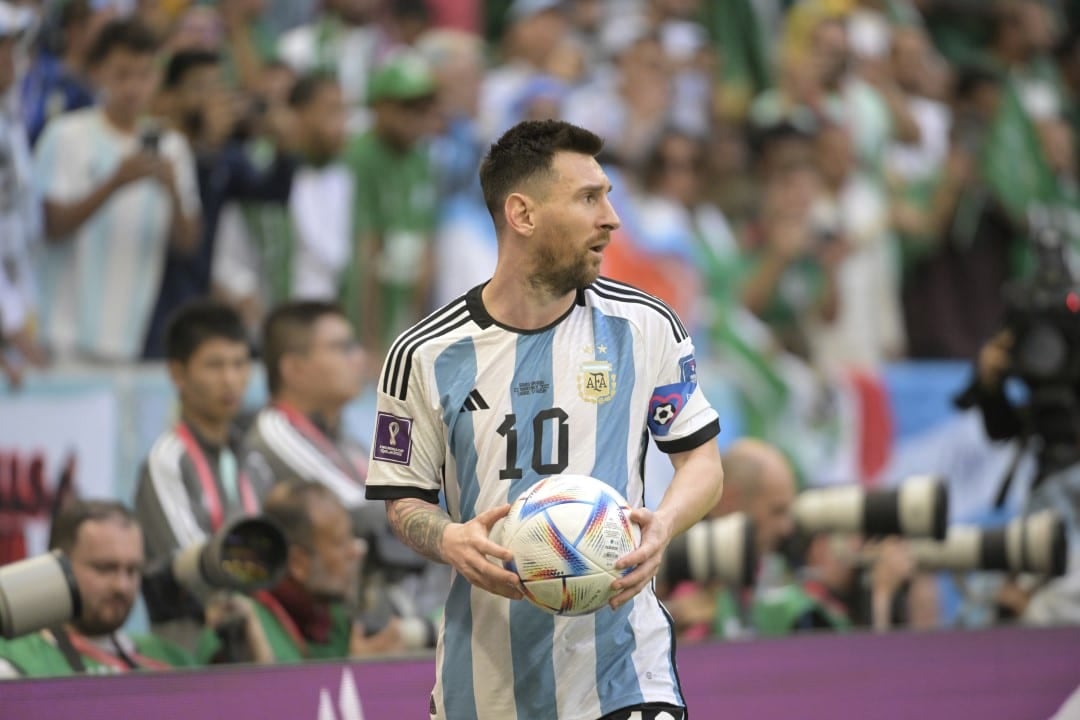
If the Argentine national team manages to defend its world title, a feat last achieved by Brazil in 1962, Lionel Messi will be the central figure of this historic campaign. The 38-year-old star is on track to compete in his sixth edition of the tournament, equaling the marks of Portugal’s Cristiano Ronaldo and Mexico’s Guillermo Ochoa. The version of the athlete who will take the field, however, bears little resemblance to the young man who made his professional debut for Barcelona in 2003.
Tactical transformation over two decades
Elite players often find ways to prolong their careers in the face of natural physical exhaustion. While Cristiano Ronaldo established himself as a box finisher after losing his physical explosiveness, the Argentine number 10 opted for a different path. He modified his playing style to maintain absolute dominance over matches, anticipating the trends of a sport that has always tried to keep up with him.
The journey began with a 16-year-old boy playing wide on the right wing in a friendly against Porto, led by José Mourinho. At that time, Ronaldinho Gaúcho already insisted in training that the rookie would be the best on the planet. Shortly afterwards, during the 2005 Joan Gamper Trophy, Juventus coach Fabio Capello was amazed by the striker’s performance and tried to take him to Italy.
The emergence of the false 9 under Pep Guardiola
At the age of 21, with Ronaldinho’s performance declining, coach Frank Rijkaard determined that the Argentine needed to play in the center of plays. When Pep Guardiola took over the team in 2008, he initially kept the athlete on the right wing, but soon realized the need to centralize him. The change occurred first for defensive reasons, as the player did not recompose his marking, but it resulted in the construction of an offensive system entirely focused on him.
The milestone of this revolution occurred on May 2, 2009, during a 6-2 defeat of Real Madrid at the Santiago Bernabéu stadium. Guardiola deployed Samuel Eto’o and Thierry Henry on the wings, leaving the number 10 free in the middle to retreat, receive the ball and dictate the pace. The strategy re-edited the concept of the false 9, used by Hungary under Gusztav Sebes in 1953 and by the Netherlands under Rinus Michels with Johann Cruyff.
The movement between the defense and midfield lines turned the striker into an unsolvable enigma for opponents. Supported by Xavi, Andrés Iniesta and Yaya Touré, he found empty spaces with ease. The success of the scheme led to the header in the 2009 Champions League final against Manchester United and paved the way for frightening numbers. In 2012, the Argentine broke German Gerd Müller’s historic record by scoring 91 goals in a single calendar year, consolidating a dynasty that earned him eight Ballon d’Or awards between the ages of 22 and 36.
Transition to playmaker after the departure of Barcelona idols
The departures of Xavi in 2015 and Iniesta in 2018 forced a drastic new adaptation. Without his teammates who controlled possession of the ball and created space, the star had to assume the role of the Catalan team’s main driver. The requirement of simultaneously being the playmaker and the main scorer weighed on his shoulders, requiring an even greater retreat on the field.
He assumed the role of enganche, the classic South American number 10 responsible for initiating offensive transitions. This change in attitude was directly reflected in his statistics, with the number of passes on goal approaching the number of balls in the net during his last seasons in Europe.
- In the 2019-20 La Liga season, he recorded 22 assists and 25 goals in 33 matches played.
- In his last year at Barcelona (2020-21), he scored 30 goals and distributed 11 assists in the national championship.
- In his first season with Paris Saint-Germain, he recorded 15 assists and 11 goals, surpassing the number of goals for the first time in his career.
Leadership in the national team and winning the third championship
Tactical development at clubs occurred in parallel with a long process of acceptance into the Argentine National Team. Appointed captain in 2011, he faced a period of intense frustration following defeats in the 2014 World Cup finals and the 2015 and 2016 editions of the Copa América. The weight of public expectations led to his brief resignation from the national team, but his return marked the birth of a more vocal and combative leader.
Breaking the 28-year drought without titles in the 2021 Copa América, with a victory over Brazil at Maracanã, took an immense weight off his shoulders. At the 2022 World Cup in Qatar, the public saw a synthesis of all its previous versions. The tournament registered moments of physical explosion, such as the sprint against Josko Gvardiol in the semi-final, and moments of pure vision of the game, exemplified by the millimeter pass to Nahuel Molina in the quarter-finals and the coolness in the penalty kicks against France.
The current version at Inter Miami and the game reading
In recent conversations with former players like Zinedine Zidane, the Argentine highlighted how modern football has become more physical and tactical, reducing spaces on the field. Playing for Inter Miami and during the 2024 Copa América, his response to this scenario was to slow down the racing. He spends most of his time walking, mapping his opponents’ positioning and saving his energy for decisive fractions of a second.
Former midfielder Pablo Aimar, the number 10’s childhood idol, defined the situation by stating that the most recent version of the star is always the best. The legacy built over twenty years goes beyond simply counting trophies. It’s about the ability of an athlete to continually reinvent himself, going from a fast winger to a revolutionary false 9, transforming into a cerebral point guard and, finally, the maestro who guided Argentina towards the top of the world.