
A Quaest survey, released this Wednesday (10), shows that President Luiz Inácio Lula da Silva (PT) leads with 44% of voting intentions in a possible second round against Senator Flávio Bolsonaro (PL), who registers 38%. The numerical difference, which previously indicated a technical draw, has now widened.
In the previous survey, in May, Lula had 42% and Flávio Bolsonaro appeared with 41%. In April, the senator was numerically ahead, scoring 42% against Lula’s 40%, and in March, both were tied with 41%.
This survey signals a change in the scenario that showed a technical tie since March, with Lula now opening a six percentage point lead over his opponent.
Still, the confrontation remains more balanced than at the beginning of the Quaest historical series, in August 2025, when Lula held a sixteen point advantage. In December, this difference fell to ten points, the period in which Flávio Bolsonaro announced his pre-candidacy.
The June study is the first by Quaest to measure the electorate’s reaction to recent events, such as the revelation of dialogues between Flávio Bolsonaro and banker Daniel Vorcaro, arrested for fraud, in addition to new measures announced by the Trump administration that affect Brazil.
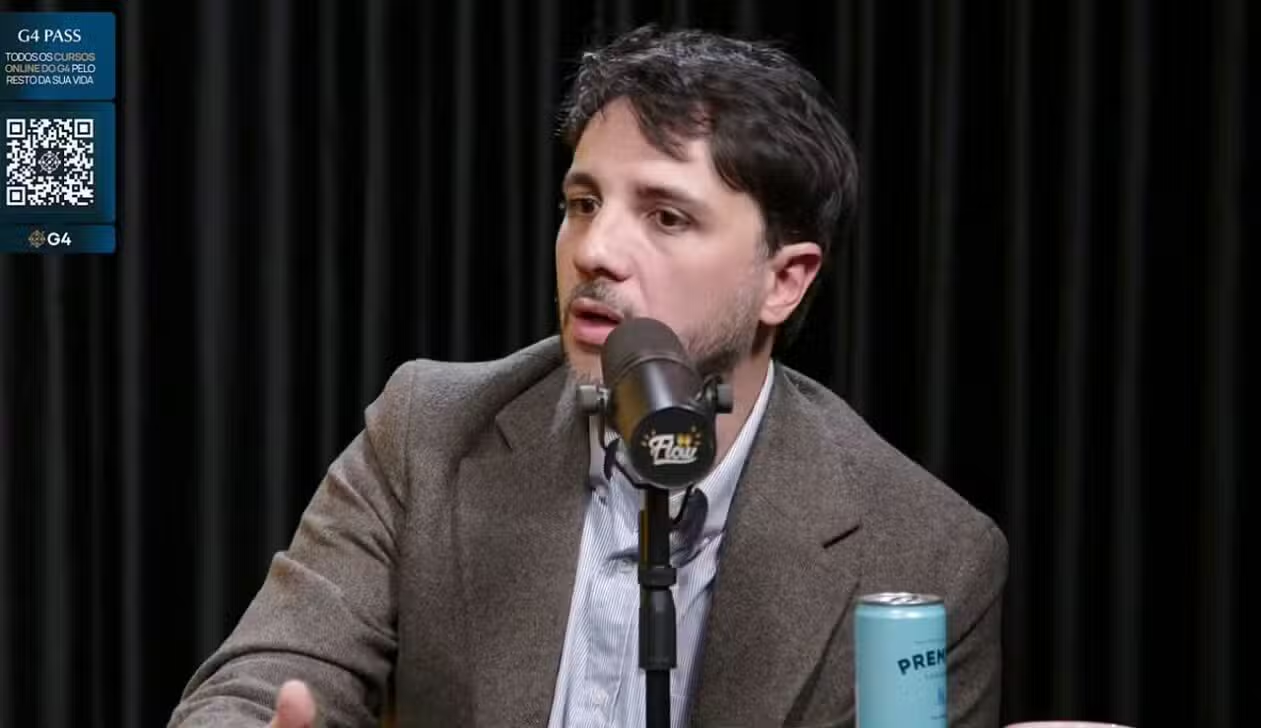
“The most significant change happened among the independents, who replaced Flávio with Lula”, says Felipe Nunes, director of Quaest.
This segment of the electorate represents a third of the total and could be decisive in the dispute. Independent voters are those who identify neither with the right nor with the left, nor as Bolsonarists nor as Lulistas.
In this group, voting intentions for Lula rose from 29% to 37%, putting him ahead. Flávio Bolsonaro, in turn, fell from 31% to 24%, and had his best moment in April, reaching 33%. Another 30% of independents declare that they would not vote in a second round between Lula and Flávio.
The survey also indicates an improvement in the perception of the federal government, attributed to the impact of measures announced in recent months, such as the Income Tax exemption and the Desenrola program, focused on helping indebted families.
Felipe Nunes also highlights the fall of Flávio Bolsonaro among the non-Bolsonaro right, where the PL senator had reached 90% of voting intentions in April, and now registers 82%.
“The other names on the right, however, are unable to improve their performance against Lula to the point of being more competitive than Flávio. Zema has had a negative fluctuation in the last month and is ten points behind Lula”, details the director of Quaest.
Master Case and Trump measures
The director of Quaest analyzes that the worsening of the scenario for Flávio Bolsonaro is linked to the electorate’s reaction to the disclosure of conversations with Daniel Vorcaro.
- The majority (65%) believe that Flávio was wrong to ask Vorcaro for resources to finance the production of the film “Dark Horse”, about Jair Bolsonaro.
- 58% believe that the PL senator may have some illegal involvement with Banco Master.
- 62% say that Flávio Bolsonaro was aware of Vorcaro’s involvement in corruption cases.
- The percentage of Brazilians who believe that the Banco Master crisis affects the Bolsonaro family the most increased from 9% to 16%.
Quaest also consulted voters about the measures announced by Trump in relation to Brazil. Regarding the classification of criminal factions as terrorists, which was criticized by Lula and defended by Flávio Bolsonaro, the electorate is divided: 45% agree and 45% disagree. However, 60% say that this decision should be made by the Brazilian government.
According to the survey, 53% of those interviewed believe that the sanctions imposed by Trump will harm Brazilian companies and banks.
Regarding the new tariffs announced by the White House, 47% agree with Lula, who accuses Flávio of having influenced the decision. Furthermore, 46% believe that the US is punishing Brazil because of PIX, while 36% believe that it would be retaliation for the Brazilian president’s criticism of the US government.
The survey was commissioned by Genial Investimentos and interviewed 2,004 people aged 16 or over, between the 5th and 8th of June. The margin of error is plus or minus two percentage points, with a 95% confidence level. Registration with the TSE is BR-07661/2026.
Quaest, 1st round: Lula leads with 39%, and Flávio has 29%
Quaest also presented voters with second round simulations in which Lula would face Renan Santos (Missão), Romeu Zema (Novo) and Ronaldo Caiado (PSD).
Felipe Nunes highlights the performance of the founder of MBL and pre-candidate for Missão, Renan Santos. “The one who has improved in the 2nd round simulation is Renan Santos, who reached 31%, his best performance in the historical series. But he still appears less competitive than Flávio.”
Lula x Renan Santos scenario (June/2026):
- Lula (PT): 45% (maintaining the 45% of May; rising from 44% in April, 43% in March, 44% in February and 46% in January);
- Renan Santos (Mission): 31% (rising from 28% in May, 24% in April, 24% in March, 25% in February and 26% in January);
- Undecided: 4% (it was 5% in May, 5% in April, 3% in March, 4% in February and 4% in January);
- Blank/null/will not vote: 20% (it was 22% in May, 27% in April, 30% in March, 27% in February and 24% in January).
Lula x Romeu Zema scenario (June/2026):
- Lula (PT): 45% (rising from 44% in May, 43% in April, 44% in March, 43% in February and 46% in January);
- Romeu Zema (New): 35% (down from 37% in May; it was 36% in April, 34% in March, 32% in February and 31% in January);
- Undecided: 3% (it was 4% in May, 4% in April, 4% in March, 4% in February and 4% in January);
- Blank/null/will not vote: 17% (it was 15% in May, 17% in April, 19% in March, 21% in February and 19% in January).
Lula x Ronaldo Caiado Scenario (June/2026):
- Lula (PT): 45% (rising from 44% in May, 43% in April, 44% in March, 42% in February and 44% in January);
- Ronaldo Caiado (PSD): 34% (down from 35% in May; it was 35% in April, 32% in March, 32% in February and 33% in January);
- Undecided: 4% (it was 4% in May, 4% in April, 3% in March, 4% in February and 4% in January);
- Blank/null/will not vote: 16% (it was 17% in May, 18% in April, 21% in March, 22% in February and 19% in January).