New discoveries challenge the existence of Planet Nine and complicate research in the Solar System
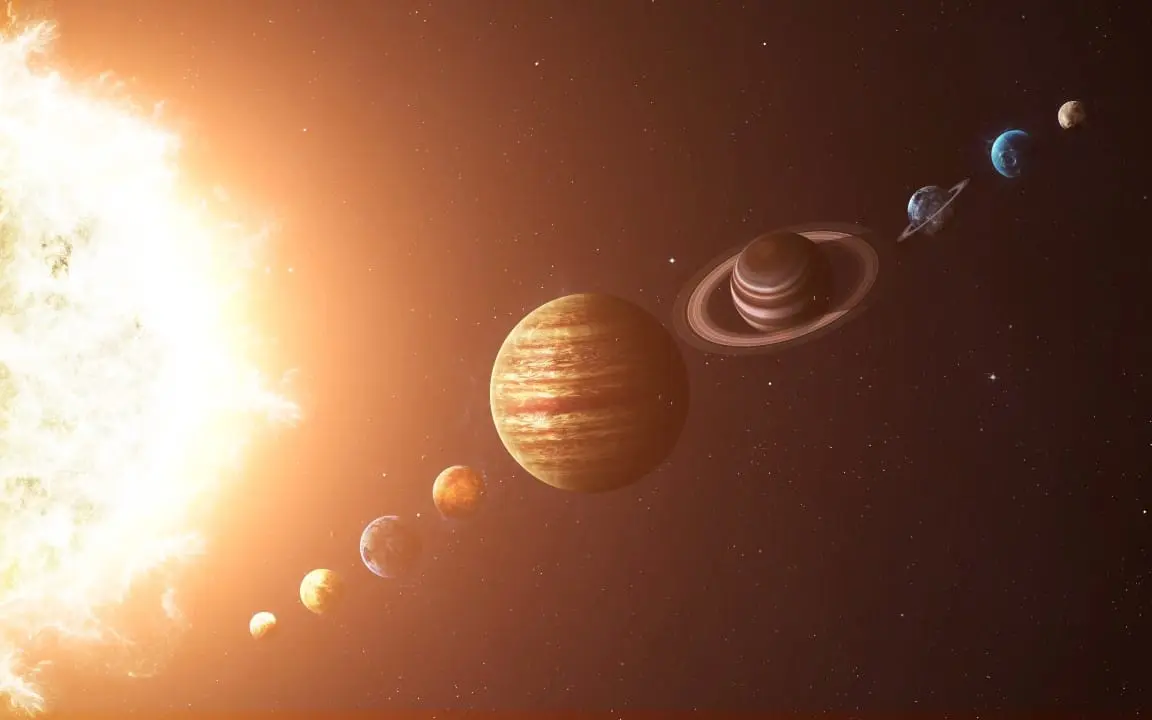
The persistent search for the enigmatic Planet Nine continues to mobilize the scientific community, but recent discoveries transform the Solar System’s greatest mystery into an even more intricate challenge for researchers.
The question about the presence of a massive, yet unidentified planet in the far reaches of the Solar System is not new. Conceived even before the revelation of Pluto, in the 1930s, the theory, then known as Planet X, was proposed by renowned astronomers to justify the anomalies in the orbit of Uranus, which deviated from physical predictions. The gravitational pull of an uncatalogued celestial body, several times larger than Earth, was seen as the possible cause of this incongruity.
The Uranus controversy was finally clarified in the 1990s with a reassessment of Neptune’s mass. However, in 2016, a new hypothesis about a possible ninth planet was presented by astronomers Konstantin Batygin and Mike Brown, both from Caltech (California Institute of Technology).
Caltech researchers propose the existence of Planet Nine
The scientists’ thesis revolves around the Kuiper Belt, a vast region located beyond Neptune, made up of dwarf planets, asteroids and other celestial bodies, including Pluto. Numerous Kuiper Belt objects, also called trans-Neptunian objects, have been observed in orbit around the Sun, but, similar to Uranus, their trajectories do not follow a continuous and predictable pattern. Batygin and Brown maintained that a considerable gravitational force must be influencing these orbits, proposing Planet Nine as a solution to the puzzle.
This dynamic can be compared to the movement of our own Moon. Although it circles the Sun every 365.25 days, as expected from the distance, the Earth’s gravitational attraction causes the satellite to also orbit our planet every 27 days. To an outside observer, the Moon exhibits a spiral motion due to this interaction. Similarly, many objects in the Kuiper Belt reveal evidence that their orbits are influenced by more than just solar gravity.
Although the Planet Nine theory met with initial skepticism among astronomers and space scientists, the volume of evidence has been growing. Increasingly powerful observations confirm that the orbits of trans-Neptunian objects are, in fact, erratic, boosting research.
In 2024, Mike Brown categorically stated: “I believe it is very unlikely that P9 does not exist. There are currently no other explanations for the effects we see, nor for the multitude of other P9-induced effects we observe in the Solar System.”
As an illustration, in 2018, a new possible dwarf planet in solar orbit was announced, named 2017 OF201. This object, approximately 700 km in diameter (Earth is about 18 times larger), has a very elliptical orbit. The absence of a roughly circular path around the Sun suggested two possibilities: a primordial impact on its existence or the gravitational influence of Planet Nine.
Leia Também

Where to watch South Africa vs Canada live at the 2026 FIFA World Cup

Saudi Aramco aircraft crash results in 14 deaths near oil terminal in Saudi Arabia

Portuguese newspaper criticizes Cristiano Ronaldo’s performance in Portugal’s draw; Diogo Costa is elected highlight
Obstacles and questions in the theory of the ninth planet
On the other hand, if Planet Nine really exists, the absence of its discovery until now raises doubts. Some astronomers question whether the orbital data of Kuiper Belt objects is sufficient to support definitive conclusions about their existence. Alternative explanations for the movement of these celestial bodies have been proposed, such as the influence of a ring of debris or, more speculatively, the presence of a small black hole.
The main challenge, however, lies in the temporal limitation of observing the outer Solar System. Object 2017 OF201, for example, has an orbital period of about 24,000 years. Although an object’s trajectory around the Sun can be mapped in a few years, detecting any subtle gravitational changes probably requires analyzing four to five complete orbits.
Recent identifications of objects in the Kuiper Belt have also presented new obstacles to the Planet Nine theory. The most recent is 2023 KQ14, a celestial body discovered by the Subaru telescope, located in Hawaii.
Classified as a “sednoid”, 2023 KQ14 spends most of its time far from the Sun, but still within the vast area of its gravitational pull – a region that extends approximately 5,000 Astronomical Units (AU), with 1 AU being the distance between the Earth and the Sun. The sednoid nature of the object implies that Neptune’s gravitational influence is minimal or non-existent on it.
2023 KQ14’s closest approach to the Sun occurs at about 71 AU, while its furthest point reaches approximately 433 AU. In contrast, Neptune orbits about 30 AU from the Sun. This new object also exhibits a very elliptical orbit, but notably, it is more stable than that of 2017 OF201. This stability suggests that no massive planet, including a hypothetical Planet Nine, would be significantly influencing its trajectory. This discovery intensifies the mystery, indicating that, if it exists, Planet Nine would need to be positioned beyond 500 AU from the Sun, or its interaction would be even more complex than previously imagined, complicating the solution of the enigma.
Sednoids in the Kuiper Belt Raise New Questions
To make matters worse for the Planet Nine theory, 2023 KQ14 is the fourth sednoid identified. The previous three also demonstrate stable orbits, which strengthens the hypothesis that any ninth planet, if it exists, would have to be situated at an extremely remote distance.
Even with these challenges, the possibility of a massive planet still influencing the orbits of celestial bodies in the Kuiper Belt persists. However, astronomers’ ability to locate such a planet is restricted by the limitations of space travel, even unmanned space travel. It is estimated that it would take 118 years for a probe with the speed of NASA’s New Horizons to travel far enough to reach it.
Consequently, research will depend on the continued use of ground-based and space-based telescopes to detect new evidence. The constant discovery of asteroids and distant objects, driven by the improvement of observation capabilities, should progressively bring more clarification about what really exists in the depths of space. Thus, monitoring this vast universe promises revelations in the coming years.