Spotify suffers global instability and leaves thousands of users without music this Tuesday
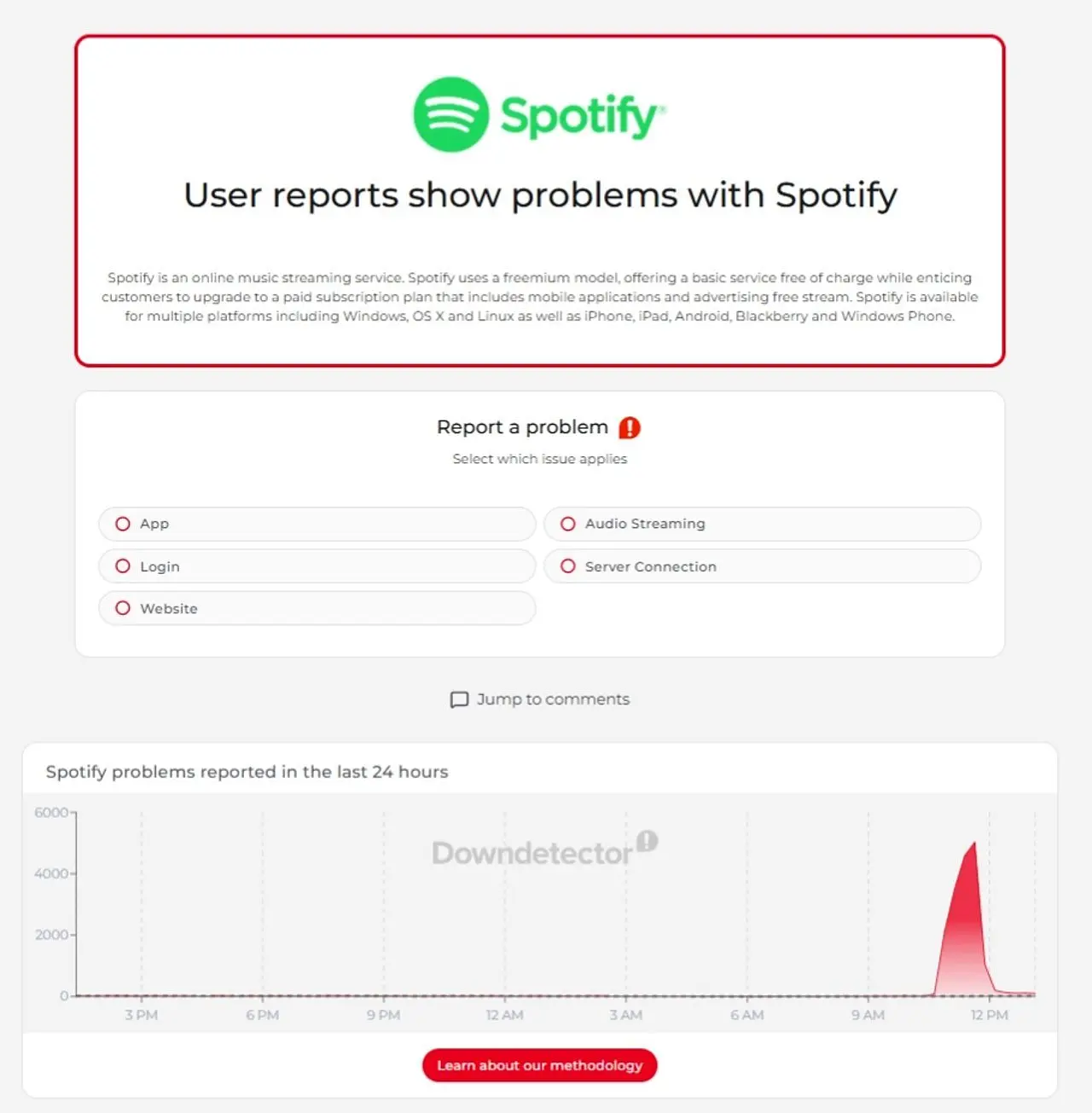
The world’s leading audio streaming platform faced a significant signal drop this Tuesday, interrupting the routine of thousands of listeners around the planet. Spotify, which currently serves more than six hundred million monthly active users, experienced severe connection outages that prevented songs, albums and podcasts from loading. The peak of instability lasted just under two hours, generating an immediate wave of complaints on social networks and internet traffic monitoring panels, until the company’s engineering team managed to stabilize the servers and confirm the return to normality.
Details about the peak of complaints and the time of server outage
The first signs that the system was experiencing technical difficulties began to appear mid-morning, around 10:45 am Brasília time. In a matter of minutes, the volume of error notifications skyrocketed on collaborative tracking platforms, showing that the problem was not isolated to a specific region. The website Downdetector, known for compiling complaints from Internet users in real time, recorded an abrupt jump that surpassed the mark of five thousand simultaneous alerts at its most critical moment.

This sudden interruption compromised several aspects of the service, affecting everything from the search for new artists to the loading of playlists saved in the cloud. Consumers trying to access the catalog of millions of tracks via cell phone or computer were faced with infinite loading screens or network error messages. The rapidity with which the volume of complaints escalated demonstrates the high daily dependence that the public has developed on continuous entertainment services.
Main failures reported by subscribers during the application blackout
A detailed analysis of the data provided by monitoring dashboards revealed the exact nature of the obstacles faced by the streaming giant’s customers. Most of the frustration stemmed from direct crashes in the software interface, indicating that communication between the application installed on the devices and the company’s databases had been cut off. To understand the scale of the event, the records were divided into specific error categories.
- More than half of the records pointed to general flaws in the application itself, preventing basic navigation through the content tabs.
- About 23% of people reported a complete inability to start playing any audio track, even those that appeared to be available on the screen.
- Approximately 16% of reports indicated a direct loss of connection to central servers, which unexpectedly logged some users out of their accounts.
These numbers illustrate a cascading failure scenario, something common when content delivery networks (CDNs) experience traffic bottlenecks or internal update errors. Those who had songs downloaded for offline listening managed to overcome part of the problem, but any attempt to interact online resulted in an immediate synchronization failure.
Official positioning of the audio giant and the reestablishment of connections
Faced with the immediate repercussions, Spotify management used its official support channels to recognize the existence of the blackout. The company published a brief notice confirming that it was aware of the anomalies affecting application loading and assured that its technicians were already investigating the root cause. This upfront transparency is standard practice in the technology industry to quell subscriber panic and prevent customer service channel congestion.
The infrastructure recovery work was carried out quickly. Around 12:18 pm Brasília time, the complaints curve on Downdetector had already plummeted to around three hundred notifications, indicating that the spread of the correction was reaching global devices. Soon afterwards, the company issued a new statement declaring that all technical obstacles had been officially resolved, restoring the expectation of uninterrupted availability that governs the digital signatures market.
Leia Também

The absence of Neymar’s wedding ring in a New York club stirs social media during the Brazilian team’s break

Parachuting plane crash leaves eleven dead in northeastern France this Sunday

Financial analysis indicates that GTA 6 generated US$1 billion in the first hour of pre-sales
Recent history of instability raises debates about cloud infrastructure
This Tuesday’s incident takes on more complex contours when analyzed from the perspective of the Swedish platform’s recent history. Just over a month ago, in mid-May, the same audio service suffered a collapse of even greater proportions. On that occasion, the monitoring panels recorded around twenty-two thousand simultaneous complaints, with thousands of people unable to even log in to their personal profiles.
The repetition of these episodes in a short space of time raises a warning about the resilience of the cloud architectures used by media corporations. Maintaining a continuous flow of data to hundreds of millions of devices requires perfect synchronization between local and global servers. Each time a node in this network fails, consumer confidence is tested, forcing companies to invest heavily in system redundancy to prevent local failures from becoming global blackouts.
The importance of real-time monitoring platforms for the digital market
Accurate documentation of this signal outage was only possible thanks to the collaborative tracking ecosystem that has formed on the modern internet. Tools like Downdetector work as a vital thermometer for the health of the web, based on people’s organic behavior. When a service goes down, Internet users’ first instinct is to seek external confirmation to find out whether the defect is in their Wi-Fi router or in the contracted company’s servers.
By grouping these searches and complaints into easy-to-read graphs, these portals provide a double service. They inform the lay public about the extent of the problem and simultaneously provide valuable metrics for affected companies’ own engineering teams. The speed at which this data is compiled allows you to trace an exact timeline of the incident, from the first sign of slowdowns to the complete resolution of the data traffic.
Consequences of signal drops for the routine of consumers and content creators
While a two-hour outage may seem like a minor event from a technical perspective, the impact on people’s daily lives is quite palpable. On-demand audio consumption has become the default soundtrack for activities ranging from working out at the gym to staying focused in corporate offices. The sudden unavailability disrupts the rhythm of work and leisure for millions of individuals who have outsourced the storage of their music libraries to the cloud.
In addition to the final listener, the creative industry also feels the effects of these instabilities. Podcasters who schedule episode releases for specific times and artists who rely on non-stop play counts to generate revenue lose valuable engagement during blackouts. For the technology sector, each failure of this magnitude serves as a stark reminder that the convenience of the hyperconnected world goes hand in hand with the fragility of its invisible infrastructures.