

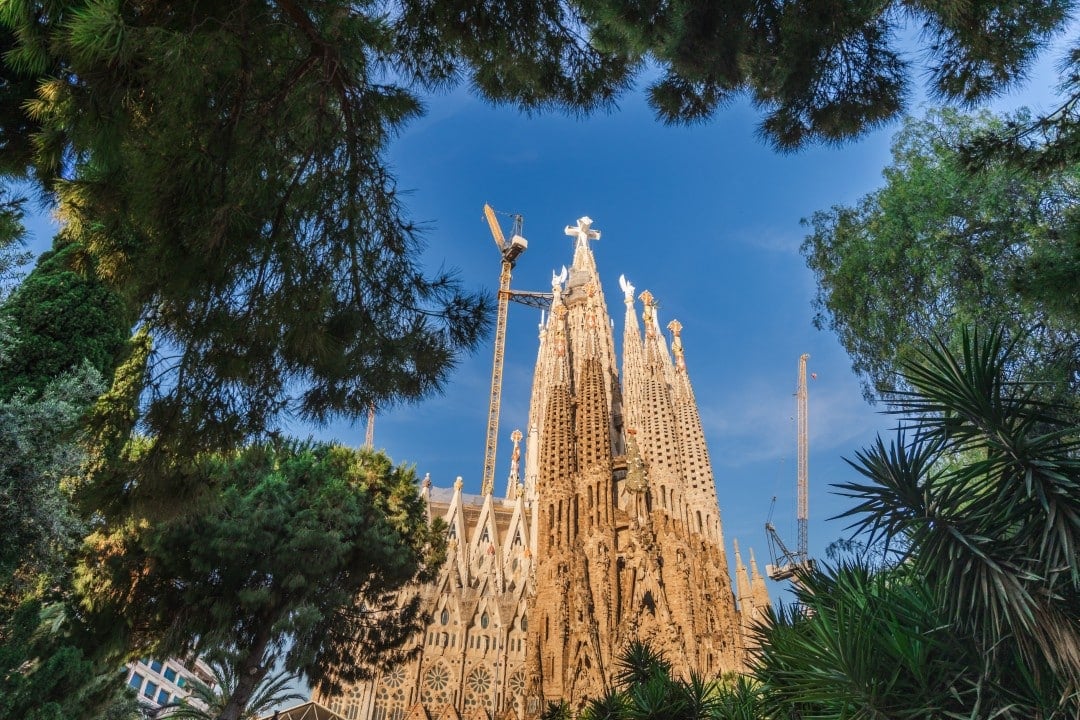
Tourists and residents in Barcelona cannot help but look up when contemplating the imposing Sagrada Familia, an architectural landmark in Spain. Visitors’ eyes are immediately led by the surreal, sinuous lines that make up the sculptural towers, culminating at the top of each spire.
This observation now reaches a new height. With more than 144 years of uninterrupted work, the cross that crowns the main tower, known as the “Tower of Jesus”, was installed in February, promising to make the church the highest religious structure in the world, at 172.5 meters.
Disruptions due to conflict, political issues and funding challenges have marked the progress of the majestic but incomplete Sagrada Familia for decades across the Barcelona landscape. Now, the long-awaited final tower has had its reveal.
Pope Leo The date of June 10, which marks the completion of the Torre de Jesus, the last of the 18 towers, also coincides with the centenary of the death of Antoni Gaudí, the visionary architect responsible for the project.
The Sagrada Família stands out as a masterpiece of color, art and geometric complexity. More than a religious emblem, the building reflects Gaudí’s deep respect for nature and his mastery of advanced engineering.
A vivid example of the complexity of this undertaking is the final piece of the architectural puzzle: the cross at the highest point of the Tower of Jesus, which glows an intense white under the Spanish sun. With the height equivalent to a five-story building and an estimated weight of 100 tons, its installation was an elaborate process that took several months.
According to the project manager, Mexican architect Mauricio Cortes, Gaudí’s intention was for the cross to shine during the day and illuminate the city’s outline at night. Like his predecessors, Cortes had to balance two major obstacles: remaining faithful to Gaudí’s original conception and, at the same time, meeting the rigorous technical requirements, including the need for the tower to be relatively light.
The manufacture of the cross took place in Germany, from where 14 prefabricated pieces in concrete and stainless steel were sent to Spain. The choice of stainless steel, an unconventional material in Gaudí’s time, was essential to reduce the total weight of the structure without compromising the required resistance.
After arriving in Barcelona, the pieces were carefully transported by crane to a workshop set up approximately 60 meters above ground level, just above the main nave of the basilica.
Before the topping out ceremony, Cortes led a team on a guided tour of the building, commenting that, of course, “times have changed, and technology and regulations have advanced.” Even in the face of these changes, he expresses confidence that the work remains loyal to Gaudí’s original vision for the Sagrada Familia. “I think it’s certainly very close to the outside (as planned by Gaudí),” he added. “There is more room for interpretation in the interior, as Gaudí did not specify the details.”

The sacred, sky-defying architecture of Catalonia
From the studio, located at a strategic and elevated point, it is possible to have a panoramic view not only of the entire city of Barcelona, but also of details of the architectural elements that crown the buildings.
It was a perspective that Gaudí knew he would never witness in his lifetime. From the moment he took charge of the project, after the departure of architect Francisco de Paula Villar due to a disagreement with the construction company, Gaudí was aware that he would not see the work completed. The scale and complexity of the undertaking made this virtually impossible for a single lifetime.
The story is widely known that, when asked about the completion date, Gaudí replied: “The client is in no hurry.” He was referring to God, not the construction company or the faithful in Barcelona.
Gaudí, a native of Catalonia, lived long enough to witness the completion of the first tower. However, he could never have predicted the numerous obstacles that would delay the project after his death in 1926.
Ten years after Gaudí’s death, Spain was gripped by chaos. In July 1936, anarchists set fire to the basement of the Sagrada Família and invaded the architect’s studio, resulting in the destruction of many plans and plaster models. Fortunately, not all of the material was lost.
Much of the lost information was recovered through Gaudí’s disciples and collaborators, who had documented his plans in books, articles, sketches and photographs. Most importantly, according to the current chief architect, Jordi Fauri, Gaudí passed on a specific design philosophy to his successors. Although modern technologies such as digital modeling software and industrial robots have been employed in the latest constructions, the fundamental principles have remained untouched.
Another major challenge has always been securing financing. The Sagrada Família, conceived as a “church of atonement”, depends exclusively on donations and entrance fees, which have been charged since its opening to the public in 2010, to maintain the pace of work. This funding model, based entirely on voluntary contributions and tourism, distinguishes it from many historic European cathedrals, often financed by monarchies or broad ecclesiastical funds.
The fragility of this system became evident when the COVID-19 pandemic caused a collapse in the tourism industry, causing a drastic drop in ticket revenue. However, the flow of visitors has recovered quickly since then, with nearly 5 million people visiting the temple in the last year alone.
New challenges and controversy await the completion of the Glória facade
Although the Sagrada Família may appear to be in a state of completion, the reality is that the work is far from finished. With the Tower of Jesus now erected (the interior is expected to be completed in 2028), attention turns to one of its main entrances, the “Fachada da Glória”.
Being the last of the three facade decorations planned by Gaudí and considered the main entrance, its construction has generated significant tensions with residents living across the street.
The crux of the matter lies in the project to install a large staircase. As the main entrance is approximately 4 meters above street level, the Sagrada Familia Construction Committee Foundation proposed an imposing structure that would connect the building to the public road, allowing pedestrians to pass underneath. This plan would require considerable space and could potentially involve the demolition of an apartment building opposite, which is why many local businesses and residents are vehemently opposed to the proposal.
Alicia Busquets, who has lived nearby for three decades, is one of those directly affected.
“Is there anyone who can guarantee that my house will not be demolished in two years?” asks Busquets, expressing the uncertainty that hangs over the community.
According to Salvador Barroso, leader of a group of residents impacted by the proposal, many share the same concerns and complain about the lack of clear information about the work schedule. Meanwhile, the commission responsible for construction maintains that it must first reach an agreement with the city before discussing the matter with residents.
While this controversy is unlikely to overshadow this week’s events, it serves as a blunt reminder that the Sagrada Familia remains unfinished, and the fate of those who have lived in its shadow for so long is yet to be resolved.
“We are at a dead end,” said Barroso. “There are all kinds of rumors and all kinds of things being said, but the reality is that nothing is certain. With the Pope’s visit just days away, it’s like a pressure cooker.”