

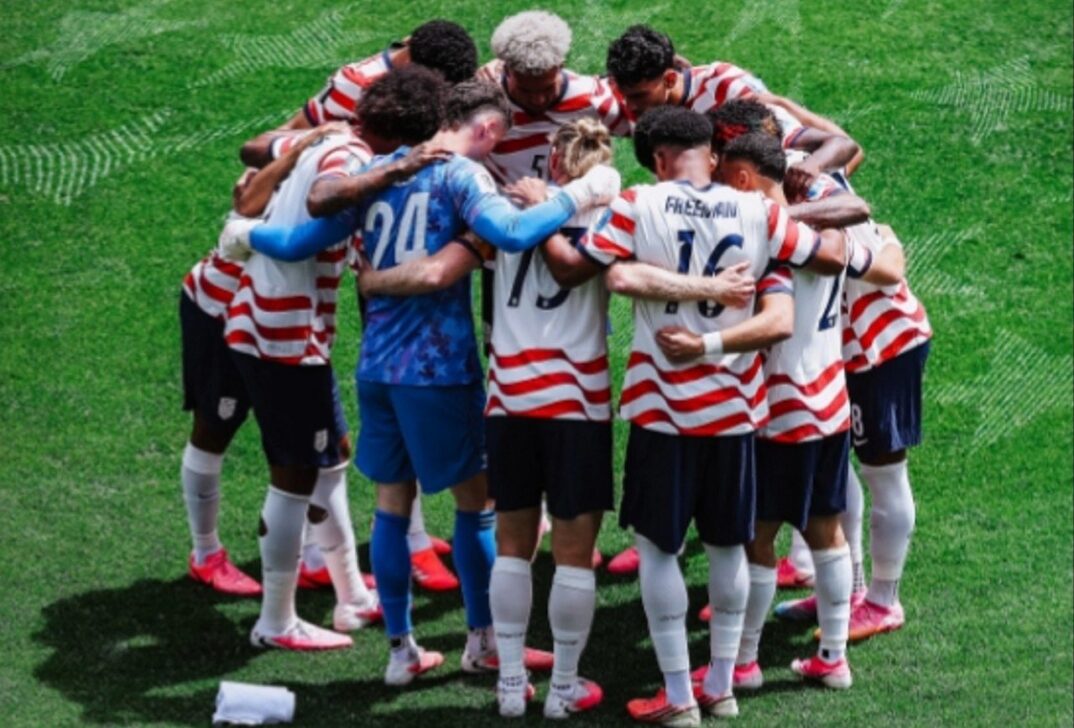
The chance of a knockout duel between the football teams from the United States and Iran in the next World Cup attracts great attention from fans and the press. Even though they were placed in different groups, the crossing in the round of 16 became a mathematically viable scenario, taking on dramatic contours as it coincided with a moment of delicate peace negotiations between the two governments, proving once again that pitches tend to reflect the complexity of global geopolitics.
Looking at the current league table, the Middle Eastern squad has two points and is in second place in Group G, behind Egypt, who recently overcame New Zealand. On the other hand, the North American team has already stamped its passport to the next phase with ease, dominating the top of Group D.
If the current positions are maintained until the final whistle of the first phase, the two delegations would fall on completely opposite sides of the elimination bracket. In this standard configuration, a direct clash would only be possible in a hypothetical title decision, something that sports analysts consider highly unlikely to happen.
However, there is a combination of results that could catapult the Iranians to the top of their bracket. To achieve leadership, the team depends on a specific scenario in the final round:
- Beating the Egyptian team in their last match is mandatory.
- Expect Belgium to stumble in their respective match.
- Mathematically guarantee that the Belgians do not take the first overall position in the table.
If this turnaround in scoring is confirmed, the two historic rivals would be on a direct collision course in the round of 16, as long as both survive the unprecedented Round of 32 stage, introduced in the expanded 48-team format of 2026. This would be the third chapter of this rivalry in tournaments organized by football’s highest governing body.
How was the historic first meeting on French lawns in 1998
The first time that these two antagonistic powers shared the same field in a World Cup took place in the qualifying phase of the tournament hosted in France. The duel was played on June 21 of that year, taking place at the iconic Gerland Stadium, located in the Lyon region.
At that time, diplomatic relations had been severely broken since the events of the 1979 Islamic Revolution, creating an atmosphere of worldwide apprehension. Surprisingly, what was seen during the ninety minutes was a true lesson in sportsmanship, showing that the rolling ball has the power to break seemingly insurmountable barriers.
Even before the referee authorized the start of the game, the Middle Eastern representatives handed out bouquets of white roses to their opponents, culminating in a joint photograph that went around the planet. When the match started, the Iranians showed technical superiority and secured a historic 2-1 victory, in a duel valid for Group F.
Due to the enormous symbolic burden involved and the exemplary behavior of all professionals on the field, that specific confrontation entered the annals of sport under the nickname “The Peace Match”.
Tense atmosphere marked the second match played in Qatar
It took exactly 24 years for destiny to put these two shirts face to face again on the sport’s biggest stage. The long-awaited reunion took place on November 29, 2022, during the last round of Group B of the World Cup held in the Middle East.
Unlike the script seen in Europe, this time the North Americans dictated the pace of the game and emerged victorious with a slim score of 1-0. The result was decisive, as it marked the winners’ advance to the knockout stage and sent the defeated delegation back home early.
The atmosphere in the days leading up to the opening whistle was extremely heavy, driven by massive demonstrations in Iranian territory following the death of young Mahsa Amini. Adding more fuel to the fire, the United States football federation published images of the rival flag without the Islamic Republic emblem on its social networks, expressing support for the activists and turning the game into a powder keg.
The digital provocation angered political leaders and the state press in the Asian country, who demanded severe punishments from the tournament organizers. Despite the chaos behind the scenes, athletes on both sides adopted a calming speech in interviews, asking that the public’s attention be restricted only to tactical and technical performance.
Impacts of recent military conflicts on tournament logistics
Bringing the situation to the contemporary scenario, the end of February this year was marked by a military escalation, when joint forces from Israel and the United States bombed strategic military installations in Iranian territory. This new wave of hostilities casts a shadow of uncertainty over any international event involving representatives of these nations.
Interestingly, after months of aggressive rhetoric, the Washington government revealed last week the existence of a preliminary diplomatic document signed with its rivals. This memorandum of understanding provides a 60-day window for diplomats to work out the final details of a truce agreement.
A direct reflection of this political chess is the current training base of the Asian team, which had to settle in Tijuana, Mexico, due to strict bans on issuing American visas. The choice of the border city, neighboring San Diego — one of the competition’s official venues — highlights how international embargoes affect sports logistics, forcing teams to find creative solutions to participate in the global event.