

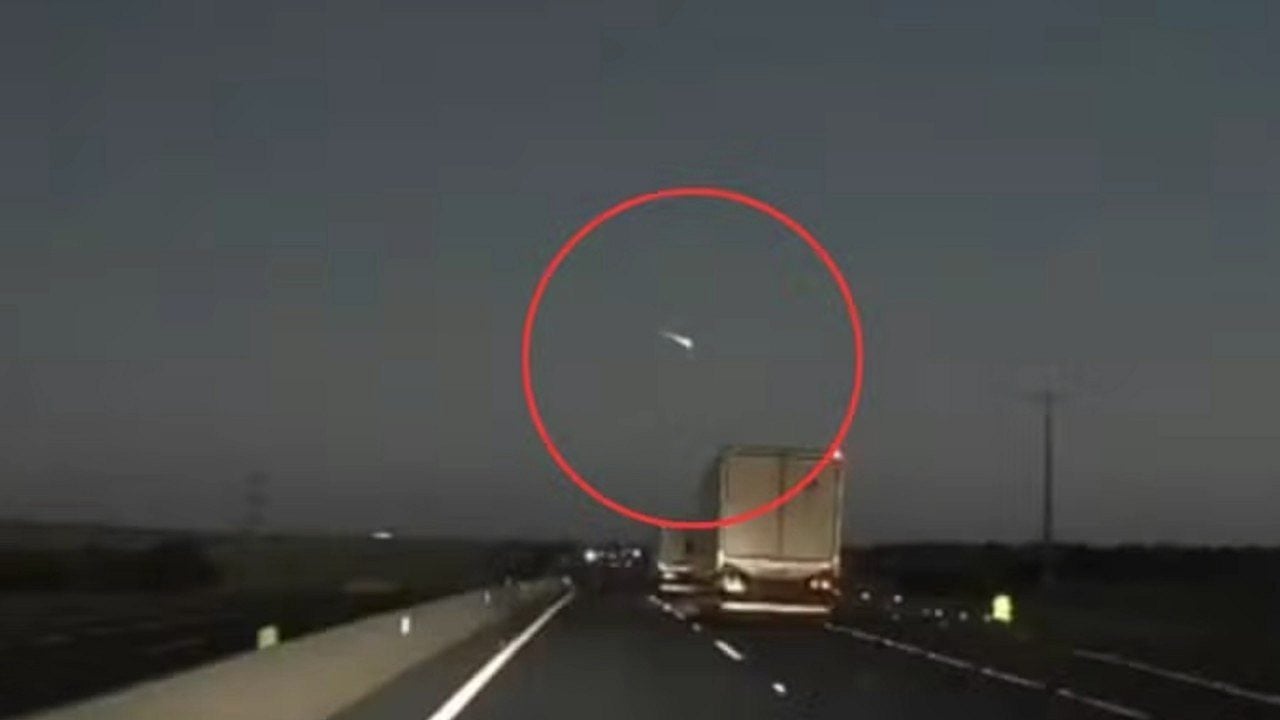
A surprising astronomical event caught attention in the west of São Paulo after a car camera recorded the passage of a celestial body over the municipality of Presidente Venceslau. The incident occurred on Monday morning (22), thanks to the lenses of a car safety device.
The equipment was positioned on the windshield of the car that was traveling along the Raposo Tavares Highway (SP-270). The clock showed approximately 6:40 in the morning when the lens captured the light path with extreme clarity.

Through the video, it is possible to notice the space object, popularly known as a “shooting star”, tearing through the sky and disappearing in the blink of an eye, while drawing a bright beam. Researchers in the field soon mobilized to explain the physical dynamics behind this visual spectacle.
According to Vitor Rafael Borges Filgueira, who serves as vice-president of the Mariápolis Astronomy Association (SP) and is also a historian, the fragment falls into the bolide category. The expert explains that the intense flash and multiple tones recorded in the video are direct consequences of extreme friction, which overheats and ionizes the gases in our atmosphere.
Filgueira highlights that seeing a car with such clarity in the interior of São Paulo is an unusual fact, as reports tend to focus on densely populated capitals, such as São Paulo and Fortaleza. However, the absence of light pollution in smaller cities provides an ideal setting for collecting high-quality scientific information.
The researcher also points out that, even when the Earth is not going through the peak of a meteor shower, wandering bodies can cross the airspace in various directions. This dispersion happens because space rocks travel across vast expanses of the celestial vault, increasing the chances of random observations throughout the year.
Corroborating the analysis, Rodrigo Raffa, physics teacher and coordinator of the Centauri Astronomy Club, based in Itapetininga (SP), attested that the fireball spotted on the highway is, in fact, a bolide-type meteor.
Raffa highlights that this classification is given to events of spectacular proportions, whose brightness temporarily overshadows the reflection of conventional planets and stars, even brightening the night or morning landscape abruptly, exactly as the recording demonstrated.
The physicist hypothesizes that the luminous fragment is debris associated with the June Bootids. It is an annual meteor shower, formed by dust and ice left in the wake of comet 7P/Pons-Winnecke.
Despite the strong suspicion, the coordinator of the astronomy club warns that pinpointing the exact origin of the object in the west of São Paulo requires a greater number of videos from different angles. With more evidence, scientists can perform triangulation calculations to discover the exact radiating point and map the spatial trajectory of the rocky body.
Understand the technical differences between spatial nomenclatures
Going deeper into the topic, Rodrigo explains that it all starts with small fragments wandering through the space vacuum. While these particles remain outside Earth’s orbit, science classifies them as meteoroids, which can have different origins:
- Rocky chips detached from larger asteroids.
- Dust and ice particles left behind by comets.
- Space debris generated by satellites and human activities.
The scenario changes drastically when these rocks invade the Earth’s atmosphere. The collision with the air at very high speed generates unbearable heat that incandescents the material, creating the trail of light that we call a meteor — a term that strictly defines the luminous and atmospheric effect, and not the rock itself.
If the object is large and dense enough to withstand burning during free fall and ends up colliding with the surface of our planet, the surviving rock gains the definitive name of meteorite.
A crucial detail is that the meteorite nomenclature only applies to naturally formed rocks, leaving out any type of human space debris. Every day, the Earth is bombarded by thousands of small meteoroids, but the vast majority turn to dust in the upper atmosphere, ensuring the safety of those on the ground.
Visual signs that help identify passing space rocks
Gustavo Vieira, an academic on the Physics course at the Universidade Estadual Paulista (Unesp) on the Presidente Prudente campus, provided technical details about the dynamics of the fall, remembering that these celestial bodies invade our atmosphere at dizzying speeds.
The university student reports that the force of friction added to the violent compression of the air generates a temperature so extreme that the rock instantly combusts. It is exactly this incineration process that produces the flash streaking across the horizon.
So that the population does not confuse the astronomical event with the passage of commercial aircraft or equipment in orbit, Vieira lists unmistakable visual characteristics that facilitate correct recognition.
Speed is the most obvious deciding factor: space rocks appear out of nowhere, tear through the sky in fractions of a second and disappear. On the other hand, commercial planes move slowly and progressively for those observing from the ground, and satellites maintain a linear and monotonous route.
The light emission also gives away the identity of the object. While helicopters and planes use signaling systems that flash in patterns of green, red and white, the meteor emits a continuous, unique glow that lasts for a very short time.
Gustavo specifies that the color palette of the fireball — which can be green, yellow or white — depends directly on the chemical composition of the rock. Meteors rich in magnesium, for example, tend to shine in blue-green tones, while the presence of iron generates a yellowish trail when reacting with atmospheric gases at speeds that can easily exceed the 250,000 kilometers per hour mark.
Artificial satellites, on the other hand, operate in a completely different way, as they do not have their own headlights or lights, functioning only as mirrors that reflect the Sun’s light.
Due to this reflective characteristic, they are usually only visible to the naked eye during dawn or early evening, looking like small white dots that slide across the sky without blinking at any time.
Analyzing the shape of the tail, the student remembers that bolides like the one registered in the interior of São Paulo usually leave a trail of plasma and smoke resulting from the burning, but that goes out almost immediately after passing.
High-altitude aircraft, in contrast, often form long white trails of vapor condensation that remain marked in the sky for several minutes, something impossible for the ephemeral light from a space rock.
Finally, the sound issue is definitive. Jet engines produce a continuous, recognizable rumble, while viewing satellites and the overwhelming majority of meteors is a completely silent visual experience for viewers on the surface.