

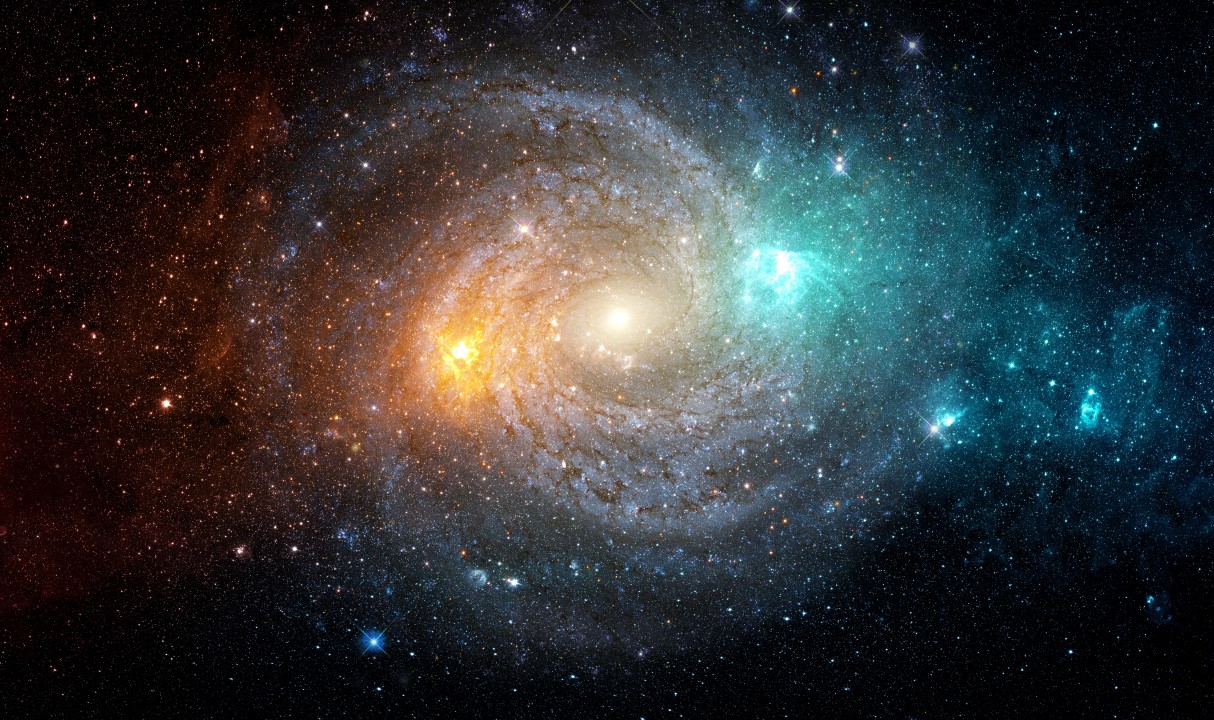
The spiral galaxy M101, also known as Messier 101, was observed in detail by the 4-meter Mayol Telescope, located at the Kitt Peak National Observatory, Arizona, in the United States. This celestial body is located in the constellation Ursa Major, approximately 20 million light years away from Earth.
Characteristics of the grandiose spiral galaxy M101
M101 is classified as a “frontal” galaxy, meaning its plane faces Earth directly, offering a spectacular view. Its magnificence has earned it nicknames such as “Weather Vane Galaxy” and “Fireworks Galaxy.”
Estimates indicate that M101 has a diameter of around 170,000 light-years and is home to approximately 1 trillion stars.
Along its spiral arms, scattered pink areas, reminiscent of clouds, signal intense regions of star formation, where new, hot stars continually emerge. It is also possible to identify young bluish stars and dark bands of cosmic dust, which serve as raw material for the birth of new stars.

Discovery of supernova SN 2023ixf by amateur astronomer
While M101 is a stellar nursery, it is also the stage for the end of life of other stars, cosmic events of great magnitude.
On May 19, 2023, Japanese amateur astronomer Koichi Itagaki made an important discovery: the supernova SN 2023ixf in the M101 galaxy. This phenomenon has been classified as a “Type II Supernova”, which results from the explosion of a massive star.
Type II supernovae occur when a massive, evolved star exhausts its nuclear fuel, forming an iron core. Unable to support its own weight without the energy of fusion, the core collapses violently, expelling the star’s outer layers in a spectacular explosion.
Importance of M101 for observing the complete stellar cycle
Among recent supernovae, SN 2023ixf stands out for its relative proximity to Earth, providing a unique opportunity for researchers to carry out detailed observations.
Research published in January 2025, involving an international group with members from the National Astronomical Observatory of Japan and Kyoto University, revealed crucial data. Using JVN (Japan Very Low Laser Bidirectional Network) and other radio instruments, the observations showed that the explosion’s precursor star was actively outgassing and losing mass for several decades before collapsing, providing an unprecedented glimpse into the behavior of massive stars before they become supernovae.
M101, therefore, is an invaluable celestial object for astronomy, allowing humanity to witness the grand cycle of life and death of stars at a relatively accessible distance.
The original image of M101 was released by NOIRLab on June 30, 2020 and later republished on NOIRLab’s official X account on June 20, 2026.