

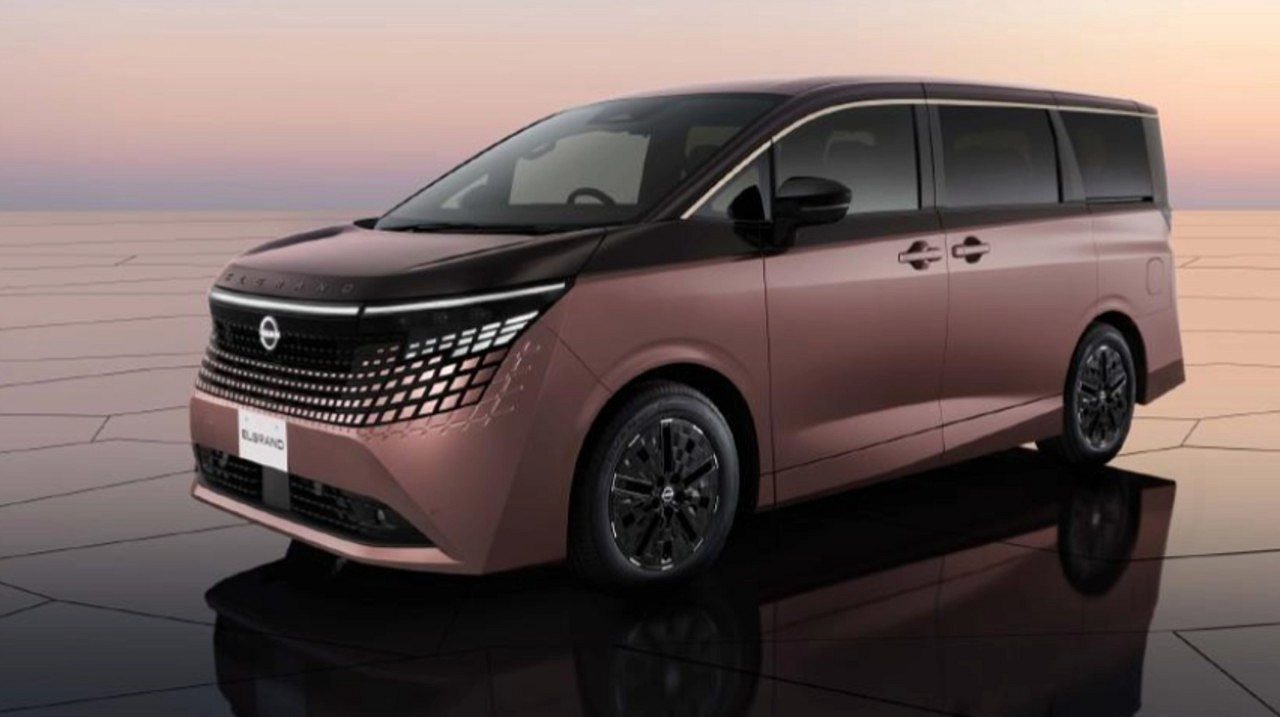
The Nissan Elgrand, a luxury minivan from Nissan Motor, will receive a complete update in July 2026, marking its first redesign in 16 years. Originally launched in 2010, the current model has seen its competitors, the Toyota Alphard and Vellfire minivans, largely dominate the segment. Despite Toyota’s hegemony, the characteristics between the vehicles have not drastically diverged. To understand the scenario, we sought the opinion of Toyota dealers on the future of Elgrand.
Nissan Elgrand returns to the market after 16 years
The vehicle comes with a series of innovations that highlight the technological capacity of the automaker Nissan.
The new Elgrand comes with the third generation e-POWER system and e-4ORCE electric all-wheel drive in all versions. Other highlights include intelligent dynamic suspension, a 14.3-inch integrated display and a 22-speaker BOSE sound system. Its design is conceived as a “private MAGLEV”, promising an exclusive lounge experience on wheels, which generates great theoretical expectations.
Given these news, how are salespeople at Toyota dealers, traditionally the most impacted, facing the arrival of the new Elgrand?
Toyota salespeople’s perception of the Elgrand
For consumers looking for greater distinction in vehicles, differentiating themselves from the Alphard and Vellfire models, the Elgrand can be an ideal alternative.
The impressions collected among salespeople at Toyota dealerships show a consensus: “The technical characteristics are impressive, but there was a certain relief when checking the final value of the vehicle.”
The starting price of the new Elgrand starts at 6,897,000 yen, reaching 8,698,000 yen in the most complete version. In contrast, the Alphard is offered from 5,599,000 yen, with its top plug-in hybrid version reaching 10,699,700 yen. This initial comparison reveals that the Nissan Elgrand is positioned with higher prices than Toyota’s best-selling models.
“With this pricing, Alphard will certainly maintain its leadership”, stated one of the Toyota representatives, demonstrating that the competition is not seen as an imminent threat.
Details that reveal the difference in interior design
Unlike the Alphard and Vellfire, the Elgrand’s interior was designed with predominantly horizontal lines, giving it a feeling of opulence and sophistication.
While external aesthetics are subjective, internal design demands functionality. It is important to analyze the particularities that distinguish vehicles in these aspects.
On the instrument panel, the Elgrand stands out with its integrated central gauge, while the Alphard offers a large central monitor with a symmetrical layout. The Elgrand’s cabin conveys a welcoming atmosphere, but with a peculiar touch, while the Alphard suggests a car more geared towards being driven by a driver. Therefore, in terms of perception of luxury, the Alphard maintains a slight advantage.
However, a relevant difference from Elgrand is the inclusion of a footrest on the passenger seat, a convenience absent in the Alphard.

Resale value: the main challenge for Elgrand
Elgrand’s commercial success will likely be determined by its potential value on the used market and ability to generate genuine consumer interest.
The confidence of Toyota sellers is largely supported by the high resale value that the Alphard has historically maintained in the market.
The Alphard boasts a remarkable track record, retaining approximately 70% of its initial value after three years of use. Despite a recent fluctuation, this depreciation is still considered minimal. This high residual value is crucial for buyers who use residual value financing, a popular modality for luxury vehicles where the resale guarantee directly influences monthly installments and the exchange decision. For Elgrand, the big unknown is how it will behave in this aspect, which will be the decisive point for its consolidation.
For now, the new Elgrand seems to have no chance of overcoming Toyota’s dominance. However, market dynamics present complex nuances.
Among consumers with high purchasing power, there is the notion that “many people already own Alphards and Vellfires”. The vast presence of these models, including due to strong business demand, is beginning to discourage those who value exclusivity. Elgrand’s “mobile private lounge” concept emerges as a strong argument for this niche market.
The ride quality offered by the third-generation e-POWER engine and intelligent dynamic suspension is undeniably superior. Experts suggest that it surpasses the Alphard in terms of silence and driving comfort. In this way, the number of test drives made available by dealerships will have a direct impact on Elgrand’s sales volume.
Evidently, for the new Elgrand to be able to compete effectively with the Alphard, it is essential that it achieves a robust resale value. Only by consolidating its premium status in the market will Elgrand transform the dispute into a real clash.
The competitor, who resurfaced after 16 years, demonstrates remarkable capacity. However, your success in exploiting this potential will depend on sales performance in the coming months. The question remains: Alphard or Elgrand, which will be the dominant minivan? Regardless of the result, the boom in the large minivan segment benefits the Japanese automotive industry.