

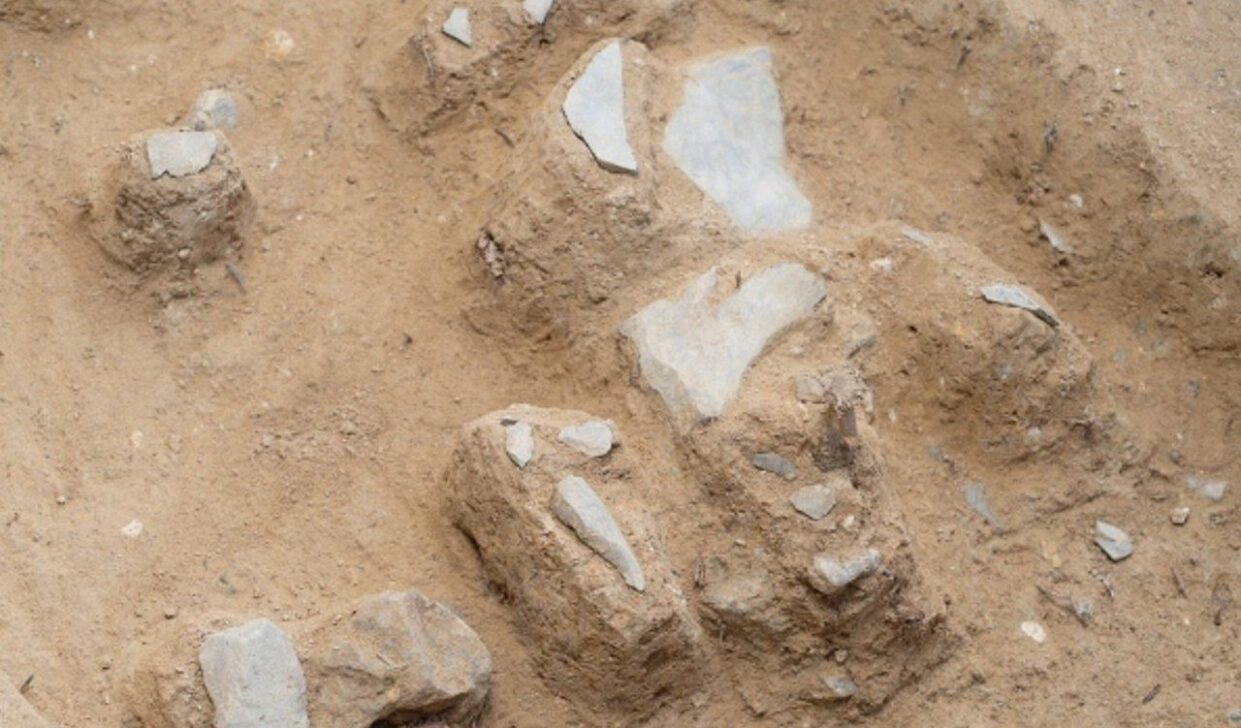
An important archaeological discovery in Nara Prefecture, Japan, has brought to light a previously unknown source of sanukite, a glassy volcanic rock indispensable for making stone tools during the Paleolithic Period. The revelation was made by a team of researchers led by Narumi Mitsuishi, who serves as head of the planning and curation department at the Kashihara Archaeological Institute, a prominent institution in the Japanese province itself. The raw material was exposed due to a hillside collapse that occurred at the Tsurumine-so 1 Site, located in Anamushi, Kashiba City.
Discovery of essential raw material for prehistory
The news about the find was released on the 23rd, marking a turning point for studies on the lives of prehistoric humans in the region. Natural landslides at the Tsurumine-so 1 Site in Kashiba revealed sanukite veins directly into the landscape. This type of occurrence is rare and of great value to archeology, as it offers an unprecedented view of how Paleolithic communities could have accessed and exploited geological resources in their environment. Traditionally, many sanukite extraction sites were identified by traces of flakes and tools, but the exposure of the rock in its natural form provides direct clues to the original availability and potential attraction that these points represented.

Characteristics and importance of sanukite in the Paleolithic era
Sanukite is notable for its unique properties. Classified as a volcanic rock with a glassy texture, it has an exceptional ability to be fractured in a predictable way, resulting in extremely sharp edges. This characteristic made it a preferred material for the manufacture of a wide range of cutting instruments, including knives and scrapers, as well as projectile points, such as spears and arrows, which were crucial to the hunting and survival of our ancestors. The hardness and precision of sanukite blades allowed Paleolithic people to process food, prepare skins for clothing and build shelters, directly influencing their technology and ability to adapt to the environment. The rarity of high-quality sources of this rock and the durability of tools made from it made it a valuable commodity, often exchanged between different groups, which may indicate primitive trade networks.
Understanding the ancient use of natural resources
The visibility of the ore in its raw form at the Tsurumine-so 1 Site is considered by experts to be a key element in understanding the beginning of the intensive use of this raw material in ancient times. The theory is that the ease of access to exposed sanukite may have been the deciding factor in Paleolithic people identifying and beginning to systematically exploit this specific source. This realization alters our understanding of the intelligence and geological knowledge of prehistoric humans. They not only sought out materials, but also demonstrated an understanding of local geology, which guided them in locating the best deposits. This suggests a sophisticated level of observation and experimentation to identify valuable resources, far beyond the simple chance encounter.
New perspectives for Japanese Paleolithic technology and economy
The discovery offers a promising horizon for reassessing the technology and resource economy of the Paleolithic communities that inhabited Japan. Until now, many studies have relied on the analysis of already processed artifacts, which has made it difficult to fully understand extraction methods and the size of supply networks. With the identification of a primary source of sanukite, researchers can now more precisely investigate the chipping techniques used, the scale of tool production, and the logistics involved in transporting the material to other settlements. This unprecedented perspective is vital for reconstructing the patterns of life, migration routes and interaction between different human groups in the region during the Paleolithic Period, offering a richer and more detailed panorama of the material culture of these peoples.
Presentation of search details
The detailed results of this innovative research will be widely discussed at an event of great relevance to the scientific community. The general conference of the Japanese Paleolithic Society, scheduled for the 27th, will be the stage for the official presentation of the details of the find. The Kashihara Archaeological Institute team’s presentation is expected to generate intense debate and pave the way for new lines of investigation into the fascinating history of technology and human subsistence in Paleolithic Japan.