

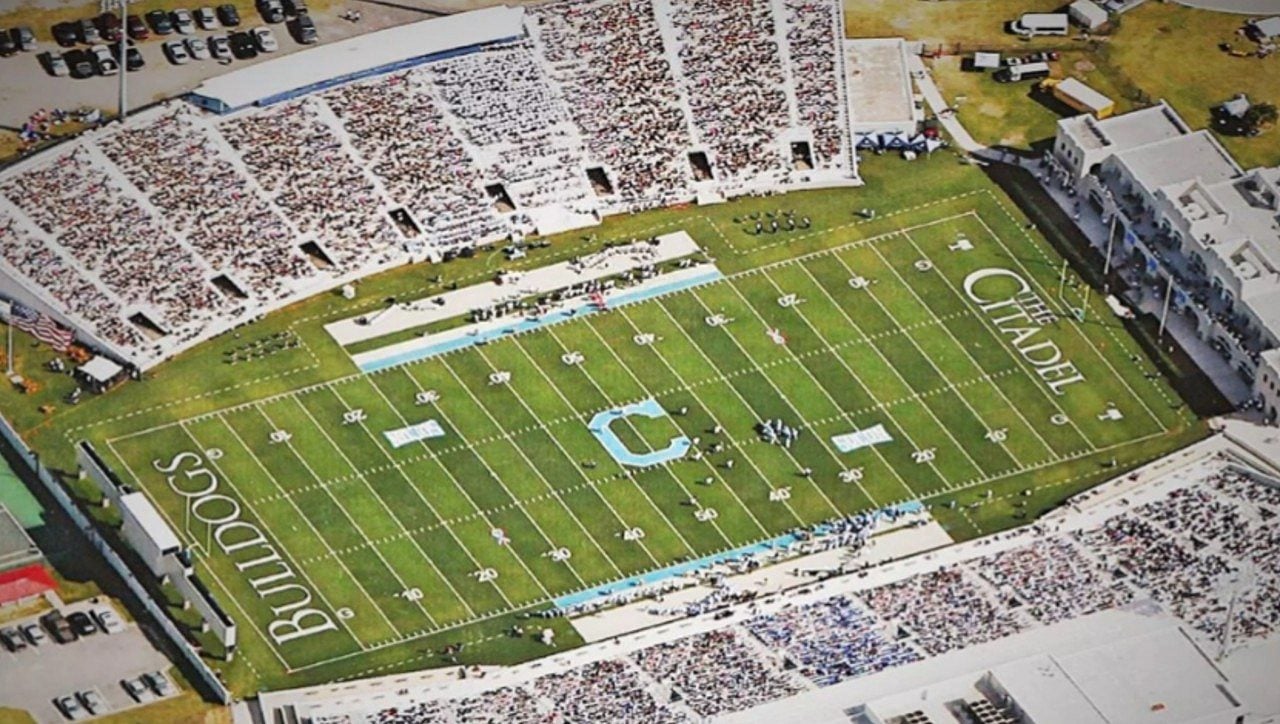
Construction workers at Johnson Hagood Stadium, part of The Citadel, in Charleston, discovered approximately 50 graves containing human remains while installing a new drainage system in the eastern area of the site.
The military institution is now preparing the exhumation and subsequent reburial of the remains in an adjacent area, in the southern sector of the stadium. This measure follows a 2004 municipal protocol, implemented after the revelation of more than 300 graves in the vicinity of the athletics field during a previous development.
The stadium, erected by the city in 1927, occupies the site of the former Tower Hill Cemetery, which served as the final resting place for more than 26,000 individuals between the years 1841 and 1927.
The Citadel, which has owned the stadium since the 1960s, said it halted construction work on May 15, the date of the first identification of remains. Since then, the academy and its team have been in dialogue with city hall, state agencies and archeology experts to deal with this and the other 50 graves discovered in additional research.
Jonathan Hoffman, vice president of communications and marketing at The Citadel, stated in a statement that the institution recognizes the enormous relevance of historical remains for the residents of Charleston. He assured that, in partnership with the City Hall, there will be a broad dialogue with the community on the subject, and that the university will strictly follow the best archaeological practices and the guidelines of the State Office for Historic Preservation, coordinating actions with everyone involved in the project.
These discoveries are nothing new in Charleston, a city with a long history of urbanization over old cemeteries. It is estimated that around 54,000 people were buried in mass graves in various public cemeteries throughout the peninsula between 1672 and 1927, as pointed out by Nic Butler, local historian and creator of the Charleston Time Machine podcast from the Charleston County Public Library, which explains the frequency of these archaeological finds in the region.
Other recent instances of unmarked graves being identified include areas such as the Gailliard Center, the grounds of a residence on Smith Street, and the location below the old YWCA building on Coming Street, where the College of Charleston plans to build a new dormitory.
At The Citadel stadium, burial sites emerged as Hill Construction worked to install a drainage system under a new grandstand in the east section. The excavations, which reached nearly three meters below sea level to accommodate plastic rainwater retention chambers, revealed human remains close to the surface.
Zach Kight, superintendent of Hill Construction, confirmed that operations were immediately halted following the discovery and that the area was turned over to an archaeologist. Ele destacou que a prioridade da equipe é realocar os indivíduos encontrados com o máximo de respeito, garantindo-lhes um novo local de descanso permanente.
The Citadel reported that the recently unearthed remains will be reburied in a fenced area, located south of the stadium, which will require expansion to accommodate the new burials.
The public cemetery, which spans 9.3 acres beneath Johnson Hagood Stadium, was named Tower Hill in reference to the Martello Tower, a defensive structure erected around 1814 on nearby high ground. Its original borders were defined by Congress Street to the north, President Street to the east, Line Street to the south and the Ashley River to the west.
Among those buried in these lands are several social groups that marked the history of Charleston, such as enslaved people, Irish immigrants, asylum patients, Confederate soldiers and sailors, as well as other sailors and countless babies.
Julie Bowling, a former teacher living in the Wagener Terrace neighborhood next to The Citadel, has dedicated the last two years to organizing a partial inventory of the individuals buried in the cemetery. Its digital database, entitled “Friends of Tower Hill Cemetery”, records the names of thousands of people, detailing aspects of their lives such as age, gender, ethnicity, origin, cause of death and, in certain situations, the name of their former owners.
With a master’s degree from The Citadel, Bowling expressed his frustration upon learning of the violation of more graves at his former educational institution. She argued that the military academy should go beyond simply placing a plaque and removing bodies, seeking more meaningful ways to honor the deceased.
For Bowling, “twenty-three thousand people or more deserve much greater recognition than just a commemorative plaque”.
The researcher, who plans to complete her database by the end of the summer, proposed the creation of a vast tree-lined garden, conceived as a tribute to the enslaved and needy inhabitants of Charleston, whose names and stories are often neglected by the collective memory.
She lamented that “only the rich and powerful receive recognition and glorification” in history.
The individuals buried in Tower Hill Cemetery, Bowling reiterated, “are entitled to our recognition in the same measure as any other human being.”
Municipal regulations stipulate that after the removal of human remains from any site, the responsible party must conduct historical studies, archaeological investigations, establish communication with the community, and perform historical or genetic examinations. Additionally, the construction of a memorial and the development of a reburial plan are required, both subject to City Council approval.
City spokeswoman Deja Knight McMillan said in a statement that city officials have been aware of the presence of human remains on The Citadel stadium grounds since 2004, when the university obtained Council approval for their removal and reburial in the initial phase of the project. She added that, in this final phase of work, the university reaffirmed its commitment to continuing with archaeological investigations and laboratory analyses, in collaboration with the SHPO (State Historic Preservation Office), the DES (Department of Environmental Services) and other experts, ensuring responsible and respectful management of the enterprise.