

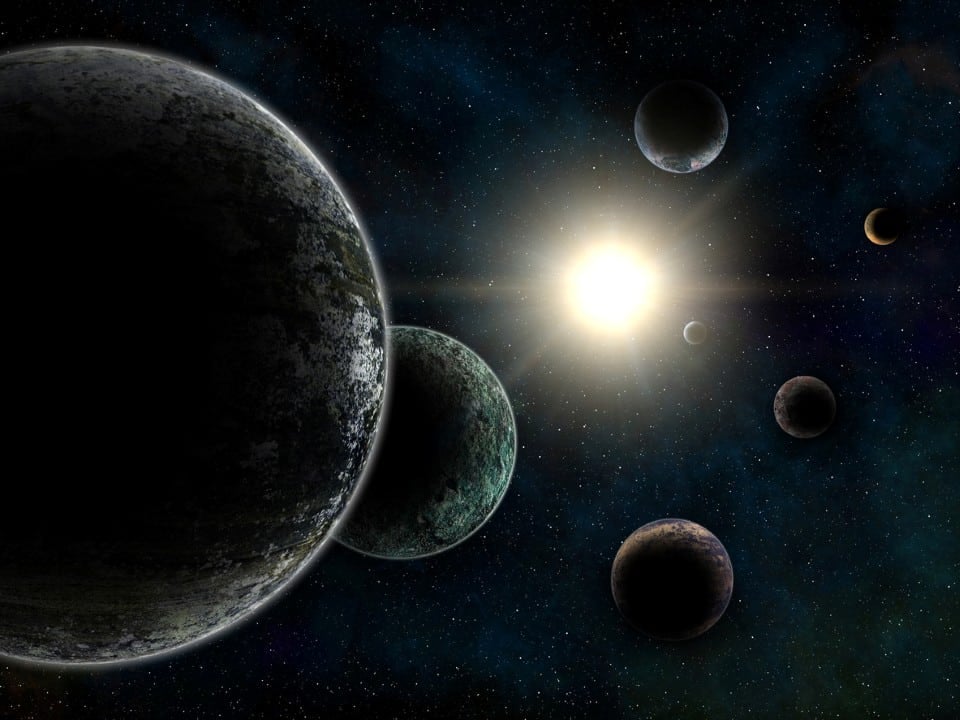
Two of the lowest density exoplanets ever recorded have been detected orbiting a star approximately 1110 light years from Earth. Named TOI-791b and TOI-791c, these celestial bodies have a volume comparable to that of Jupiter, the largest planet in our solar system, but exhibit a density so surprisingly low that they are lighter than cotton candy. The revelation of this discovery, led by an international group of scientists, was detailed in the magazine *Monthly Notices of the Royal Astronomical Society*.
The rarity of “super-bloated” people in the universe
These worlds belong to an unusual classification of planets known as “super-puff” or “super-puffed” planets. They are characterized by their massive volumes and surprisingly small masses, which makes them an enigma for current models of planetary formation. Before this discovery, only four examples of this category were known, making the identification of two new ones, in the same star system, an event of great impact for astrophysics.
Unique characteristics of the new exoplanets TOI-791b and TOI-791c
Measurements indicate that TOI-791b has a density of just 0.038 grams per cubic centimeter (g/cm³), while TOI-791c registers 0.047 g/cm³. To illustrate the uniqueness of these values, it is worth comparing: the average density of Earth is 5.5 g/cm³, and that of Jupiter, a gas giant, is 1.33 g/cm³. This colossal difference suggests a composition and internal structure radically different from the planets with which we are more familiar.
Astrophysicist George Dransfield, main author of the research, highlighted the importance of this identification. “We knew of few of these super-bloated planets until now. Finding two more, and in the same system at that, is extraordinary,” he said in a statement. The extreme low density of these bodies makes them priority targets for future research, with the aim of unraveling the complex processes of how planetary systems originate and evolve over time.
Challenges for planetary formation models
The existence of planets as large and light as TOI-791b and TOI-791c poses a major challenge to prevailing theories about the formation of giant worlds. The most accepted models, such as core accretion, suggest that gaseous planets form from a solid rocky core that, upon reaching sufficient mass, begins to attract large amounts of gas from its protoplanetary disk. However, for these planets to have such low densities, a formation process or atmospheric composition would be required that are not yet fully understood.
Scientists speculate that the atmosphere of these “super-swellers” may be composed of extremely light gases, such as hydrogen and helium, perhaps with a small amount of heavier elements, or that they formed under very specific conditions of temperature and pressure that allowed this expansion. Radiation from the parent star can also play a crucial role in “inflating” their atmospheres. Further study of these exoplanets could force a revision or addition of new mechanisms to current models of how planets develop.
The role of the TESS space telescope in the discovery
The discovery was made possible thanks to NASA’s Transiting Exoplanet Survey (TESS) Space Telescope. Launched in 2018, TESS is a space observatory that searches for exoplanets using the transit method, in which it detects small drops in a star’s brightness when a planet passes in front of it. Its ability to monitor large areas of the sky for long periods has been instrumental in identifying thousands of exoplanet candidates, including rare “super-puffs.”
Monitoring TESS observations with ground-based telescopes and other space instruments is essential to confirm the nature of exoplanets and characterize their properties, such as mass, radius and density. In the case of TOI-791b and TOI-791c, combining transit data with radial velocity measurements allowed researchers to calculate their masses and, consequently, their surprisingly low densities.