

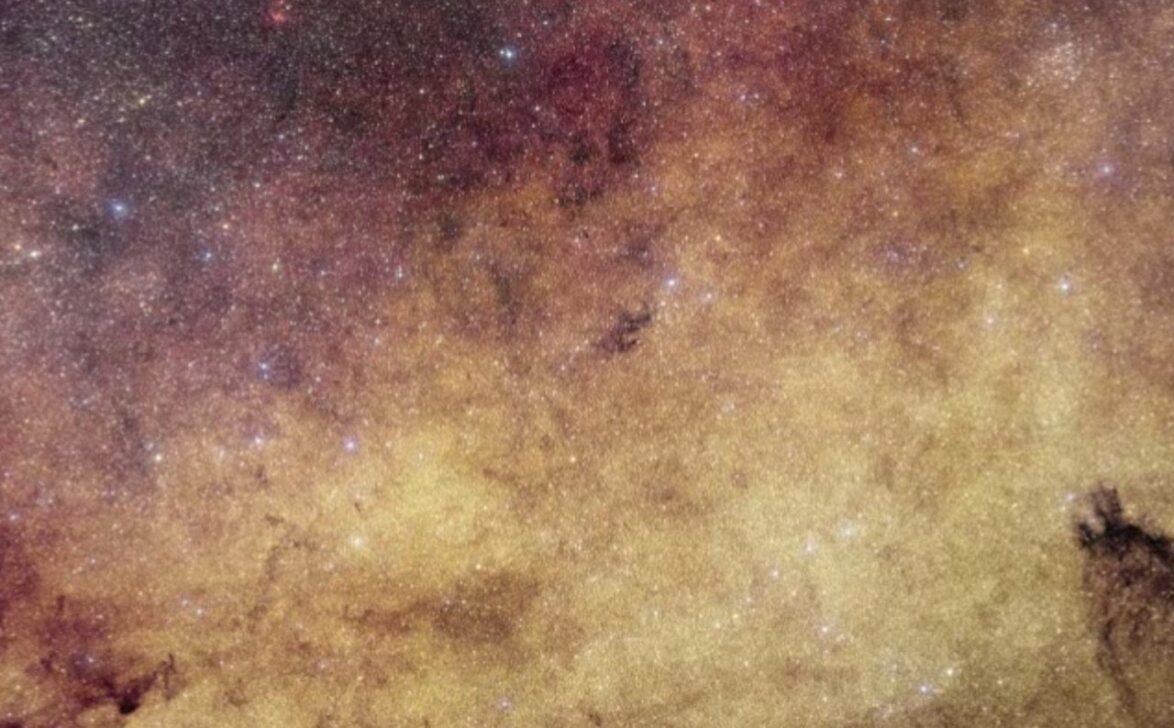
The European Space Agency (ESA) recently revealed the widest and most detailed photograph ever captured of the center of the Milky Way in visible light.
Obtained by the Euclid space telescope, the record displays more than 60 million stars clustered in the galactic bulge, the central and most luminous area of our galaxy, in addition to recording nebulae and stellar groupings.
The image was produced in March 2025, based on approximately 26 hours of observation, and results from the combination of nine different photographs.
Each segment of the composition covers a celestial extension greater than the size of the full Moon, demonstrating Euclid’s capacity. To illustrate the magnitude, large terrestrial equipment would require around 2 thousand hours to obtain the same panorama.
Although designed to probe the invisible dark matter and energy components that predominate in the universe, the Euclid telescope typically directs its view toward very distant galaxies.
However, at the request of astronomy experts, this time he turned his focus to a closer region. The great benefit of the device lies in its ability to isolate individual stars, even in such a densely populated area, without suffering glare from the intense brightness.
This ability is fundamental for scientific research. The new image is expected to help locate and study exoplanets, which are worlds orbiting other stars, using a technique known as gravitational microlensing.
This method is effective when a star is positioned in front of a more distant one, functioning as a natural magnifying glass and intensifying the luminosity of the celestial body in the background.
If a planet is in orbit around the nearest star, its gravitational force will cause an additional subtle change in its brightness. It is precisely this detail that allows us to identify the presence of the exoplanet.
In the last twenty years, approximately 300 exoplanets have been detected using this methodology, all using ground-based telescopes and aimed at the core of our galaxy. The new Euclid record already covers 51 previously identified planetary systems, promising to significantly expand studies on many others yet to be discovered.
It is worth mentioning that a single daily capture is not enough to discover new planets; To do so, it would be necessary to monitor the stars for more than 20 days.
However, this photograph functions as a starting point, a record of the “before”. By mapping the exact position of stars before any future alignment, it becomes a crucial temporal reference for upcoming missions, such as NASA’s Roman Space Telescope.
In this way, technology will help to confirm the existence of planets and measure their masses. The technique is particularly efficient in detecting icy worlds far from their host stars.