

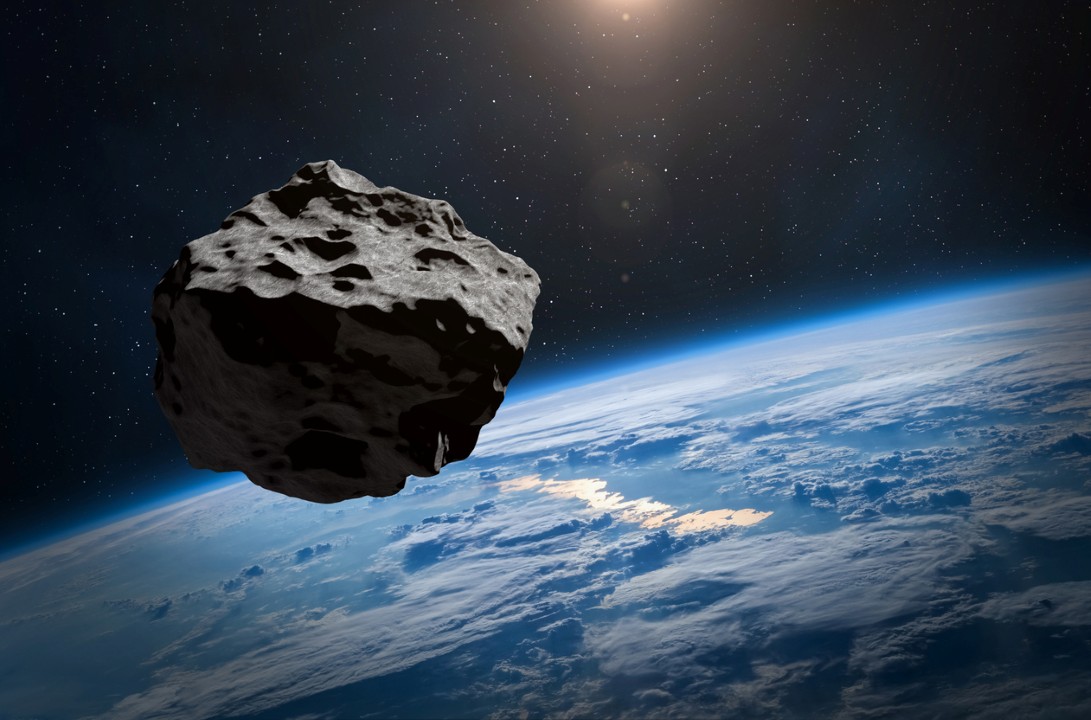
A huge asteroid will approach planet Earth next Saturday (June 27). The European Space Agency (ESA) announced that the celestial body can be observed using small telescopes or even binoculars.
The space organization emphasized that the asteroid, first identified in July 1997 under the designation (152637) 1997 NC1, poses zero risk of impact with Earth’s soil.
Juan Luis Cano, from ESA’s Planetary Defense Office, stated that “the arrival of an object of this size close to Earth only occurs every few years.” He added that, this time, visibility could be compromised by the Moon, which will be bright and close during the asteroid’s closest approach.
The ESA indicated that the asteroid has estimated dimensions between 750 and 1650 meters, a calculation based on its ability to reflect sunlight, which varies from 5% to 25%. However, other analyzes suggest that this reflectivity could reach 60%, which would imply that the true size of the rocky body would, in fact, be smaller than initial projections.
The closest encounter with Earth is scheduled to occur at 8:14 am, Brasília time. At that moment, the asteroid will be at a distance that corresponds to 6.66 times the separation between the Earth and the Moon, exceeding 2.5 million kilometers.
Understand the nature and composition of asteroids
Asteroids are predominantly small objects, with a rocky or metallic constitution, that reside in the so-called asteroid belt, located between the orbits of Mars and Jupiter. Some of them, however, can come close to and even cross the Earth’s trajectory, being defined as bodies with a diameter greater than one meter.
Rocky fragments in orbit smaller than asteroids are known as meteoroids, which, when they enter the Earth’s atmosphere, manifest themselves as meteors. On the other hand, asteroids with enough mass to acquire a spherical shape due to the action of their own gravity are called dwarf planets, Pluto being a notable example.
These celestial bodies are formed by rocks that preserve the primitive materials from which the planets of our Solar System developed. Unlike terrestrial rocks, which have undergone millennia of erosion and geological transformations, asteroids have remained unchanged, thus offering a valuable intact record of the genesis of the planetary system for scientific research.

Monitoring space rocks with potential risk to Earth
There is an additional crucial reason for the in-depth study of asteroids, and also comets: their proximity to our planet. Near-Earth Objects, known by the acronym NEOs, encompass asteroids with diameters ranging from 3 meters to 40 kilometers and are continuously monitored by the Center for Near-Earth Object Studies, belonging to NASA, the North American space agency.
Due to their characteristic orbits, which are elongated or elliptical, these objects can be up to 195 million kilometers away from the Sun, which occasionally takes them into a risky approach to Earth. Although the chance of a large-scale collision with the planet is seen as relatively low, the destructive power that such objects possess requires uninterrupted vigilance.