

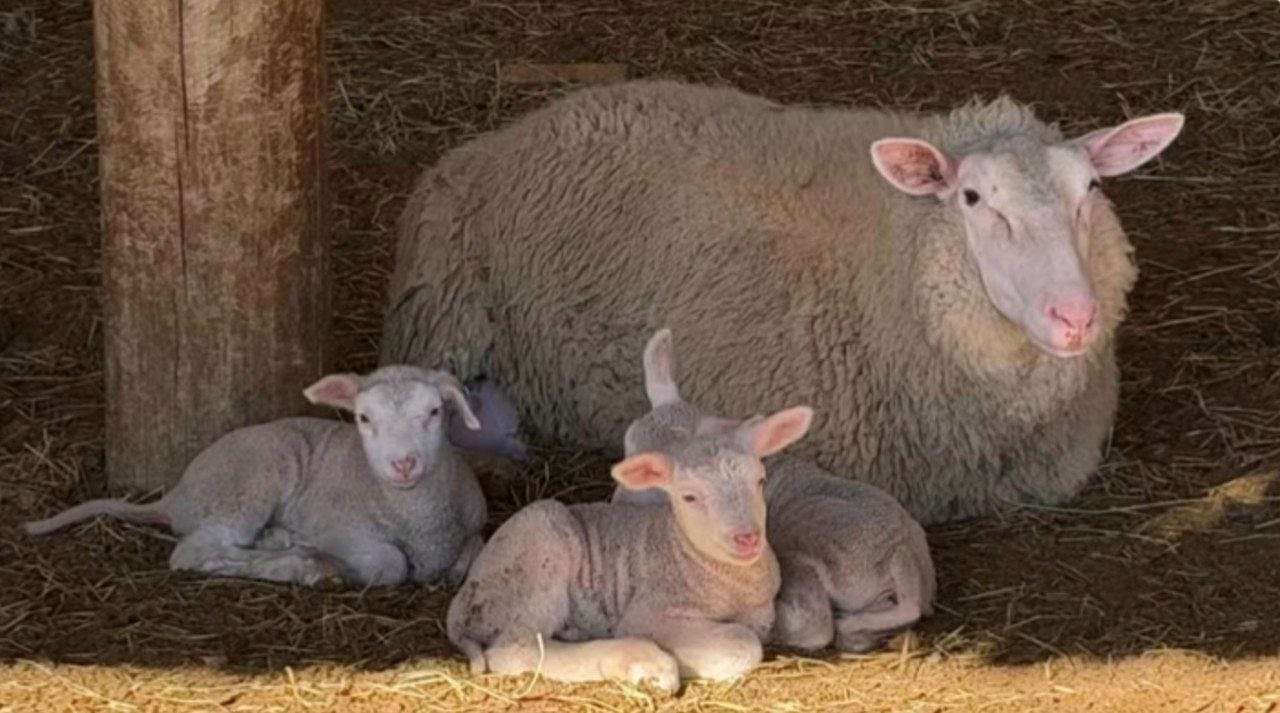
An extraordinary event occurred on a rural property in Rancho Queimado, in Greater Florianópolis, during the current month, when a sheep surprised by giving birth to three lambs in a single birth.
In sheep farming, this occurrence is classified as uncommon, corresponding to just 1% of births, according to data released by the Brazilian Agricultural Research Corporation (Embrapa).
The puppies, two females and one male, came into the world on June 16, according to a report from owner and veterinarian Leonardo Käufer.
The veterinarian said that, upon arriving in the morning for milking and to inspect the herd, he noticed the sheep visibly exhausted, restless and showing discomfort.
Observing the labor, Käufer immediately carried out the necessary procedures to assist in the extraction of the first lamb.
Belonging to the East Friesian breed, of German origin, known for its high prolificacy and aptitude for dairy production, the veterinarian already anticipated the possibility of a second puppy, an expectation that was confirmed shortly afterwards.
However, after the birth of the second lamb, Käufer opted for a more in-depth touch examination as a precautionary measure. The surprise was great when discovering the presence of a third cub.
The veterinarian admitted that, at the time of the discovery, there was fear that the third animal had not survived, given the extreme rarity of triplet births.

Considered a “very unusual” event, Käufer recalls a previous twin birth, which took place eight years ago, where one of the puppies did not survive. This time, the satisfaction is immense due to the survival of all three lambs, which already have a destination: the females will remain on the farm as future matrices, while the male will be taken to another dairy property to act as a stud.
Due to the sharing of uterine space and nutrients during the gestational period, the lambs were born smaller and more delicate compared to puppies from single or twin births, as explained by the veterinarian.
Despite their initial fragility, they all show good health and progress, requiring only food supplementation via bottle. This assistance benefits both the young animals and the mother, who faced a very physically demanding birth.