

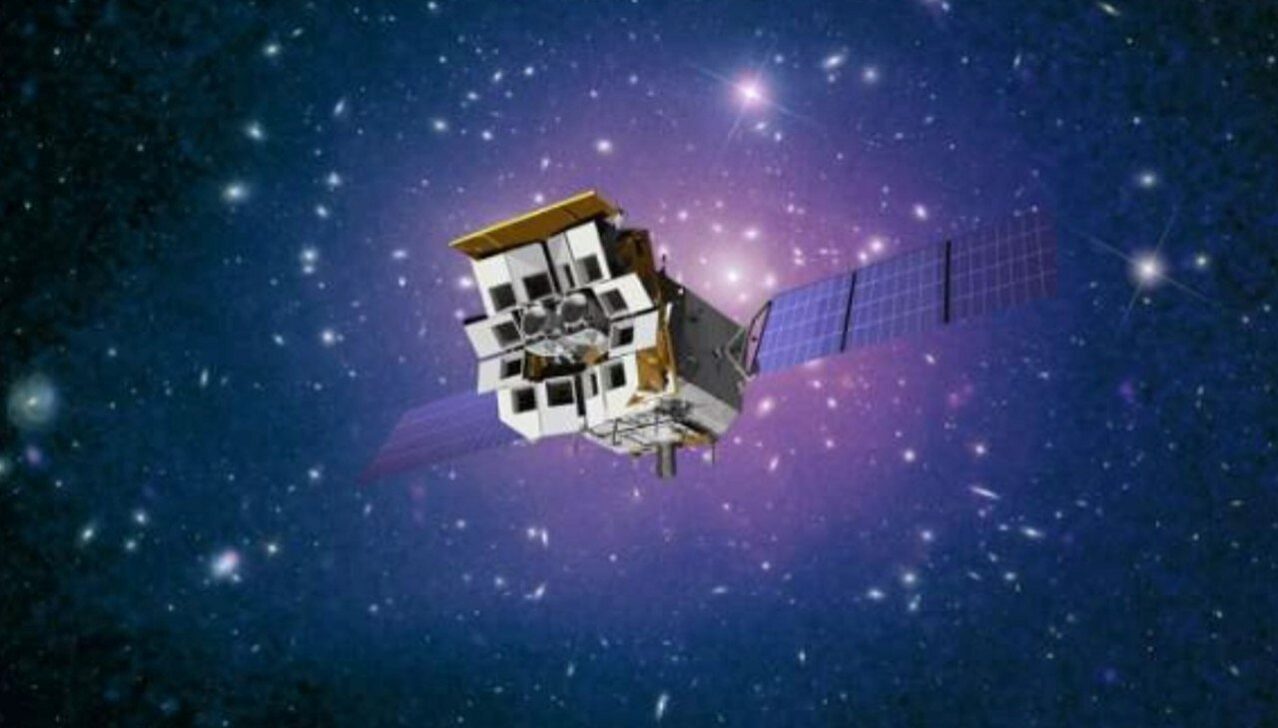
An unprecedented cosmic event was recently detected by the Chinese Einstein Probe probe, leaving the scientific community intrigued. The explosion, captured in X-rays, does not align with any of the known classifications of stellar phenomena.
The record points to two distinct flashes of X-rays, with an interval of approximately 200 seconds between them. This anomalous sequence challenges current astronomical models and suggests the occurrence of a type of eruption that is not yet understood.
Unexpected discovery during routine Chinese telescope scan
The Einstein Probe, launched in 2024 by the Chinese Academy of Sciences in collaboration with the European Space Agency, has the main objective of monitoring high-energy, short-lived events in the universe. Its function is to scan the sky in search of luminous outbreaks that appear and disappear quickly, and it was in this context that the phenomenon manifested itself in an unexpected way.
On March 5, 2024, the probe identified the event, named EP240305a. Inicialmente, um clarão de raios-X com duração de cerca de dois minutos foi registrado. Just over three minutes later, a second, even more prolonged pulse was observed.
The presence of this second peak, so close to the first, was what intrigued scientists the most. Such a repeating pattern over such a short period is unusual and differs from previously documented astronomical events.
A Sonda Espacial 'Einstein' da China Detectou Uma Misteriosa Explosão Cósmica, e os Cientistas Não Fazem Ideia do Que a Causou https://t.co/QLYl9veoyI pic.twitter.com/USBfXu0Qbi— Brazilian Space (@brazilian_blog) June 25, 2026
Immediately, telescopes both on the ground and in space were trained on the region where the signal originated. The intention was to unravel the nature of the phenomenon, but collecting more data only intensified the mystery, making it even more difficult to fit into existing categories.
The X-ray signal faded in a matter of days, while radio emissions associated with the explosion gradually diminished over weeks. This divergence in the time of signal disappearance added another layer of complexity to the analysis.
In an attempt to categorize the event, the researchers made comparisons with several already cataloged celestial occurrences:
- Tidal disruption, which occurs when a black hole destroys a star.
- Short-lived stellar explosions.
- Radio emissions associated with other cosmic eruptions.
- Previously identified fast X-ray transients.
However, none of the existing explanations was able to reproduce the complete set of features observed in event EP240305a.
Research points to the hypothesis of a gamma ray burst, but data is lacking
The hypothesis that comes closest to describing EP240305a is that of a gamma ray burst (GRB), a type of extreme event linked to the death of massive stars or the collision between them. However, one crucial aspect deviates from the norm: no signal of gamma rays was detected.
Given this absence, the research team opted for a more reserved classification. They described the phenomenon as a transient with GRB characteristics, but “dark” in gamma rays, highlighting that current data do not allow definitive confirmation of its origin as a traditional GRB.
This uncertainty is precisely what gives the case its scientific importance. The lack of consensus and a final verdict keeps the phenomenon as an open field for new discoveries.
Questions persist about the origin and nature of the mysterious signal
Among the theories under consideration, one suggests that the explosion’s jet of energy may have been directed away from Earth or obscured by material surrounding its source. However, this and other ideas remain possibilities, without proof.
EP240305a remains under intense study, and scientists emphasize that events like this are particularly valuable because they challenge consolidated knowledge, pushing science to seek new understandings about the universe.
There is still no conclusive explanation for the phenomenon observed by the Einstein Probe. This lack of definitive answers is precisely what keeps the signal a fundamental object of investigation for modern astronomy.