

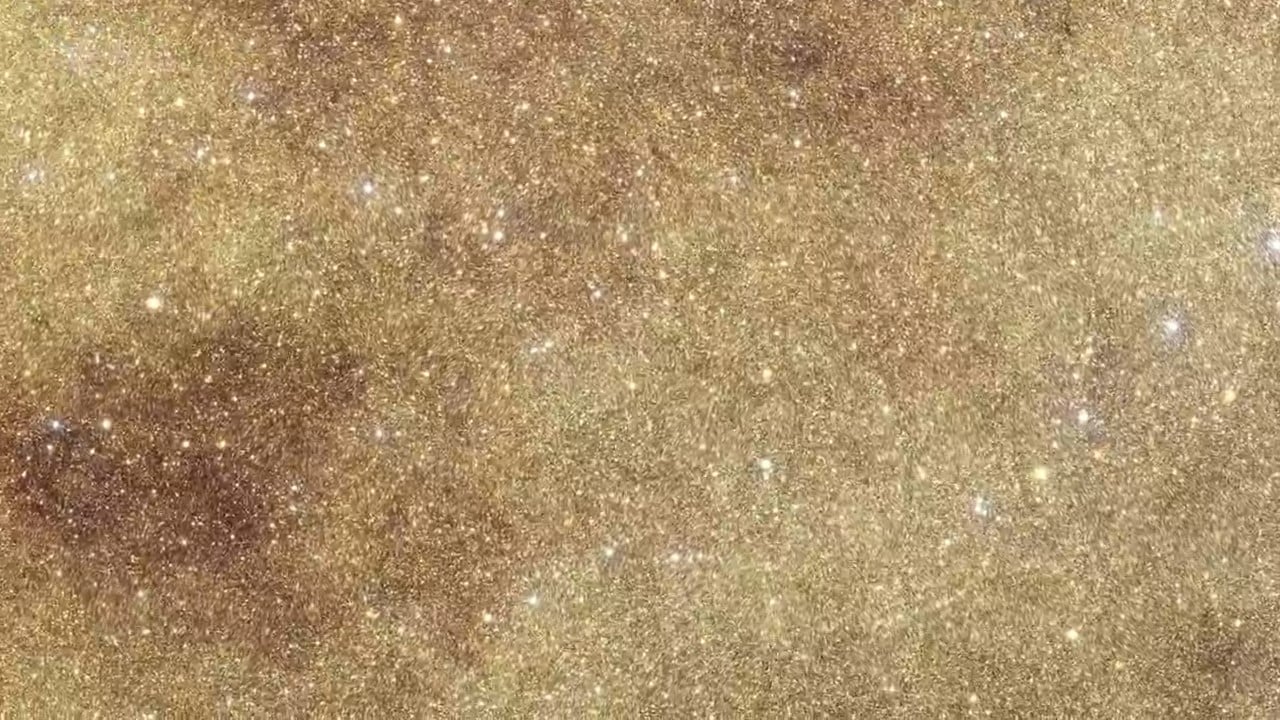
The European Space Agency (ESA) released an unprecedented record made by the Euclid space telescope, which focused on one of the most populated areas of the Milky Way. Detailed observation of the galactic bulge has revealed an extraordinary concentration of more than 60 million stars at the heart of our galaxy.
To compose this impressive image, Euclid dedicated approximately 26 hours of scrutiny in March 2025. The equipment carried out nine different observations, covering a portion of the sky that exceeds the apparent size of the full Moon by several times.
According to the scientists involved in the mission, the data collected goes beyond simple star mapping. They pave the way for new investigations into exoplanets and allow deeper analysis of the luminosity of already identified star systems.
Exploring the core of the Milky Way with Euclid technology
Although Euclid’s main goal is to create a large-scale, three-dimensional map of the Universe, its initial observations of the galactic center demonstrated a remarkable ability. The telescope is capable of individualizing stars even in areas of unusual stellar population density.
The examined area, which contains a vast amount of more than 60 million stars, offers astronomers a unique opportunity. They can investigate fluctuations in the luminosity of these celestial bodies, potential signs of the existence of planets in their orbits.
Researchers associated with the mission reported that the telescope was successful in identifying previously cataloged planetary systems. Furthermore, Euclid provided valuable information that will help improve mass measurements of planets located outside our Solar System.
The Euclid discoveries also represent an indirect advance for future space endeavors, such as the Nancy Grace Roman telescope. This new observatory, scheduled to launch on a Falcon Heavy rocket from Cape Canaveral in the United States no earlier than August 30, will benefit immensely. Euclid’s ability to peer through the dust and gas of the galactic center, a challenge for ground-based telescopes, provides an essential catalog and mapping for Roman, which will focus on microlensing techniques in this same region.
The future Nancy Grace Roman observatory will employ the gravitational microlensing technique. This innovative method uses the gravity of a star as a magnifying glass for the light of another distant celestial body, making it possible to detect planets that would otherwise be invisible.
In the last twenty years, investigations based on this approach have already led to the discovery of around 300 exoplanets. All of these findings were made using telescopes located on Earth, aimed at the central region of the galaxy.
Additionally, the researchers emphasize that the recent image captured by Euclid acts as a valuable baseline record. It can be used as a point of comparison for future star alignment events.
This way, any new detection will make it possible to compare current data with the previous state of the stars. This will enable an improved understanding of the behavior and dynamics of planetary systems.