

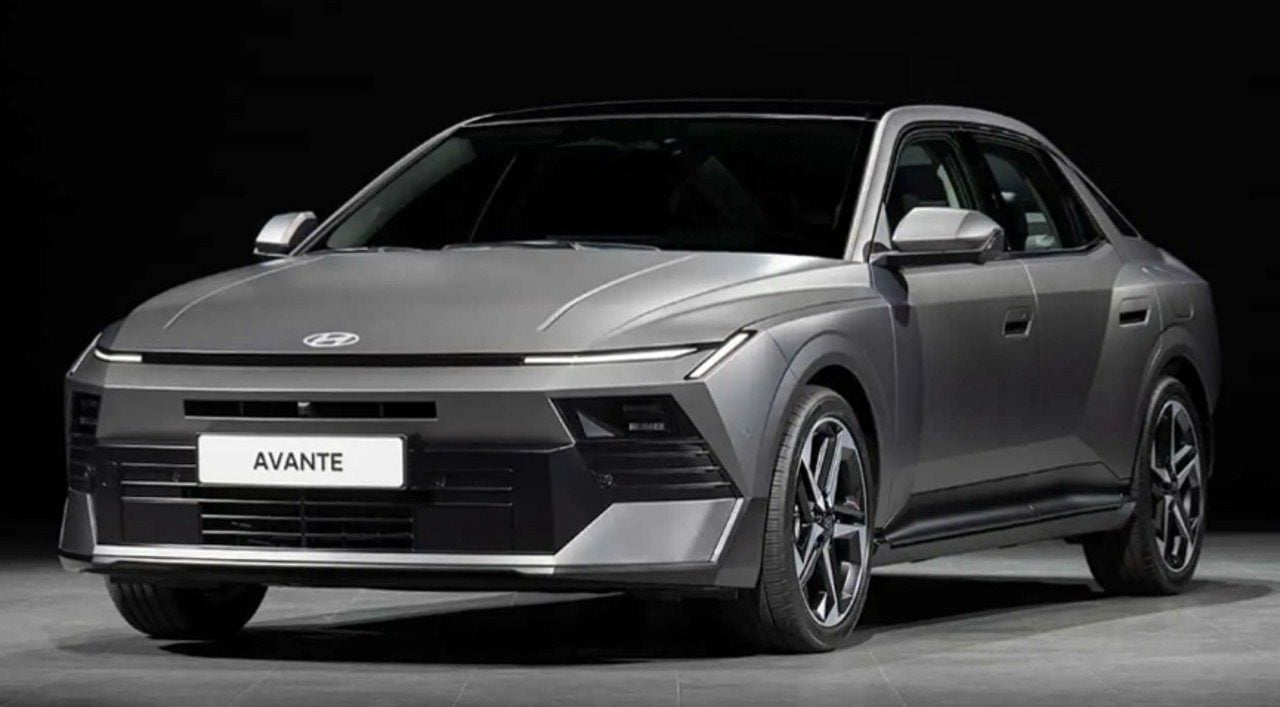
South Korean automakers often introduce radical transformations to the look of their launches, and the latest Elantra exemplifies this approach. Recently presented at the 2026 Busan Motor Show in South Korea – where the vehicle is sold under the name Avante, the eighth generation of the compact sedan displays a completely renewed aesthetic compared to the previous version, both outside and inside.
With lines reminiscent of Iron Man’s armor, the new Elantra surprises with details such as wider wheel arches and door handles integrated into the body. One of the visible indicators of its growth is the inclusion of a side window at the rear, an element that adds a distinctive touch to the profile and highlights its expanded dimensions. The vehicle now measures 4,765 mm, surpassing the previous model by 55 mm. Of this increase, 30 mm was applied to the wheelbase, which now reaches 2,750 mm, resulting in an interior with more space for occupants.
Hyundai itself highlights that the redesigned Elantra offers livability close to that of medium sedans, such as the Sonata. In addition to the gain in length, the new generation of the car is 30 mm wider, totaling 1,855 mm. Its height also had a slight increase, reaching 1,425 mm, although there is still no confirmation whether this change results in greater headroom for passengers, despite the roof line appearing to be more horizontal.
Striking style inspired by the “art of steel”
The South Korean automaker has revealed that the new-generation Elantra embodies the “Art of Steel” design language, characterized by an abundance of sharp edges and expressive contours. Both the headlights and taillights were designed to form the letter “H”, and a wide spoiler that spans the entire width of the rear also stands out. The set is complemented by 18-inch two-tone wheels, whose five-spoke design reinforces the vehicle’s angular aesthetics.
The Elantra’s cabin conveys the impression of belonging to a superior automotive class, equipped with Hyundai’s advanced Pleos infotainment system, which operates on Android. The standard touchscreen is 12.9 inches, with the option of a larger 14.6-inch version. Fortunately, the interface kept some physical controls below the display, reducing the number of buttons, but without completely eliminating traditional functionalities.
A horizontal digital instrument panel is strategically positioned in front of the driver. The Hyundai badge on the steering wheel was removed and replaced by four dots that symbolize the Morse code of the letter “H”, a stylistic trait already present in other models of the brand. The gear selector has been relocated to the back of the steering wheel, freeing up the lower portion of the center console, which now houses two wireless chargers.
New features and engine options
Other notable elements include ambient lighting on the door panels and main dashboard, as well as two large cup holders positioned in front of the center armrest. Traditional buttons were retained on both the steering wheel and the driver’s door. The passenger side of the dashboard features a textured finish that simulates a soft material, elevating the vehicle’s perceived refinement.
In the South Korean market, the Avante will be offered with a 2.0-liter naturally aspirated gasoline engine, delivering 147 horsepower, which represents an increase of 25 hp compared to the previous generation. Additionally, a more efficient hybrid variant will be available, combining a 1.6-liter engine with a system that increases combined power to 155 hp. This hybrid version incorporates Hyundai’s latest regenerative braking technology and an innovative function, “Stay Mode”, which allows occupants to use battery power to keep the air conditioning and infotainment system running, similar to a fully electric car, even with the engine turned off.
The launch of the new Avante in the domestic market is scheduled for the third quarter of this year, with the global version of the Elantra for other markets possibly arriving throughout 2027.
Hyundai has a history of bold designs, and the eighth-generation Elantra continues that reputation. The launch of any new sedan is welcome in the automotive scene, and it is positive to see that the popular vehicle segment continues to receive attention and innovations. Future prospects indicate the development of a high-performance “N” version, equipped with a more powerful engine, although its arrival on the market should occur a few years after the launch of the conventional variants.