

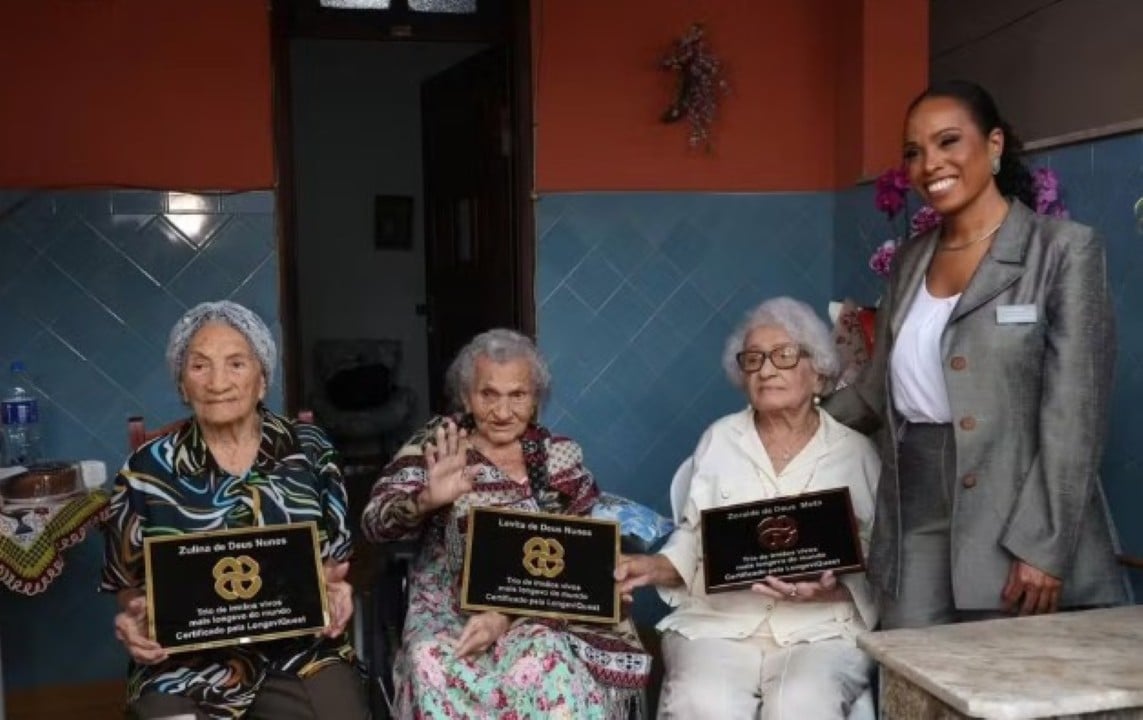
Brazilian researchers are focused on studying a trio of sisters who, together, reach 316 years of age, aiming to unravel the mysteries of longevity. These women were recently recognized by Guinness World Records as the oldest living sisters globally.
The scientific initiative, called the Longevo DNA Project, is coordinated by professor Mayana Zatz at the University of São Paulo (USP) and focuses on investigating the biological elements that drive the aging process. The specific case of these three sisters offers a unique opportunity to understand physical and cognitive resistance in individuals who reach very old ages.
To this end, the study intends to analyze individuals aged 90 to 100 years or more, contrasting them with those who manifest frailty, cognitive impairment or chronic illnesses, in order to identify markers associated with long life.
“Through genetic tests, our focus is to discover genes that offer protection, as we already know about the existence of several,” explained Mayana Zatz, who also leads the institution’s Human Genome Research Center. She added that “the greater the number of individuals who exceed 100 years of age, especially in families with multiple centenarians, the more accurate and rich in data our investigation will be.”
The scientific community postulates that genetic inheritance has a more significant influence than environmental factors on the conservation of health and functional capabilities during old age.
The three sisters — Zulina de Deus Nunes (103 years old), Zoraide de Deus Mota (104 years old) and Levita de Deus Nunes (109 years old) — live in Rio de Janeiro. They were recognized by LongeviQuest, an international entity that confirms longevity records and works in partnership with Guinness World Records.
“Achieving this longevity in sisters is a clear indication of the strong presence of a genetic element,” said Ben Meyers, CEO of LongeviQuest. He also highlighted that, as they live close together, they benefit from a family support network, which also highlights an essential community component.
Centenarians attribute their long lives to a balanced diet and a routine of physical activities. Zulina recalled a childhood immersed in swimming and fishing in rivers, highlighting that “everything we consumed was fresh, we didn’t have a refrigerator.” Zoraide added, emphasizing that “breastfeeding has a fundamental value”.
Apart from these aspects, the sisters’ life trajectory appeared to be quite ordinary. Levita worked as an artisan and, later, at a television station. Zoraide worked as a nurse and was responsible for raising five children, while Zulina, as a housewife, dedicated herself to raising six.
Levita reflects on her existence without expressing regret. “My childhood and adolescence were good. I have no reason to complain,” she said.
Scientists seek to understand how genetic factors, to the detriment of lifestyle, act to protect the cardiovascular system, muscles and cognitive functions against the adverse impacts of aging.
The purpose of the research, as highlighted by João Paulo Guilherme, Zatz’s colleague, is “to reach a group of 500 centenarians so that it is possible to draw more assertive and final conclusions about longevity”.