

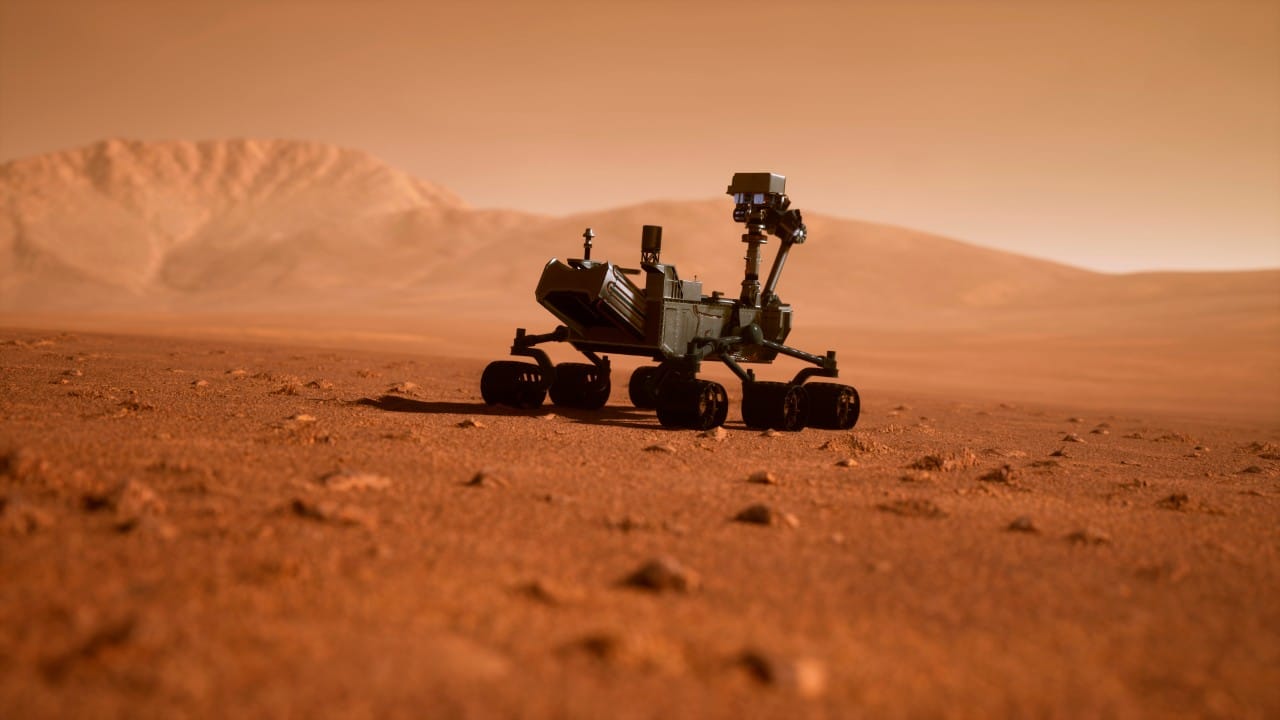
The NASA-operated Perseverance robotic probe has identified intricate carbon molecules in rock formations in Jezero Crater on the planet Mars. This revelation intensifies indications that the red planet may have harbored life billions of years ago. The location of the discovery is particularly relevant, as the area had already been noticed by scientists due to mineral characteristics that refer to formations created by microorganisms in primordial terrestrial environments.
Although the findings do not confirm the presence of past Martian life, scientists view this information as significant progress in elucidating Mars’ past. The investigations were carried out with the SHERLOC instrument, which employs an ultraviolet laser to detect chemical and organic compounds in rocks. The outcrop called Bright Angel, where the detections took place, was part of an ancient riverbed that flowed into the vast Jezero Crater lake billions of years ago.
The importance of this discovery is magnified by the fact that it occurred in the same area where Perseverance had already detected, in 2024, mineral formations in spots and nodules that bear similarities to traces of terrestrial microbial activity. The data were released this Wednesday (24) in a scientific article in the journal Science Advances, signed by the team responsible for the research.
Analysis of macromolecular carbon and its possible origins
The material detected by the rover was called MMC, or macromolecular carbon. On planet Earth, this substance is commonly found in fossilized organic matter, such as remnants of ancient microbial communities. However, it is crucial to highlight that MMC can also arise from geological processes that do not involve any type of life.
Ashley Murphy, a researcher at the Arizona Institute of Planetary Sciences and lead author of the research, commented to The Guardian that MMC “may originate from biological sources, such as fossilized organic matter found in microbial mats and coal.” She added that the substance “can also form in reactions between rocks and water or arrive with the impact of meteorites”, highlighting the complexity of the interpretation.
SHERLOC data indicate that organic carbon is present both in primary rock sediments and in minerals that formed later from the movement of underground fluids. For experts, this characteristic suggests that organic matter may have been integrated into the Martian ecosystem at different times throughout the geological evolution of that area.
Jezero Crater as a possible refuge for Martian life
Scientists emphasize that the geological context of the area where the discovery was made is equally important as the organic material itself. Jezero Crater holds evidence of an ancient river delta, which demonstrates the existence of liquid water in large volumes in the region in the distant past.
Such information corroborates the theory that the local environment would have offered favorable conditions for the development of microscopic life. The textural characteristics of the rocks, combined with evidence of fundamental carbon, point to a potentially habitable ecosystem, if primitive life forms had thrived in that ancient Martian delta.
An additional piece of interest lies in the great distance between the areas of Mars where organic compounds have been detected. Before Perseverance’s recent analyses, the Curiosity rover had already identified organic matter in Gale Crater, more than 2,000 miles away. This vast spatial distribution suggests that Mars’ ability to harbor life and the presence of organic compounds were not restricted to a specific location, but could have been common billions of years ago. However, several hypotheses persist for the origin of this material: it may have been brought by meteorites or cosmic dust, the result of chemical reactions between water and rocks, or even have a biological origin.
Waiting for Martian samples for definitive confirmation
Despite the enthusiasm generated by the recent results, scientists admit that the instruments present on Mars do not have the ability to discern whether the carbon discovered comes from living organisms or natural chemical processes. The final answer awaits the return of samples for analysis in terrestrial laboratories.