

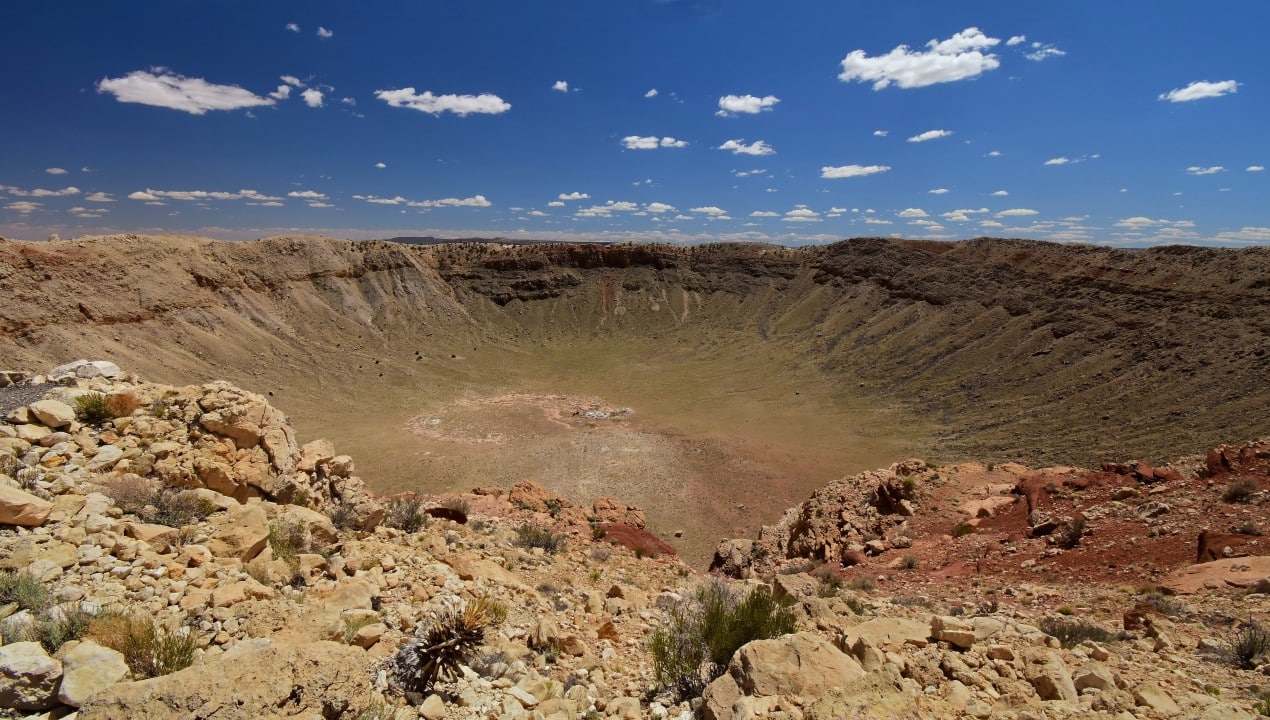
In the Pilbara region, a vast desert in Western Australia, an elevation approximately 40 kilometers in diameter holds the remains of a primordial impact: an ancient site where a meteorite crashed into the Earth billions of years ago.
Rock fragments at the site, which geologist Chris Kirkland describes as “a rare glimpse into the violent processes that shaped the ancient Earth,” have been subjected to new measurements. These analyzes indicate that the collision occurred more than three billion years ago, making it the oldest meteorite impact ever documented on the planet.
A group of Curtin University researchers, led by Kirkland, published a study on Tuesday detailing the most accurate estimates to date for the age of the North Pole Dome impact. The structure was initially described in early 2025. The article, published in the journal *Geology*, dates the event to around 3.02 billion years ago, during the Mesoarchean era.
In this remote period, the Earth’s surface was almost entirely covered by oceans and the planet suffered an incessant bombardment of meteorites. While the traces of these impacts are best preserved in the craters of the Moon, which at the time was closest to Earth, erosion and the movement of tectonic plates on our planet have erased most of these marks, making the discovery an invaluable geological record.
For many decades, the Pilbara area was considered by scientists as a possible meteorite impact site, but its exact age remained uncertain. Now, advanced mineral dating techniques have allowed researchers to find the clearest evidence of this ancient geological event.
“The impact left behind a ‘mineral clock’. By dating minerals that were recrystallized or that re-formed in the damaged rocks, we can now determine when this extraordinary event happened,” Kirkland explained in a statement.
The most significant evidence came from the analysis of zircon, a mineral found in the region’s basalt rocks. These small, extremely resilient grains are capable of preserving a record of geological time for billions of years.
Some of the zircon grains displayed “skeletal” and branching patterns, suggesting sudden growth. Such formations, similar to those seen in lunar craters, indicate that the zircon recrystalized under the extreme heat generated by the impact.
With the aid of a High Resolution Ionic Microprobe, scientists estimated the age of zircon grains to be between 3.4 and 3 billion years ago, with an average of 3.02 billion years. To validate these findings, they also examined apatite, another mineral that formed in fissures in the affected rocks, in conjunction with the movement of heated liquids. Measurements for apatite showed a statistically identical mean age.
“The new dating positions the North Pole Dome structure as the oldest known impact crater on Earth and the only recognized example from the Archean eon, a crucial phase in which the planet’s first continents were forming,” details Kirkland. Previously, Yarrabubba Crater, dated at 2.2 billion years old and located 800 kilometers to the south, held this record.

Peer criticism and the age-of-impact controversy
The minerals analyzed in this new study were discovered in “shatter cones,” which are conical rock structures formed by the intense shock wave of a meteorite impact.
When the crater was initially documented in March last year, preliminary estimates of its age were based solely on the correlation between the ages of the rock layers located above and below these cones. This approach resulted in an estimate of about 3.5 billion years, but already at that time some academics, including colleagues on Chris Kirkland’s team, disputed these findings.
The main objection came from Aaron Cavosie, also a geologist at Curtin University, who led another study into the impact of North Pole Dome. Their research found shatter cones between significantly younger rock layers, dated at approximately 2.7 billion years old. This evidence, according to him, indicated that the impact could only have occurred after that date.
“While I am relieved that the authors have backed away from their 2025 hypothesis of a ‘3.5 billion year impact,’ I also do not believe they have made a convincing argument for a [3.02 billion year] impact,” Cavosie said.
Kirkland, in turn, refutes these criticisms: “The argument for a more recent age still depends on the long-distance correlation of rocks that have not been dated, based largely on satellite mapping rather than direct geochemical or geochronological analysis,” he argued. “We now have two mineral clocks obtained from the impacted rocks themselves indicating the same age. This is why direct dating is so important.”
Alec Brenner, a geologist at Harvard University and an early critic of the research, also expressed his reservations. “Although the new study rules out this observation because these rocks have not been dated, they can be correlated quite directly with nearby rocks that have already been dated,” he explained.
Kirkland also argued that the mineralogical changes observed in his study, such as the formation of minerals by hot water passing through cracks in damaged rocks, would be unique to a process like a meteorite impact.
Contrary to this perspective, Brenner disagrees. “Observing an unknown fluid flow event does not mean it was the result of an impact,” he said. “[Kirkland] has also worked on other craters in which similar dated fluid flow events were clearly not related to impacts. In most cases, they are not.”
“So I would suggest that they dated a previously undocumented hydrothermal episode in the region,” concluded Brenner.