

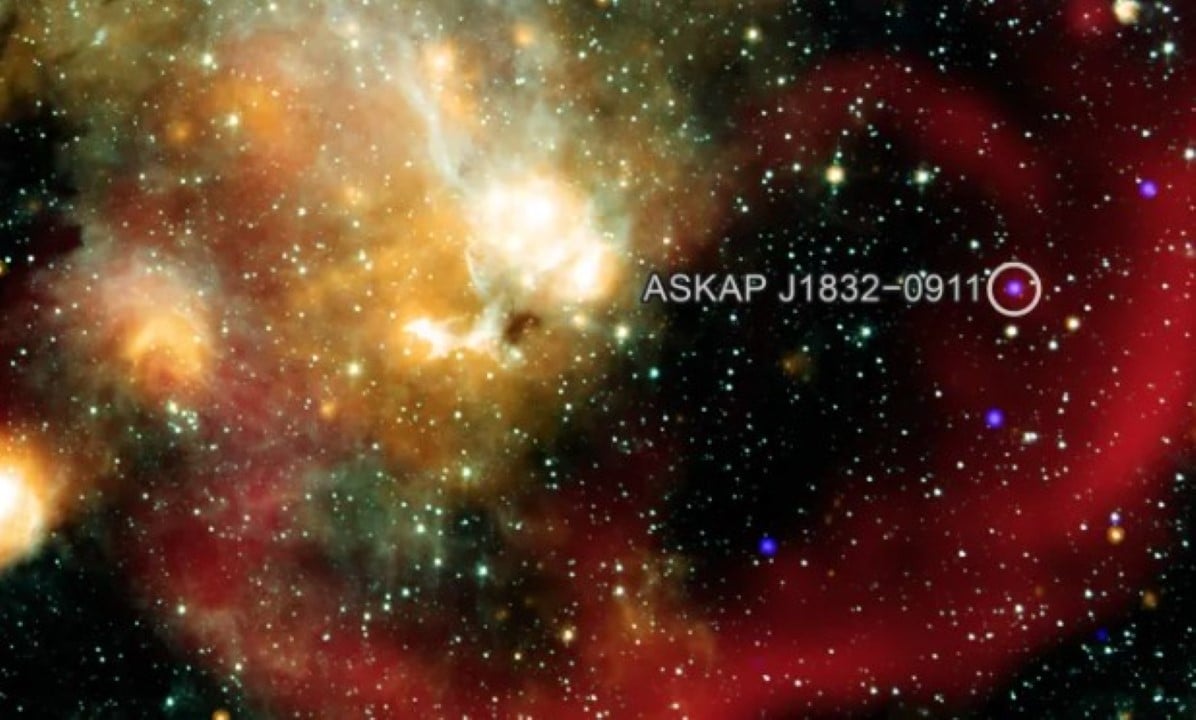
Recent research released by NASA has revealed unprecedented behavior in the star ASKAP J1832−0911, providing new clues about the origin of a newly discovered category of enigmatic cosmic objects.
The analysis was carried out by combining information from the Chandra X-ray Observatory, belonging to the American space agency, and the SKA Pathfinder radio telescope (ASKAP), located in Wajarri Country, Australia.
The star is part of a group of celestial bodies called “long-period radio transients”, identified for the first time in 2022, which manifest regular variations in the intensity of their radio waves for tens of minutes.
This intensity modulation is shown to be thousands of times longer than the variations seen in pulsars, which are rapidly rotating neutron stars with signal repetitions several times per second.
The celestial object ASKAP J1832 presents an oscillation cycle in its radio waves every 44 minutes, which places it in the classification of long-period radio transients. Using Chandra, the scientific team discovered that ASKAP J1832 also exhibits regular fluctuations in its X-rays with the same 44-minute periodicity.
This is the first time that an X-ray signal with this characteristic has been identified in a long-duration radio transient, opening new perspectives for understanding the physics behind these objects previously only observed in radio waves.
The team of scientists rules out the possibility that ASKAP J1832 is a pulsar or a neutron star that attracts matter from another celestial body, since its particularities do not correspond to the typical intensities of radio and X-ray signals from these known phenomena.
Some particularities of ASKAP J1832 could be attributed to a magnetar, a neutron star with an extremely strong magnetic field, which is more than five hundred thousand years old.
However, other characteristics observed in ASKAP J1832, such as its strong and inconstant radio emission, are difficult to justify for an old magnetar.