

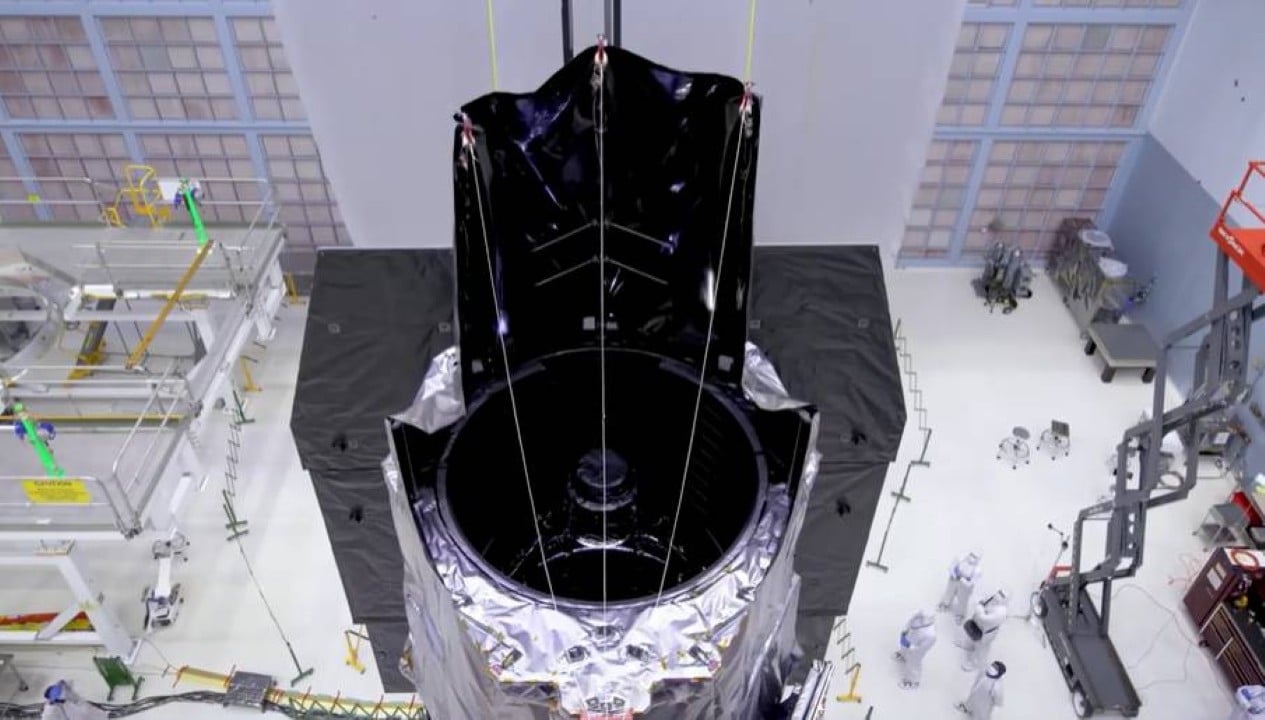
Understanding the vastness of exoplanets in the Milky Way will gain a significant boost with NASA’s Roman Space Telescope. The tool was designed to drastically expand our knowledge about these distant worlds.
- Forecast to identify approximately 100,000 new celestial bodies in the Milky Way.
- Joint application of sophisticated techniques such as planetary transit and gravitational microlensing.
- Obtaining large volumes of data on general atmospheric patterns and climatic conditions on other planets.
An unprecedented era for space exploration begins with the launch of NASA’s Roman telescope. This innovative tool has the potential to transform astronomy by examining hundreds of millions of distant stars, searching for yet unknown worlds.
Uncovering the main objective of the Roman mission
The space agency’s goal is to significantly expand the list of cataloged exoplanets. The primary focus is to map sectors of the Milky Way that are still little explored, to understand variations in planetary formation at different points in the galaxy.
Unlike past investigations, which focused on areas close to Earth, the new observatory will direct its observation toward the dense center of the Milky Way, filling a critical gap in current research. Experts project the discovery of approximately one hundred thousand new celestial bodies with this ambitious approach.
Technological methods for detecting remote exoplanets
Aiming for significant results, the telescope will employ two approaches to contemporary astrophysics. The first method is planetary transit, which consists of observing the temporary decrease in the luminosity of a star when a planet passes in front of it.
The second technique is gravitational microlensing, which harnesses the force of gravity from distant stars as natural lenses. This ingenious mechanism allows the detection of smaller and colder planets, paving the way to finding worlds with orbital characteristics similar to those of our solar system.
Influence of stellar composition on planetary formation
Differences in the chemical composition of stars are fundamental to the cosmic structure of forming planets. In the galactic nucleus, heavy elements accumulate, acting as essential raw materials for the emergence of rocky bodies and gas giants throughout the galaxy.
- Stars with a high concentration of elements such as silicon and magnesium are more likely to have giant worlds.
- The central areas of the galaxy, although they present high radiation, are rich in materials essential for planetary formation.
In contrast, stars located in the peripheral regions of the galaxy exhibit a lower concentration of these complex chemical components. This spatial disparity directly influences both the physical characteristics and the number of planetary systems that can thrive in these cosmic environments.
The essential elements for this analysis were identified as the following:
- Silicon, found in abundance in centrally located stars.
- Oxygen, fundamental in molecular composition.
- Magnesium, which impacts the formation of rock structure.
Details about collecting atmospheric information
The mission will not be dedicated to in-depth individual chemical analyses, unlike other space telescopes in operation. Instead, the equipment will focus on gathering vast amounts of data on broad atmospheric trends, making it possible to compare climates and thermal patterns on thousands of distant planets.
Instruments focusing on infrared radiation will be of primary use in the study of so-called hot Jupiters. By observing fluctuations in orbital luminosity, astronomers will be able to trace the circulation of heat and the intensity of winds in these exotic atmospheres.
The primary characteristics to be investigated in these research include the following aspects:
- Temperature variations between day and night periods.
- Changes in areas of greatest warming.
- Global configurations of intense and continuous winds.
Revolutionary potential of the mission for astronomy
The scientific community predicts that Roman’s impact will be similar to that of the Kepler telescope, which previously transformed space astrophysics. This new observatory will make available a public database of monumental proportions, facilitating access and stimulating new discoveries by researchers globally, without any restrictions.
This vast exploration will contribute to unraveling profound enigmas about our own cosmic genesis in the galaxy. By exposing the number of planetary systems that exist, humanity will be able to more clearly discern its unique and intriguing position in the immense observable universe.