

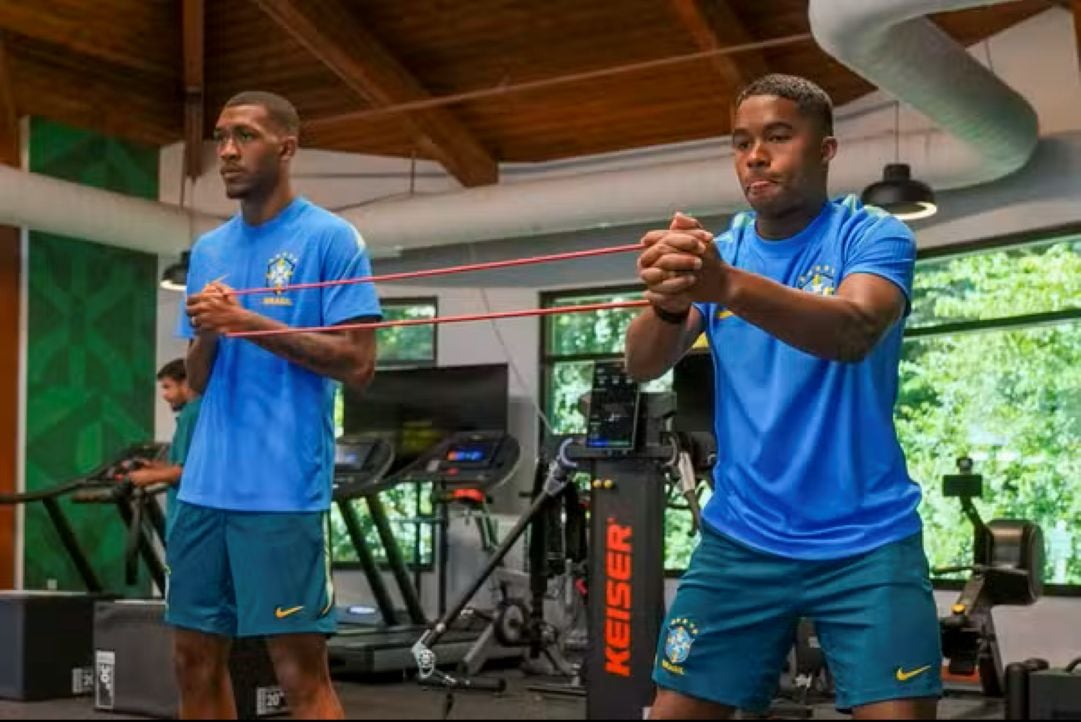
Two strikers just 13 days apart in birth share a remarkable series of coincidences in their careers, from their rapid rise through youth football to their early arrival in Europe. On June 26, 2022, both were 15 years old and played in the final of the Copa do Brasil under-17. Exactly four years later, the duo reached a new level, being called up for the World Cup with the national team.
In that final, Palmeiras, with Endrick, beat Vasco, from Rayan. The São Paulo team won the first game 4-1 and, despite losing the second leg 4-2, secured the national title with goals from both young stars when they were still very young.
There are solid reasons for the impressive progression of these two athletes, who have set new milestones for Brazil at the World Cup. They are among the youngest players to join the national team since Ronaldo in 1994, joining the list of youngest Brazilians to participate in a World Cup.
In a light-hearted comment earlier this year, Carlo Ancelotti joked about the future of the national team, expressing optimism by mentioning the signing of a four-year contract.
Even though they did not participate in the full preparation cycle of the national team under the coach’s command, Rayan and Endrick earned their place due to their recent performance for their respective clubs, Bournemouth, in England, and Lyon, in France, where Endrick was on loan from Real Madrid.
Rayan shows his blossoming and consolidates his place in the national team
Chosen to fill Raphinha’s position in the starting lineup against Scotland, especially for his ability to expand the attacking field, Rayan emerged as a surprise in the squad during the FIFA Date in March. At the time, Ancelotti took advantage of the friendlies as a last chance to observe players he had not yet tested.
During that period, the coach commented about Rayan: “He is a powerful athlete, with technique and an excellent attitude on the field. He adapted very well in a highly difficult league, the Premier League. From what he is showing, he deserves to be here.”
The striker registered five goals and two assists in 15 matches, helping his club rise from 13th to 6th in the league, securing an unprecedented place in the Europa League.
The main mentor behind the development of these characteristics, including before his transfer to Europe, is Fernando Diniz. It was the coach, even during his time at Vasco, who instructed him to score from the wing, recover, play wide on the wings and also close to finish, encouraging him to take risks.
In October last year, Diniz categorically stated: “I consider him, perhaps, the most complete striker in Brazilian football.”
He added: “He can play on both sides, as a number 10, as a number 9, with the same ease. He’s strong, left-footed, fast, young, doesn’t need a lot of distance to shoot and can finish from any position. For me, he’s a player that the Seleção should watch very carefully.”
It is no surprise that Rayan makes a point of constantly thanking Fernando Diniz for his fundamental role in his rise to the national team.
Last Friday, Rayan, smiling, declared: “Diniz will always be a father to me. My defensive side, he was a person who helped me a lot in this aspect. If he lets me, he calls me almost every day. I will keep him in my heart, he always helped me.”
His career at Vasco, since he was six years old, has always seen him as a star: with 280 goals at 11, moving up to the under-20s at 15 and making his professional debut in the same year he won the South American Under-17s. This path was marked by overcoming the inconsistencies that accompanied him in the main team amidst the instability of technical command.
Roberto Dinamite, Vasco legend, expressed a special wish for the young talent: “I want to be alive to see you score many goals at Vasco.”
Endrick’s challenges and accelerated development
This same trajectory of missed steps marked Endrick’s career. He arrived at Palmeiras at the age of 11, after João Paulo Sampaio, youth coordinator, learned that São Paulo would not be able to offer a job to the boy’s father, Douglas, which would make his stay at the club unfeasible. Douglas, who started as a cleaner at Palmeiras, now works as a player agent.
Since then, Endrick has been shaped to be an “extra-class player”, according to the manager. From an early age, he had a multidisciplinary team at his disposal and remarkable genetics: while most boys reach their growth peak at 14, Endrick, at 12, was already demonstrating much more advanced levels of strength and speed.
The athlete himself acknowledged, two years ago: “Everything in my life seems to happen much faster than planned.”
At 14, he was in the Under-17s; at 15, in the Under-20s; and at 16, as a professional. In just six months, he debuted under the command of Abel Ferreira, was a decisive player in Palmeiras winning the Brazilian Championship and, soon after, was sold to Real Madrid.
However, this meteoric rise, although it took him to the highest level in world football, also meant that the striker arrived with characteristics that still needed to be improved. He had little space at Real Madrid, and going to Lyon, France, on loan, following strategic advice from Carlo Ancelotti, was a tactic to boost his evolution.
Endrick revealed Ancelotti’s advice upon arriving at Lyon: “His advice was: ‘Go out, play, develop your football in a place where you can perform and be happy’.”
The decision proved to be the right one, even though he was still behind other competitors in the position. There were eight goals, 21 games and seven assists until his call-up to the national team (and the notification that he would return to Real Madrid after the World Cup). He demonstrated, after all, what has always enchanted him from the base: the ability to create unexpected moves, the perception of the best foot to finish and the combination of explosiveness in the sprints with coolness in front of the goal.
These qualities guaranteed his call-up to the World Cup, also turning him into a fan favorite and even generating memes due to his limited use under Ancelotti. This scenario is explained by the committee’s perception that he needs to improve his participation in different phases of the game, and not just close to the area, in parallel with a recent change in positioning.
Ancelotti explained in March: “I knew him as a center forward, now he plays more on the wing. He’s doing his offensive work well, but that demands a greater defensive effort.”
Both athletes are in full development, now at 19 years old, experiencing the first in what promises to be a long series of participations in World Cups throughout their careers. And every June 26th, like last Friday, they will be able to revisit their origins before all the future they still have to conquer.