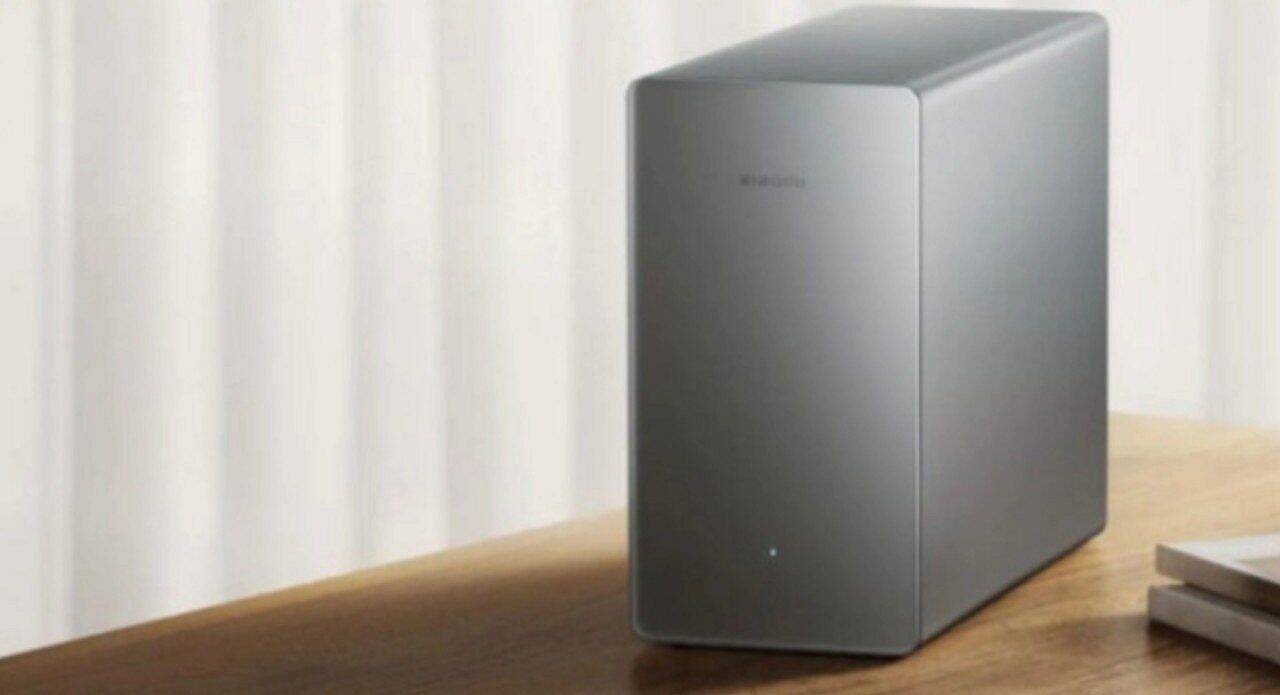
Chinese manufacturer Xiaomi has confirmed the launch of its first network-attached storage (NAS) device called Xiaomi Smart Storage. This equipment appears on the Chinese market to meet a long-standing demand for the company’s product range, targeting the consumer electronics and home automation sectors.
One of the main attractions of this product is the proposal to offer a file server for home use that is both accessible and intuitive, ideal for users with no experience in complex configurations. Its robust integration with the HyperOS ecosystem establishes it as a competitive local storage solution against subscription-based cloud services, democratizing access to a technology that has historically been seen as complex and exclusive to enthusiasts, dominated by manufacturers with interfaces less friendly to the average consumer.
The exterior design of the device follows the minimalist and discreet aesthetic, a trademark of the company’s Mijia series. Its compact dimensions were designed to take up minimal space in different environments, such as office tables or shelves in the living room. Internally, the system adopts a dual-bay arrangement, enabling the separate or joint management of two storage units.
Although previous information suggested compatibility with hard drives (HDDs) and solid state drives (SSDs) in 3.5-inch and 2.5-inch SATA formats, the first versions of the product made available by Xiaomi only employ flash storage technology in factory settings.
The software that operates Xiaomi Smart Storage is designed to simplify the operation of NAS servers, which are often seen as complex. The core functionality of this system lies in the ability to automatically transfer photos and other media files from mobile devices, ensuring continuous backups in the background with minimal user interaction.
In terms of compatibility, the device ecosystem ensures native and comprehensive integration with Android and iOS devices. Additionally, it offers support for computer operating systems, ensuring a robust connection with machines using Windows, macOS and various Linux distributions. Xiaomi’s goal is to consolidate data management from smartphones, tablets, notebooks and security cameras into a unified local network infrastructure.
Although the full list of technical specifications, including the precise processor model and internal bus standards, has not been fully released, certification data and industry leaks suggest that the device will come with a connectivity package suitable for its home use segment.
Although Smart Storage is the company’s first initiative focused purely on network storage with expandable compartments, Xiaomi had already explored this niche previously. In past years, the company has invested in hybrid alternatives, such as the Mi Router HD series, which incorporated hard drives of up to 2 TB directly into its Wi-Fi routers.
Specifications of the new Xiaomi Smart Storage
For a detailed overview of the new device’s features and capabilities, see the Xiaomi Smart Storage specifications:
- Appliance type: Home server with network attached storage (NAS)
- Hardware configuration: Dual-bay chassis
- Visual appearance: Compact cabinet and minimalist design
- Capacity Options:
- – Starter version: 4 TB (two 2 TB disks)
– Advanced version: 8 TB (two 4 TB disks)
– Professional version: 16 TB (two 8 TB disks) - Internal technology: Solid state drives (SSDs)
- Drive support: Compatible with HDDs and SSDs
- Software and features:
- – Full integration with HyperOS
– Simplified management interface for residential use
– Automatic media file backup and transfer function in the background - Supported ecosystem: Android, iOS, Windows, macOS and Linux
- Main application: Backup of smartphones and tablets, centralization of notebook data and local storage for security cameras.
Prices and launch schedule in China
Xiaomi’s strategy to launch Smart Storage involves a crowdfunding campaign in Chinese territory, scheduled for the period from July 1 to 8, 2026. The device will actually be produced if the fundraising objectives are achieved, with the promise of offering special prices for the first participants.
The server will be available in three different models, each with factory-configured storage capacity:
- The entry-level model, with 4 TB (two 2 TB drives), will cost ¥2,299 (about R$1,750) during the crowdfunding campaign. Afterwards, the retail value will rise to ¥3,499 (approximately R$2,665).
- The intermediate version, with 8 TB (two 4 TB disks), will be offered for ¥ 2,899 (equivalent to R$ 2,205) in crowdfunding, and its price in traditional commerce will be ¥ 4,499 (around R$ 3,425).
- The professional edition, with 16 TB (two 8 TB disks), will have a starting value of ¥ 4,699 (around R$ 3,575) in the support phase, with the final retail price expected to be ¥ 6,999 (approximately R$ 5,330).
For now, the company has not released information about the possible arrival of Xiaomi Smart Storage in other international markets or the availability of a global version of the product outside of China.