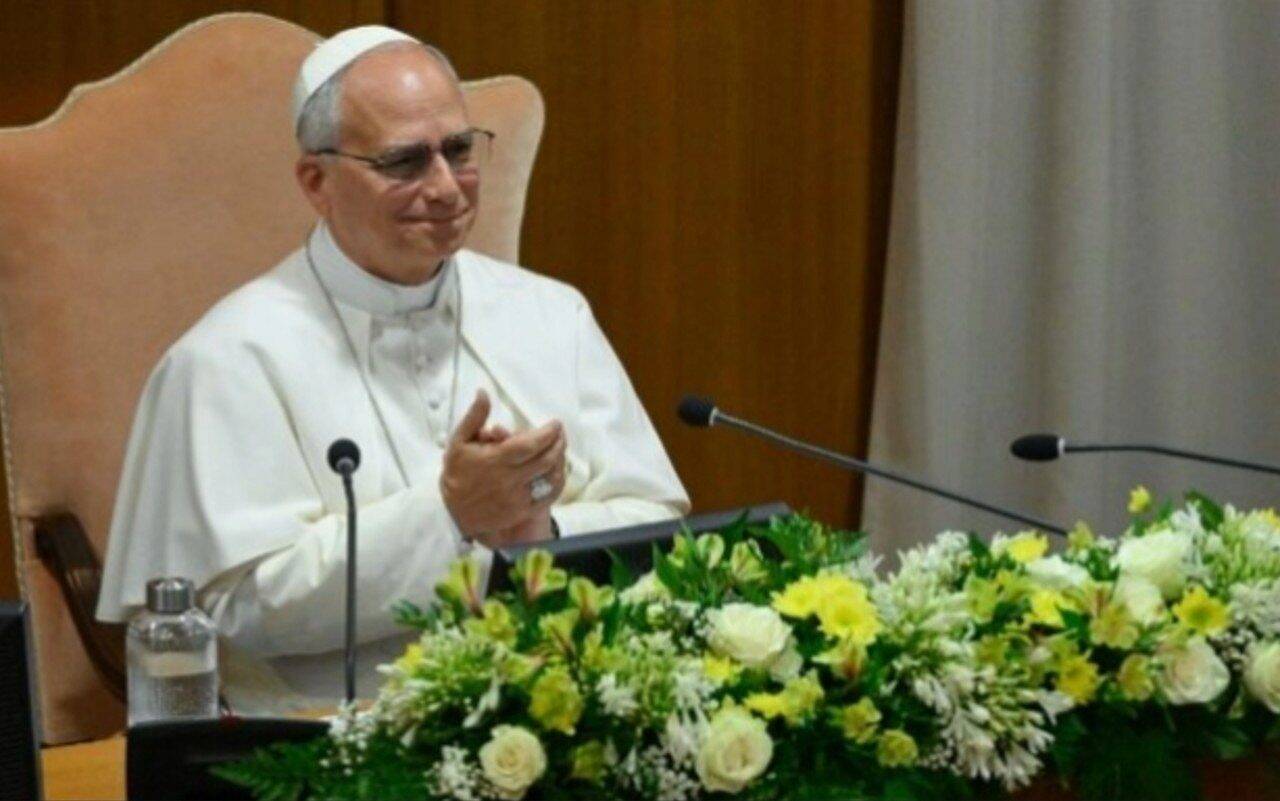
The Holy See imposed sanctions that exceed the minimum expected against an ultra-traditionalist society, after the consecration of four bishops that took place without papal approval.
Through a decree issued on Thursday, the Vatican’s doctrine department announced the schism of the Society of Saint Pius X and ordered the excommunication of its bishops and priests.
The Society of Saint Pius
In a ritual-filled five-hour ceremony held on Wednesday, July 1, 2026, in Econe, Switzerland, and attended by some 15,500 people and their children, the SSPX consecrated four new bishops. These consecrations represented a direct challenge to Pope Leo XIV, who had asked the SSPX to postpone the act in the name of Church unity.
Origin of the Society of Saint Pius X amidst disagreements
The formation of the society occurred in a context of opposition to the modernization reforms proposed by the Second Vatican Council. Among the changes implemented in Church meetings in the 1960s, the revolution in the Catholic Church’s relations with other Christian denominations, Jews and believers of other faiths stands out, as well as the permission to celebrate Mass in vernacular languages, replacing Latin.
In 1975, the founder of the SSPX, Archbishop Marcel Lefebvre, was suspended, and the society was officially repressed by the Vatican.
In 1988, Lefebvre carried out the consecration of four bishops without the Pope’s consent. The Vatican promptly excommunicated Lefebvre and the other four bishops, and the group currently remains without legal recognition within the Church.
Even after the initial schismatic act, the group continued to expand and, today, represents a challenge to the Holy See, functioning as a parallel, ultra-Catholic church that preceded the Second Vatican Council. The SSPX currently has six bishops, 751 priests, 264 seminarians in training in five seminaries, 145 religious brothers, 88 oblates and 250 religious sisters, covering 50 nationalities, according to data from the society itself. This continued growth and its organized structure show the complexity of the issue for the Vatican, indicating that the current excommunication is not just a punitive measure, but an attempt to contain an influence that it considers separatist and that fundamentally diverges from the principles of the modern church.
Automatic consequences of excommunication for schismatic act
According to the Church’s internal canon law, the consecration of a bishop without papal consent carries automatic excommunication, both for those administering the consecration and for the bishops receiving it.
The Vatican is not obliged to officially declare excommunications or issue a decree, as they occur automatically. However, on Thursday, the Holy See formalized the excommunications of the bishops and also classified the priests as schismatics, making them equally excommunicated.
The Vatican also warned the society’s faithful that they would be subject to the most severe sanctions from the Catholic Church if they “formally joined” the group.
Excommunication represents the strictest punishment under canon law. Its nature is seen as “medicinal”, aiming to instruct those who incur it about the seriousness of their actions and the need for repentance. As explained by Reverend Robert Gahl, from the Catholic University of America, the measure seeks to promote deep reflection and a change in conduct, highlighting the seriousness of the break with ecclesiastical communion and the impact on global Catholic communities.
“This ‘medicine’ may have a bitter taste, meaning it has a harsh aspect as it is a penalty, but its aim is to bring about a transformation in those who receive it,” he said.
However, excommunication does not nullify the validity of the consecration itself: the bishops of the SSPX, like their priests, are ordained validly, but illicitly.
Concessions made by Pope Francis to the SSPX in the context of restrictions
Despite general distrust of traditionalists and a policy of broader restriction on the old Latin Mass, Pope Francis made efforts to offer concessions to the SSPX.
In 2015, the pontiff decreed that Catholics could validly confess to SSPX priests, which in practice recognized the legitimacy of absolutions granted by these religious.
Francis had initially granted this permission as a one-year gesture during the Jubilee of Mercy, but later extended it indefinitely. He also established a provision to allow SSPX priests to solemnize marriages legitimately.
On Thursday, the Vatican reversed those concessions, declaring the invalidity of the sacraments of confession and marriage administered by SSPX priests.
Attempts at reconciliation between Pope Benedict XVI and society
Acting first as cardinal and then as pontiff, Pope Benedict XVI strove to heal the SSPX schism and bring the group back under the purview of Rome.
As part of his rapprochement efforts, he made two important concessions. In 2007, it eased restrictions on the celebration of the traditional Latin Mass throughout the Catholic Church. In 2009, he revoked the excommunications of the four bishops of the SSPX.
However, this gesture ended up causing great embarrassment for the pontiff and provoked a crisis with Jewish leaders, given that one of the four bishops, Richard Williamson, was known for denying the Holocaust.
Shortly before the release of the papal decree, in an interview broadcast on Swiss television, Williamson declared that he did not believe that Jews were killed in gas chambers during World War II.
Benedict XVI later acknowledged that a simple internet search would have revealed Williamson’s views.
Williamson later came into conflict with the SSPX itself, which expelled him in 2012 for insubordination. He had ignored a deadline to “declare his submission” to the society’s authority and had asked the group’s superior to resign, as informed by the entity at the time.
Williamson, ordained a priest by Lefebvre in 1976 and who served as a professor at the society’s seminaries in Europe, the United States and Argentina, died in 2025.