Artificial intelligence transforms modern cars and improves driving experience
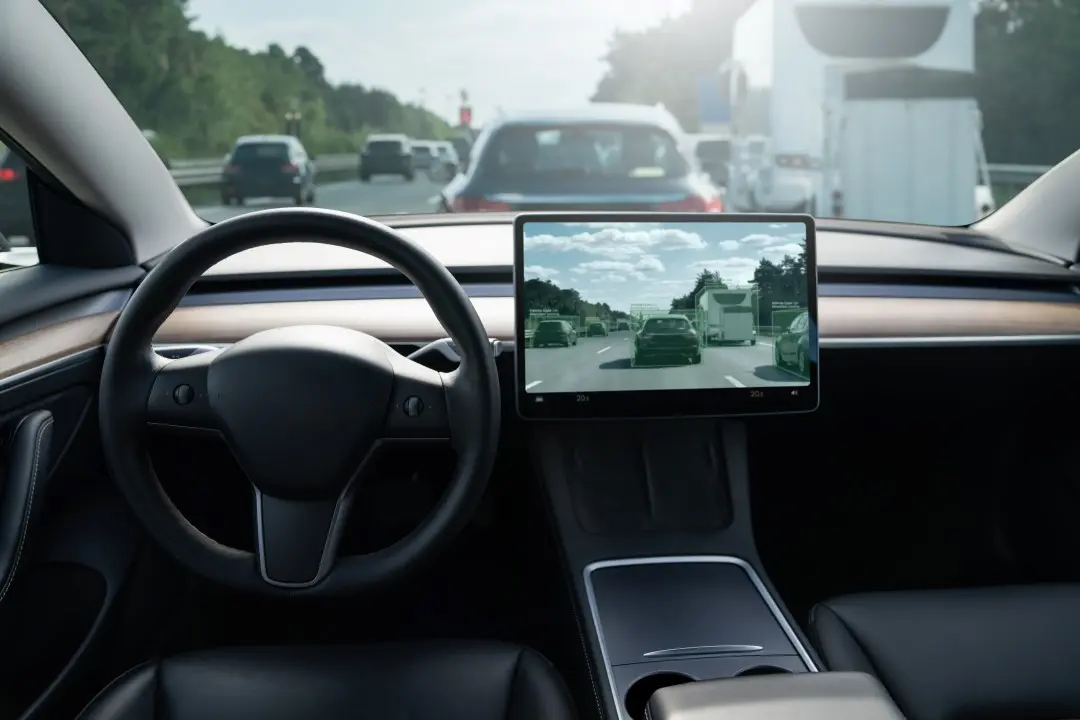
Artificial intelligence is transforming the driving experience, swapping traditional voice commands for more natural, conversational interactions. Equipados com plataformas de IA avançadas, esses assistentes aprimoram a navegação, a conectividade e o controle do veículo, redefinindo o futuro dos carros conectados e impulsionados por software.
For a long time, in-vehicle voice assistants were more a source of frustration than convenience. Drivers became accustomed to memorizing specific commands, repeating them when they were not understood, and eventually giving up, resorting to the touch screen. This phase is coming to an end, with practically all major automakers entering into partnerships with AI laboratories to adopt systems based on large language models (LLMs), which allow for more fluid conversations and interaction that truly improves the user’s daily life.
According to data from The Business Research Company, the automotive voice assistant industry is expected to reach a value of US$3.27 billion in 2026, with a projection of reaching US$5.49 billion in 2029, growing at an annual rate of 13.9%. This accelerated growth is directly linked to the new functionalities offered by on-board assistants and the intense competition between automakers to choose their AI partners for the coming years.
The transformation represents considerable commercial value, in addition to technological advancement. A compelling AI experience is quickly becoming a crucial differentiator, influencing purchasing decisions, subscription plans and brand loyalty, similar to what the mobile ecosystem did to consumer behavior about a decade ago. For car manufacturers, the car is no longer just a means of transport and has become another digital gadget vying for the driver’s attention, making the choice of assistant a decisive factor for the next generation of buyers.
On the same topic: IOS 26.4 integrates ChatGPT and Perplexity with CarPlay with voice control
From rigid commands to natural conversation
The technical leap behind this change is the replacement of old rule-based speech systems with large language models. Previously, a command like ‘find Italian food’ could generate a random, unfiltered list without understanding the real intent. Current systems interpret nuances, prioritizing distance, reviews or price, even if the driver does not explicitly request it. This evolution also allows for multi-step conversational requests, where one question builds on the previous one. A driver might say ‘take me to the nearest coffee shop and text my mom that I’m going to be late’, and then, ‘actually, let it be one with outdoor tables’, without restarting the interaction or repeating the already established context.
Behind the scenes, this natural language capability depends on the collaboration of several technologies. Automatic Speech Recognition (ASR) converts spoken words into text, Natural Language Processing (NLU) interprets the meaning and intent behind that text, and the assistant then accesses real-time data sources like maps, weather information, charging station APIs, or data from the car’s own sensors before generating a clear response.
For electric vehicle owners, these innovations translate into significant practical improvements: a driver running low on battery power can simply ask if there’s a working fast charger nearby, and the assistant can check real-time availability, price and opening hours before suggesting a route, all in a single conversation, without the need to search across multiple apps.
Follow: all about Artificial intelligence
Top partnerships between automakers and AI that reshape the dashboard
In the last year, the automobile industry has been the scene of several disputes related to AI, instead of consolidating a single standard. General Motors announced the integration of Google’s Gemini into its Buick, Chevrolet, Cadillac and GMC vehicles that use the ‘Google built-in’ infotainment system. In the United States alone, there are almost four million of these cars, which represents the largest use of conversational AI in the industry.
Mercedes-Benz pioneered AI integration, incorporating ChatGPT into its MBUX Voice Assistant using the Microsoft Azure OpenAI Service. This system allows answers to general knowledge questions powered by Bing Search, delivered in natural language. BMW, in turn, adopted Amazon’s Alexa+ service in its Intelligent Personal Assistant, presented in the new iX3 during CES 2026, with availability expected in 40 models by 2027. Tesla chose to integrate xAI’s Grok in its vehicles, while Stellantis entered into a partnership with the French company Mistral for its next generation, and Lucid collaborated with SoundHound.
The diversity of automakers’ approaches to the same challenge is remarkable. GM uses its decades-old OnStar connectivity network to justify expanding Gemini to millions of vehicles simultaneously, seeing it as a bridge to fully proprietary, vehicle-specific AI trained with GM’s own engineering data. BMW’s proposal focuses on the continuity of the driver’s digital life; a conversation started with Alexa+ at home can continue directly in the car without loss of context.
Mercedes, on the other hand, has prioritized depth of knowledge, positioning MBUX as capable of answering truly open-ended questions, not just vehicle-related commands, thanks to its integration with ChatGPT and Bing Search. Neither of these strategies has become a clear industry standard so far, and it’s likely that automakers will continue to experiment with different AI partners rather than locking in on a single architecture in the near term.
What these assistants can do in practice behind the wheel
In addition to answering curiosities, these systems are increasingly designed to handle useful, context-sensitive tasks. BMW’s Alexa+ integration, for example, can respond to a single phrase like ‘I’m cold and would like pizza on the way home’, adjusting the cabin temperature while simultaneously showing top-rated Italian restaurants along the route. It can also transport context between devices; a conversation about a ski trip started on an Alexa+ device at home can continue seamlessly when the driver gets in the car, just by saying ‘take me to the place we just talked about’.
See Also


More on this story: Experts project announcement of the iPhone 18 Pro line for August 2026
Mercedes has focused on architecture over novelty, recently partnering with Liquid AI to run parts of its voice assistant directly on the device rather than relying entirely on the cloud. This represents a significant improvement for situations like asking for directions moments before an intersection, where a round-trip delay in the cloud could result in a missed turn.
GM’s vision extends this even further, describing a future where drivers will be able to ask highly specific questions about their vehicles, even individual parts and systems, and receive a precise and accurate answer, rather than a generic answer from a general-purpose model. This level of specificity requires an assistant tuned to the vehicle’s proprietary data, not one built purely on public information. That’s why GM described its current Gemini deployment as an interim step before a more specialized OnStar-based system slated for later launch.
In addition to convenience features, some automakers are also using these assistants as an additional layer on top of driver assistance functions, enabling voice prompts to adjust driving modes, initiate diagnostic checks or display maintenance alerts, without the driver having to navigate a menu system while the vehicle is in motion.
Comparison of the main AI assistants in vehicles
- General Motors:AI Partner: Google Gemini. Assistant name: Google Built-in / Gemini. Key Capability: Natural multi-step conversations, OnStar integration.
- Mercedes-Benz:AI Partner: OpenAI (ChatGPT) + Liquid AI. Assistant name: MBUX Voice Assistant. Key capability: general knowledge answers, low-latency processing on the device.
- BMW:AI Partner: Amazon Alexa+. Assistant name: BMW Intelligent Personal Assistant. Key capability: cross-device context, smart home integration.
- Tesla:AI Partner: xAI. Assistant name: Grok (In-Vehicle). Key Capability: Conversational AI integrated into the Tesla ecosystem.
- Stellantis:AI Partner: Mistral AI. Assistant name: In development. Key Capability: Next-generation conversational infotainment.
- Lucid:AI Partner: SoundHound. Assistant name: Lucid AI Assistant. Key capability: Real-time conversational voice commands.
Real challenges behind conversational updating
Despite the demonstrated improvement, the underlying technology has real limitations that automakers are still overcoming. Large language models are susceptible to occasional ‘hallucinations’, producing confident but incorrect responses, which becomes a serious concern when the information involves navigation or security rather than mere trivia.
Most current systems also rely heavily on cloud connectivity, which introduces latency and creates potential blind spots in areas with weak signal. That’s why companies like Mercedes are testing on-device processing for time-sensitive requests. Data privacy is another growing concern, prompting automakers like GM to publicly commit to explicit consent and a policy against selling driver data, following previous criticism over data practices in connected vehicles.
Reception from drivers has also been mixed, and automakers are still evaluating how much conversational depth people really want behind the wheel, and what simply adds friction. Some drivers have expressed reluctance to allow AI systems to process everyday conversations inside their vehicles, while others have raised concerns about the design of activation keywords and the possibility of an assistant being unintentionally activated during a normal in-cabin conversation.
Full coverage: Latest News (EN)
Automakers responded by emphasizing that microphone activity is tied to explicit wake words or a physical button on the steering wheel, and that the features remain optional rather than mandatory: essential functions like navigation and climate control continue to operate without the need to link any third-party AI accounts.
Where AI in Vehicles Goes From Here
The current wave of chatbot-style assistants is largely seen as an initial step rather than the end state. GM has stated that its Gemini launch is an interim step ahead of an OnStar-trained, proprietary assistant designed to have detailed knowledge about a vehicle’s specific parts and systems. Automakers are also increasingly connecting these conversational layers to advanced driver assistance systems, using natural language interaction as the interface for features such as automated routing, predictive maintenance alerts and deeper integration with autonomous driving systems.
As the competition between Google, OpenAI, Amazon, xAI and Mistral plays out on car dashboards, not just smartphones, the modern automobile is increasingly being positioned not just as a means of transportation, but as yet another connected device in the driver’s daily digital ecosystem. This trajectory also aligns with the broader trend toward software-defined vehicles, where a car’s capabilities are expected to continually improve through over-the-air updates rather than requiring new hardware. BMW has explicitly linked the launch of Alexa+ to this strategy, while GM’s cloud-based Gemini architecture allows Google and GM to add features post-launch without a full vehicle software update.
For consumers, this likely means that the AI assistant seen today in a car showroom demonstration will be significantly different a year after purchase, a shift from how infotainment systems traditionally worked, where capability was largely fixed at the time of sale. Whether this will result in a genuinely safer and more useful driving companion, or simply a more sophisticated version of the same distracting concerns that have accompanied touchscreen infotainment for more than a decade, will likely become clearer as adoption expands beyond initial pilot vehicles over the next two to three years from the date of the event on Wednesday, July 8, 2026.