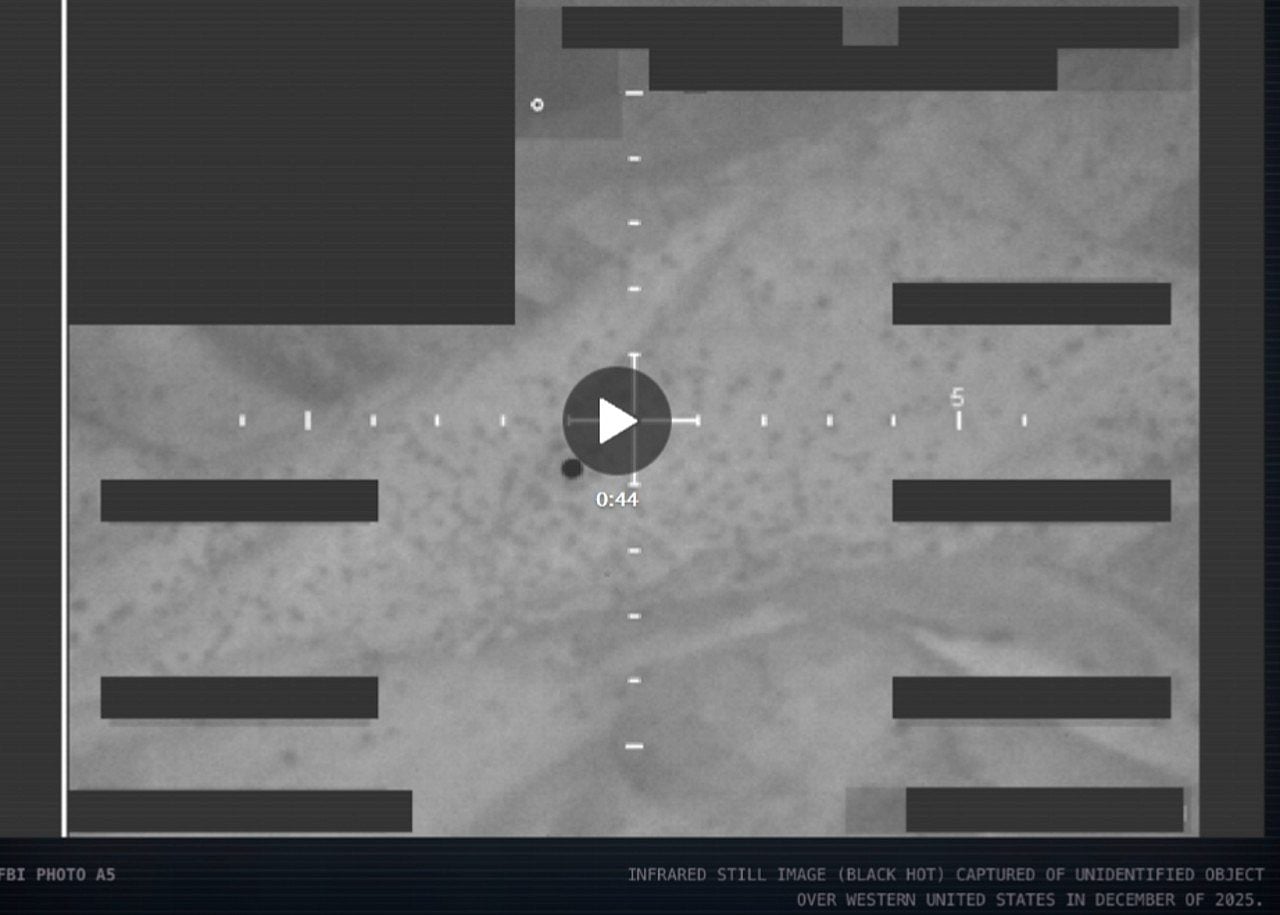
The United States government took another decisive step in its recent policy of opening up data by making available an unprecedented set of documents related to unidentified flying objects. The release, coordinated by the Pentagon, took place last Friday and brings to light materials that until then had been kept under strict military secrecy in the drawers of American intelligence. This move reflects a drastic change in Washington’s stance, which for decades, since the closure of Project Blue Book in the 1960s, treated the issue with extreme secrecy and public skepticism. Now, the federal administration seeks to demonstrate proactivity in the face of incisive demands from legislators and civil society for concrete answers about what actually flies over the country’s airspace.
What do the new visual records released by the American government reveal
Despite the immense expectations generated around the declassification of these historical archives, the material delivered to the public is mostly composed of media of low technical quality. The still images and video recordings present blurred contours, excessive graininess and little definition, which frustrates the hopes of those waiting for irrefutable proof about the origin of these mysterious objects. Aviation experts and intelligence analysts point out that visual degradation is common in captures made by infrared sensors from fighters operating at high speed, but recognize that this prevents any conclusive identification by civilians.
The North American Department of Defense made a point of highlighting in its statements that the absence of an immediate explanation for the sightings does not confirm, under any circumstances, the presence of extraterrestrial technology on Earth. The bright spots and diffuse silhouettes recorded by military cameras show artifacts performing maneuvers that apparently defy conventional aerodynamics, such as instantaneous accelerations and sudden stops with no visible control surfaces. However, the investigative teams’ absolute priority is to exhaust all earthly hypotheses, such as state-of-the-art foreign spy drones or rare meteorological anomalies, before even considering more complex theories.
Classification of materials and types of evidence made available
To organize the vast volume of information that is gradually being removed from the cloak of secrecy, military authorities have categorized incidents based on the type of sensor that captured the anomaly. This rigorous screening is essential so that the independent scientific community and university researchers can attempt to replicate or analyze the raw data in the future, applying the scientific method to a field previously dominated by guesswork. The recently published collection encompasses different types of tactical and technical documentation.
- Very short video recordings made by advanced targeting systems on Navy combat aircraft.
- Blurred photographs that show non-aerodynamic geometric shapes, such as spheres or cylinders, hovering in the air against the wind.
- Official transcripts of radio communications where fighter pilots describe, with perplexity, anomalous flight behavior.
- Preliminary intelligence reports that formally rule out the possibility that the targets were weather balloons or civilian commercial aircraft.
- Radar tracking data from warships showing targets moving at extreme speeds without emitting mandatory transponder signals.
This entire scope of evidence reinforces how complex and time-consuming the screening work carried out by government intelligence agencies is. Each visual or radar record requires dozens of hours of cross-analysis with data from weather satellites and Federal Aviation Administration (FAA) civil air traffic records to ensure that no conventional aircraft was on the same route at the time of the incident.
Pressure from Congress and the change in the official nomenclature of phenomena
The current wave of institutional transparency was not born from a spontaneous initiative by the Armed Forces, but rather from strong and unprecedented pressure exerted by the United States Congress in recent years. Lawmakers from both parties began demanding detailed reports and audits following a series of high-profile public hearings, where former intelligence officers and decorated pilots recounted troubling encounters in restricted airspace. To centralize these investigations and provide an institutional response, the Pentagon recently created the All-Domain Anomaly Resolution Office (AARO), which now serves as the primary body responsible for compiling, investigating, and releasing these reports to the public and senators.
Another crucial point in this new era of government investigations is the strategic change in the way the State refers to the topic in official documents. The classic term UFO (Unidentified Flying Object) has been officially replaced by the acronym UAP, which now stands for Unidentified Anomalous Phenomena. This semantic change has a clear scientific purpose: to remove the pop culture stigma associated with flying saucers and now cover inexplicable events that occur not only in the atmosphere, but also in outer space and the underwater environment. This more serious approach aims to attract the interest of renowned academics and ensure continued research funding.
Next steps in the ongoing document declassification policy
The commitment made publicly by the Department of Defense establishes that the release of files will not be an isolated event to calm the media, but rather a continuous, structured and progressive process. As old and recent classified reports undergo rigorous reviews to ensure that American espionage methods or sensor capabilities are not exposed to adversary nations, new waves of images and videos will enter the public domain. This controlled release strategy attempts to balance the growing popular demand for definitive answers with the non-negotiable need to keep national security intact.
In addition to publishing what is already accumulated in secret files, military authorities are implementing new flight safety protocols to make it easier for commercial and military pilots to report sightings immediately, without the old fear of professional reprisals or punitive psychiatric evaluations. The Pentagon’s expectation is that, with the standardization of real-time data collection and the use of state-of-the-art sensors specifically calibrated to detect anomalies, the next records will have a much higher visual quality. In this way, the global debate can finally evolve from the realm of conspiratorial speculation to the solid ground of scientific rigor and aerospace protection.