On Tuesday, July 12, 2026, a group of scientists in the United States released research that, although it may seem like science fiction, has its origins in a real, tragic event.
The huge forest fires that devastated Australia between 2019 and 2020, known as “Black Summer”, released so much smoke into the atmosphere that it was able to change the behavior of clouds over the Pacific Ocean.
The phenomenon, identified and named by another research team in 2023, would have played a crucial role in cooling Pacific waters, directly contributing to the establishment of a La Niña phase that lasted from 2020 to 2023.
It was this unexpected climatic event that served as the basis for new research conducted by North American scientists, recently published in the renowned scientific journal “Science Advances”.
The central question that the researchers sought to investigate was: if smoke from the fires managed to tilt the Pacific climate towards a colder state, would it be feasible to intentionally reproduce this effect?
The idea would be to use it for the purpose of mitigating the intensity of an El Niño before it could cause significant damage.
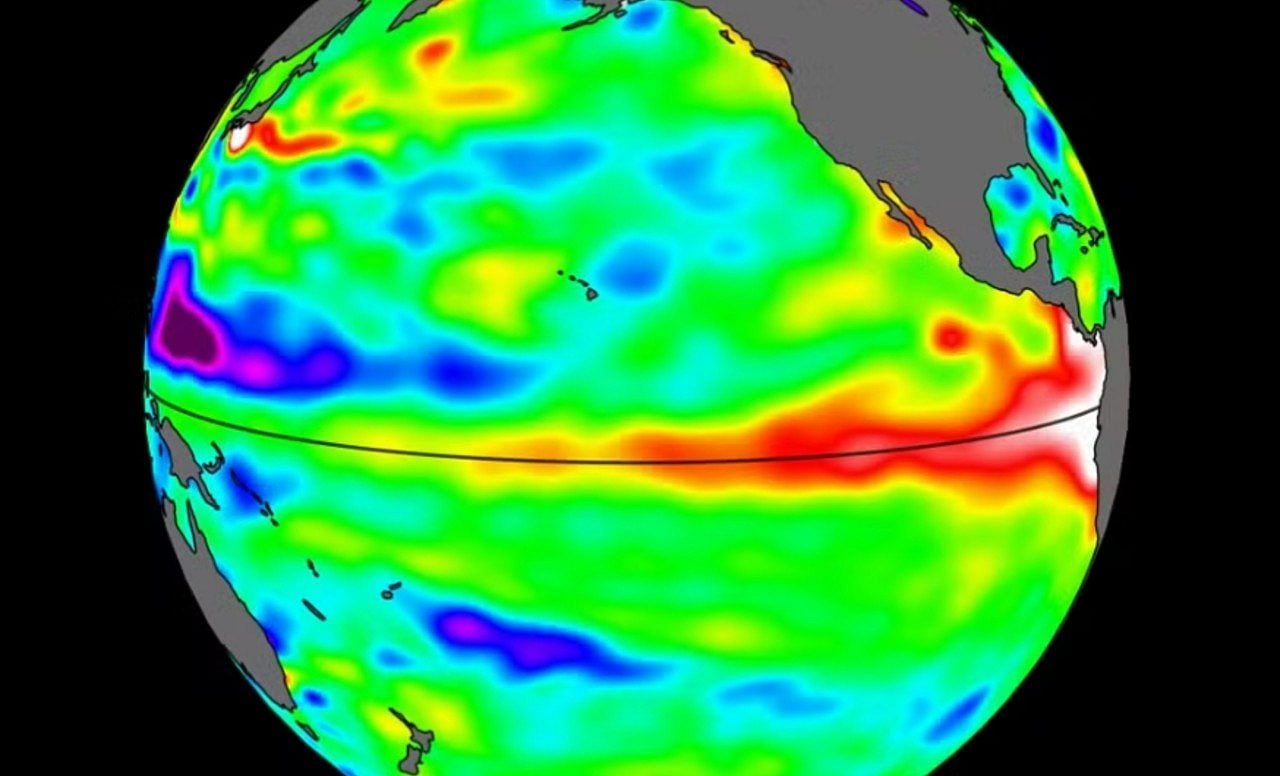
It is important to understand that El Niño and La Niña represent two distinct phases of the same climate phenomenon, called ENSO (El Niño-Southern Oscillation). El Niño is characterized by the warming of waters in the equatorial region of the Pacific Ocean by 0.5°C or more.
This phenomenon, which typically happens every two to seven years and lasts on average twelve months, causes a direct increase in global temperatures. On the other hand, La Niña is the opposite, marking a cooling of the same waters and generating equally notable impacts, but with opposite consequences.
The methodology explored in the computational models is known as marine cloud brightening (or MCB).
This proposal involves spraying tiny particles of sea salt into the atmosphere. The goal is to make lower clouds lighter and therefore more reflective, causing a greater portion of solar radiation to be reflected back into space rather than warming the ocean.
This approach is classified as solar geoengineering, a technological field that, until now, was predominantly debated as a long-term tool for controlling global warming, which has always generated great controversy.
Using a sophisticated climate model, the team simulated the impact that artificial cloud lightening would have if it were applied before two of the most severe El Niños in recent decades: those that occurred in 1997-1998 and in 2015-2016.
The authors indicated that the results were encouraging from a physical point of view. The intervention demonstrated the ability, in simulations, to reduce the strength of these climate events, as long as it was implemented early and for an adequate period.
“One of the biggest social concerns around geoengineering is the fact that if we use it to reduce long-term climate risks, we have to apply it continuously, indefinitely,” explained Jessica Wan, lead researcher on the study and postdoctoral fellow at the University of Chicago.
This is the difference that the authors highlight in relation to other geoengineering proposals: instead of trying to hold the planet’s thermometer year after year — a decades-long commitment, with all the political and technical risks that this implies — the idea would be to act only during the window of a few months in which an El Niño is forming.
Katharine Ricke, a professor at Scripps Oceanography and co-author of the study, often advocates a cautious approach to geoengineering.
But, according to her, this accidental experiment of nature gave the research an extra boost.
“It was the key breakthrough in making this a viable research question,” he said. “Without this opportunity for validation, I think our findings would not be as reliable.”
The simulations revealed that the earlier the cloud lightening started — at the beginning of El Niño’s development phase — and the longer its duration, the more effective the result was in containing the phenomenon. Interventions carried out late, only at the peak of the event, had minimal impact.
The researchers also identified a side effect that requires consideration: in the simulations that were most successful in mitigating El Niño, the subsequent La Niña phase tended to occur earlier and, in certain scenarios, with greater intensity. This finding serves as a stark reminder that any change in one component of the global climate system invariably triggers reactions in others.
Still, for Ricke, the proposal deserves to be seriously evaluated. “It’s a different way of thinking about geoengineering,” declared the researcher.
“We need to understand much more, but if there is a way to use this, in addition to other risk reduction tools, to mitigate El Niños, why not consider it?”
The experimental nature of laboratory research
It is crucial to reiterate that none of these findings have been tested in real-world conditions. The study authors themselves emphasize that the work is a “proof of concept”, and not a concrete action plan.
All analysis was carried out strictly within a single climate model. Furthermore, the researchers report that there is no knowledge of any initiative to apply this technique to El Niño, which is expected to be potentially strong for 2026, according to seasonal projections.
Independent experts, consulted by the Science Media Center in Spain and not involved in the research, corroborate the need for caution.
Carlos García-Soto, researcher at CSIC (Spanish Institute of Oceanography), highlighted that the team of authors itself was transparent about the limits of the work.
“The study is an interesting scientific contribution because it explores a physical possibility through climate simulation. However, it is important to interpret its results with caution (…) deliberately modifying a climate system as complex as El Niño requires a level of evidence much higher than that necessary to demonstrate that a hypothesis is physically plausible”, he assesses.
Similarly, meteorologist Ernesto Rodríguez Camino, president of the Spanish Meteorological Association, sees the research as a starting point for new investigations, even if a practical application is still far away.
“It is to be assumed that this work will give rise to many other works that explore ways of mitigating meteorological and climatic extremes, the origin of so many human and material losses”, he pointed out.
The experts’ caution is justified by the magnitude of what is at stake. According to the study authors themselves, highly intense El Niño events have already resulted in trillions of dollars in losses for the global economy. This amount helps explain why, despite the uncertainties, the idea of trying to “disarm” an El Niño before it occurs is seen by this team of scientists as an issue that deserves continued investigation.
Understand El Niño and its global impacts on climate
El Niño represents an abnormal warming of the waters of the Pacific Ocean, specifically in the region close to the Equator.
It is part of a natural climate cycle that alternates between hot (El Niño), cold (La Niña) and neutral phases, generating effects in different parts of the globe.
This warming causes changes in the circulation of the atmosphere, altering rainfall and temperature patterns in different locations on the planet.
In Brazil, the effects tend to be uneven: while the South region generally experiences greater volumes of rain, areas in the North and Northeast may face longer periods of drought.
The phenomenon also influences global temperatures. In years of more intense El Niño, the planet often registers heat above the historical average, adding to the global warming already underway.
The intensity of El Niño varies from one event to another, and with it, its impacts. On a planet that is already hotter, even episodes of moderate intensity can manifest more severe effects than those observed in the past.