
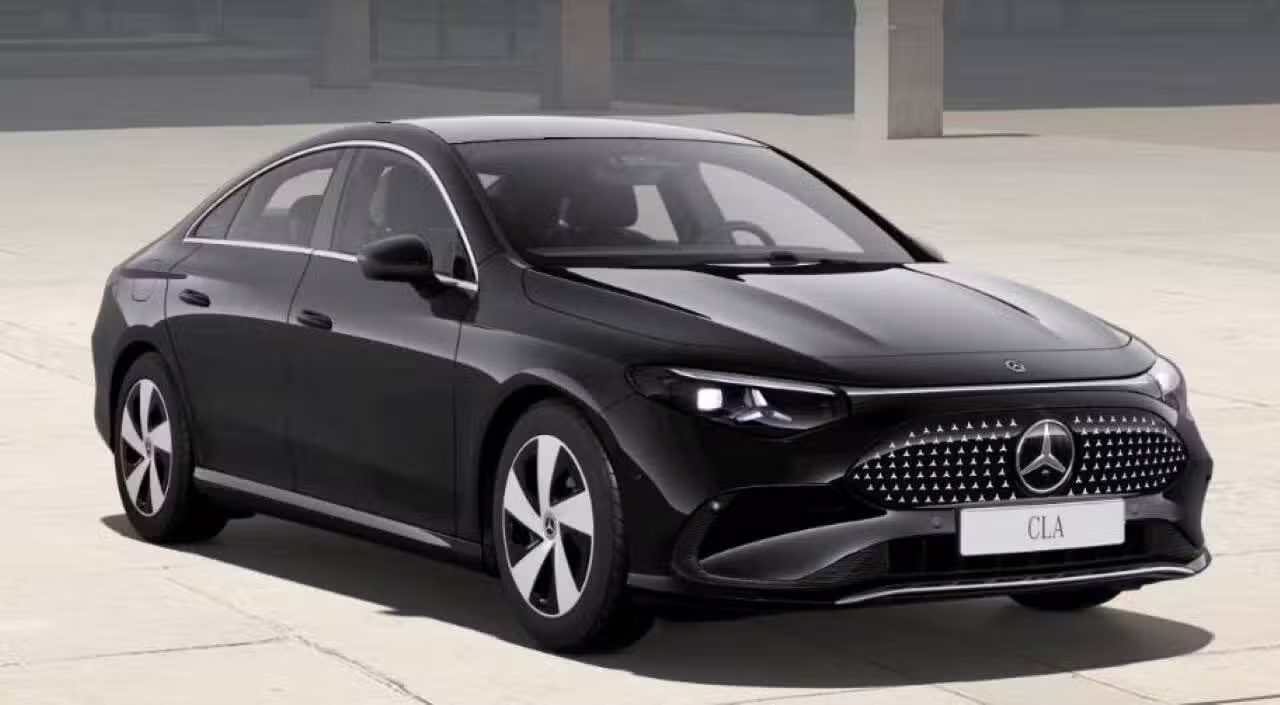
An electric Mercedes CLA 350 sedan recently accelerated along the I-75 highway, silently overtaking vehicles at great speed, demonstrating the power of the German brand’s new electrified cars.
Even though the Tesla Model 3 sedan was a phenomenon nearly a decade ago, paving the way for the era of high-performance electric vehicles, it now ranks second in sales to the Model Y, its SUV counterpart. The Model Y, launched in 2019, currently sells three times more than the sedan in the United States, a country that prefers utility vehicles.
In response to this trend, several automakers have launched electric rivals for the Model Y, from the rugged Rivian R2 to the sleek Hyundai Ioniq 5 and the flashy Mustang Mach-E.
The CLA EV, which shares the CLA-Class platform with gasoline and hybrid versions, is one of the few sedans that dares to compete directly with the Tesla Model 3 in this scenario.
This new Mercedes-Benz model seeks to win over consumers with its characteristic luxury, comfort, linear acceleration, style and practicality, although there are some reservations regarding the design and usability of the trunk.
When approaching a CLA 350 with all-wheel drive, which costs around US$67,000 (the rear-wheel drive CLA 250 version starts at US$48,500), the vehicle could be confused with a Hyundai Ioniq 6 – another Model 3 competitor that had its production reduced this year, leaving only the future Ioniq 6 N, focused on track performance and estimated at US$70,000. Features include an aerodynamic shape, horizontal taillights, a small spoiler and recessed door handles.

The Mercedes identity is revealed mainly by the large star logo positioned on a black plastic front grille, beneath a continuous light line reminiscent of the Hyundai Sonata’s styling. The look is quite bold, deviating from the traditional Mercedes design. A point of attention is the NACS connector, which shares space with a 240 volt port for home charging. Despite being designed for compatibility with Tesla’s extensive Supercharger network, it only works with 800-volt Tesla chargers. In Midwestern states where 400-volt Superchargers predominate, owners will need a special adapter, as with other brands’ CCS fast chargers, which can be an inconvenience.
However, upon entering the vehicle, the experience is undeniably Mercedes.
The superior quality of materials is evident, with door panels that feature an elegant combination of stitched leather, Alcantara inserts and leather-wrapped armrests, providing a refined ambience.
A gigantic, curved 38-inch screen stretches across the dashboard, housing three stunning screens, one of which is for the passenger. This structure is so wide that it surrounds the Mercedes aviator-style air vents located in each A-pillar, offering sharp graphics, vibrant colors and Google Earth maps. The visual richness is a clear example of the brand’s typical exuberance.
Despite its traditional luxury, Mercedes appears to be fully integrated into the digital era of the 21st century, dominated by Tesla.
When activating the voice command, requesting navigation to a specific destination, Mercedes’ virtual assistant responded politely, asking for the phrase to be repeated.
By reporting the exact location, “Hell’s Creek Ranch, Pinckney, Michigan,” the Mercedes navigation system accurately plotted a one-hour route to Hell, an unincorporated region known for its excellent roads in Michigan.
Unlike Tesla, Mercedes offers the convenience of navigation both through Android Auto/Apple CarPlay, using Google Maps, and through its native system.
While smartphone apps like Apple Maps and ABRP have evolved significantly (and some Toyota EVs rely on them to find charging points), native navigation systems in electric vehicles still stand out for more efficiently integrating charging stops into the route, which becomes even more relevant now that Mercedes has access to Tesla’s Supercharger network.
After recharging the vehicle overnight at his Oakland County home, the journey to Hell required no additional charging stops. With a range of 354 miles, the CLA easily completed the 130-mile round trip, proving the accuracy of the range number.
Independent tests carried out by Edmunds even recorded a range of 385 miles in real-world conditions for the CLA 350, exceeding the Environmental Protection Agency (EPA) estimate.
Even when driven at speeds between 75-80 mph on highways and then being heavily taxed on a winding 16-mile route along the Patterson Lake-Hadley-Hankerd roads, the robust 85 kWh battery demonstrated excellent performance, losing just 15% of its charge to travel 130 miles, with a battery drain of 147 miles.
This performance aligns with Tesla, which also showed improvements in battery autonomy accuracy. For longer trips, Mercedes’ native system mapped out a 500-mile round-trip route to Charlevoix, Michigan, including two stops at Tesla Superchargers.
This type of more extensive trip planning represents a more appropriate use for the CLA 350 EV than just exploring the roads of Hell and returning.
It is important to note that the CLA 350 EV does not directly compare to an AMG CLA35. For the same price, the petrol AMG CLA35 offers exceptional athletic performance.
Both models, the electric and the combustion engine, accelerate from 0 to 60 mph in less than five seconds. However, in curves, the AMG CLA shows superior preparation for the challenge.
The electric model, on the other hand, does not behave in the same way.
This is due to the weight of the CLA 350, which comes in at 4,600 pounds, half a ton more than its gasoline version. In comparison, the Tesla Model 3 Performance, with a weight of 4,000 pounds and similar price, demonstrates greater stability. When descending Hadley Road, facing sharp curves in SPORT mode, the CLA EV proved uncomfortable when required to make sudden changes in direction, even with the help of generous energy regeneration.
The suggestion is that this is a luxury vehicle that is most appreciated on calm journeys on motorways and when entering them.
A notable feature of the CLA 350 is its two-speed transmission, unlike most electric vehicles, including the Model 3, which use a single speed. At 70 mph, you could feel the rear engine shift into second gear, which optimizes efficiency during cruising.
Once adaptive cruise control was activated, the Mercedes allowed hands-free driving for up to 30 seconds, allowing you to admire the exquisite interior.
When asking the vehicle, “Hey Mercedes, make the sunroof transparent”, the panoramic roof automatically transformed from opaque to transparent. A friend, Peter, praised the functionality on a morning commute. On-screen controls let you choose which ceiling panels remain transparent or opaque.
In the middle lane, when pulling the left lever, the Mercedes automatically switched to the left lane to overtake slower traffic. When pulling to the right, he returned to the previous lane alone.
The ergonomics of the steering wheel are surprisingly intuitive, with rocker buttons for adjusting speed and volume. Unlike older Mercedes models, there are no steering wheel sliders or haptic touchpads. Thanks to the column shifter, there is generous space under the console, ideal for accommodating, for example, Mrs. Payne’s handbag. Rear seat comfort, however, is a little less generous due to the sunroof, requiring taller people to bend their necks.
Mercedes has also taken the time to include a frunk (front trunk), similar to Tesla’s, which offers a convenient space to store valuable items such as laptop backpacks or purchases with smart dividers.
And with the ease of voice command, it is possible to ask the vehicle to navigate to Kroger’s, a supermarket chain.
Meanwhile, the driving experience in places like Hell can be left to its combustion brother, the Mercedes AMG.
Details of the Mercedes CLA-Class EV 2026
- Vehicle type:Five-passenger electric sedan with rear- or all-wheel drive and battery options
- Price:From $48,500, including $1,350 destination charge (the CLA 350 AWD as tested cost $67,330)
- Powertrain:85 kWh lithium-ion battery with single or dual electric motor
- Power:269 hp and 247 lb-ft of torque (CLA 250 EV); 349 hp and 380 lb-ft of torque (CLA 350 EV)
- Transmission:Two-speed automatic
- Performance:Acceleration from 0 to 60 mph in 4.7 seconds (Car and Driver estimate for CLA 350); maximum speed of 130mph
- Weight:4,600-4,800 pounds (estimated)
- Fuel Economy:Range between 354 and 367 miles
Featured Model Review
- High points:Luxurious interior and convenient access to Tesla chargers
- Low points:Discreet exterior design; adapter required for 400 kW Superchargers in the Midwest
- General:3 stars