The North American space agency has officially supported financial support for a revolutionary unmanned aerial vehicle project guided by light beams. Confirmed on August 4, 2026, the undertaking has the central objective of investigating the deepest and most unexplored cavities on Earth’s natural satellite. This audacious initiative should pave the way for an unprecedented level of geological understanding, bringing human technology to subterranean chasms that have never received any kind of surface probe.
Independent flight technology that replaces old exploration rovers
Designed under the leadership of researcher Elor, the proposal is based on the premise of navigation that is one hundred percent free from external commands. The small flying robot was specifically designed to dive into lunar holes where the darkness is total, rugged environments that would make classic wheeled vehicles completely obsolete. This new format challenges conventional aerospace industry standards, directing efforts to geological zones previously classified as inaccessible for current machinery.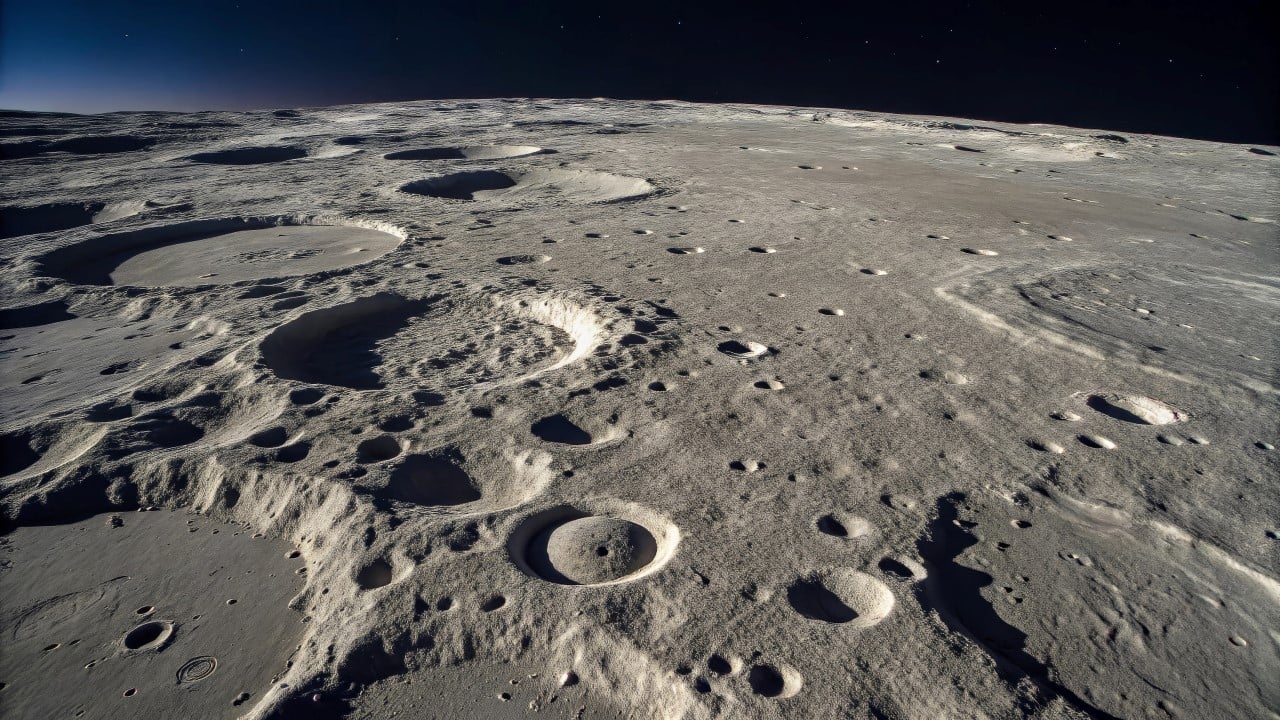
The triumph of this mission requires overcoming a scenario of extreme environmental hostility. Inside these rock formations, the absolute darkness, the lack of geolocation satellites and the absence of previous maps create a true nightmare for robotic navigation. It is to resolve this impasse that laser mapping technology becomes essential, ensuring that the drone can move without collisions while recording the topography of a completely unknown environment.
Operating without human intervention does not represent a mere whim of engineers, but an insurmountable physical requirement. The natural delay in the transmission of radio signals between control centers on Earth and the Moon’s orbit makes any attempt at instantaneous remote piloting unfeasible, forcing the system to calculate routes and make decisions in isolation. This computational independence establishes a new milestone in probe engineering, removing the human factor from direct control in highly complex operations.
The potential of lava tubes as safe shelters for astronauts
Beneath the crust of our cosmic neighbor lie vast networks of tunnels carved by rivers of magma active some three to four billion years ago. For scientists, these immense underground structures — which can reach hundreds of meters in diameter and contain gigantic installations — function as time capsules on the evolution of the solar system. In addition to their academic value, these caves are consolidated as priority targets for the construction of permanent habitats, functioning as geological shields against the lethality of the space vacuum.
Establishing a base on the exposed surface means subjecting the equipment and crew to a constant rain of radiation, micrometeorites and brutal thermal variations ranging from plus 120°C to minus 130°C. On the other hand, the interior of these ancient volcanic ducts maintains a stable thermal temperature of around 17°C, in addition to offering thick walls against threats from deep space. Assessing the structural safety of these formations is a mandatory step to ensure the long-term survival of Artemis program crews and future private sector initiatives.
Aerial equipment designed to operate in this absolute pitch black can slide through narrow passages and scan chambers that no land-based jeep would be able to access. The detailed study of these rocky walls will help to unravel the formation of the Moon and, mainly, to locate possible deposits of solid water. The discovery of usable ice in these abysses would transform space logistics, guaranteeing raw materials for the extraction of oxygen and the production of fuel in situ.
The technical challenges of operating a drone without sunlight and GPS
Transforming this concept into reality demands the resolution of severe architectural and energy matrix problems. As capturing solar energy is impossible underground, the device will need to be equipped with extreme capacity power cells or innovative compact generators. Scientist Elor highlighted the complexity of this scenario, detailing that the flight will require massive energy expenditure due to constant artificial lighting, while the lack of global coordinates will make movement in three dimensions an unprecedented challenge for the software.
Another central concern of the development team is to avoid any type of pollution in the researched environment. The researcher emphasizes that the machinery must be impeccably clean so as not to corrupt the data from the sensors that will examine a geological ecosystem preserved since the satellite’s formation. This rigorous requirement for purity, combined with the obligation to act without terrestrial support, drives experts to formulate new generation artificial intelligence, aimed exclusively at exploring extreme territories.
The great asset of the project led by Elor is the harmonious integration of multiple emerging technologies, surpassing rival proposals focused on underground exploration. She highlights that the fusion of these advanced instruments will multiply the robot’s coverage area and useful research time inside the caves. The long-term goal is for this same engineering base to be exported for future unmanned missions sent to the red planet.
The government incentive for the creation of radical exploitation machines
The financial contribution allocated to this conceptual drone is part of a strategic fund from the United States space agency, created specifically to leverage unconventional ideas. The federal agency seeks bold proposals that serve as a technological pillar for the uninterrupted human presence on the Moon and, in the coming decades, on Martian soil. This movement is part of massive planning focused on the expansion of humanity beyond Earth’s orbit.
Greg Stover, director responsible for NASA’s Advanced Research and Technology sector, emphasized that incremental improvements no longer meet current needs. In an official note, the executive highlighted that the ambitious objectives of a definitive return to the lunar environment and the subsequent trip to Mars require gigantic technological leaps. In the director’s view, injecting resources into extreme concepts such as the laser drone is the safest route to causing the disruptions that the aerospace industry urgently needs.
Sponsoring a vehicle focused on magma tubes accurately illustrates this mentality of hunting the unknown. Instead of just improving the suspension of a traditional rover, the current goal is to design an unprecedented category of independent robots. This shift in focus ensures that the scientific community is able to analyze sectors of the cosmos that, with today’s equipment, remain physically out of reach.
Adapting the project to map the subsoil of the red planet
The creators of the machinery are already planning for the results of this engineering to go beyond the borders of our natural satellite. The extensive cavities of Mars are also coveted destinations for astrobiologists, as they can hide chemical signatures protected from lethal surface radiation. This ability to adapt to different worlds justifies the high costs and multiplies the possibilities of using the small aerial explorer.
To ensure perfect functioning, the drone will need to accommodate a series of state-of-the-art components in a very small physical structure. The ability to combine all these tools without exceeding the weight limit is the factor that validates the mission, based on the following technical foundations:
- Autonomous navigation: Computer systems that identify physical barriers and calculate trajectories without human intervention.
- Topographic mapping: High-precision lasers that build 3D models of environments immersed in darkness.
- Energy storage: Ultra-compact power cells that sustain hours of flight without relying on solar panels.
- Sterile instrumentation: Analysis tools that do not release contaminants, preserving the integrity of alien samples.
If the design is approved for manufacturing and included in upcoming launch schedules, the device will deliver crucial data for understanding geology beyond Earth. It will be up to him to test whether the lunar depths offer the necessary security to shelter the first colonies of our species in space. Even though it is still in the design and simulation phase, the initiative reinforces NASA’s determination to completely change the paradigms of robotic research in our solar system.