Chinese archaeologists have revealed the discovery of seven scorched earth bonfires at the Niuheliang archaeological site, located in northeast China’s Liaoning province. The arrangement of these holes refers to the constellation Ursa Major, offering new clues about the astronomical understanding and social development of populations that inhabited the region 5,800 years ago.
The find occurred during the most recent stage of excavations and investigations at the Niuheliang complex, located northwest of the city of Chaoyang, also in Liaoning. Currently, researchers are focusing efforts on area number one of the site, where large architectural platforms and other complementary structures have already been identified.
The site of Niuheliang is considered crucial to the Hongshan Neolithic culture. The revelations obtained at this location transformed the perception of the origins of Chinese civilization and showed that an initial form of organized society already existed there approximately 5,800 years ago.
The Hongshan culture represents a prehistoric archaeological landmark of great relevance, with a period of existence estimated between 5,000 and 6,000 years ago.
The seven fires were found within the demarcated limits of Platform Number 7, a large structure. According to archaeologists, the way they were arranged closely resembles the seven stars that make up the constellation Ursa Major.
“In the identified area of Platform Number 7, we located only seven scorched earth pits, which leads us to believe that the Hongshan people modeled their understanding of the universe there, in the northern part of the platform,” said Jia Xiaobing, researcher at the Institute of Archeology of the Chinese Academy of Social Sciences and leader of the Niuheliang project.
As Jia explained, the direction pointed by the “handle” of Ursa Major varies throughout the seasons. Thus, the arrangement of the bonfires suggests that in the early stage of the Hongshan civilization, the mastery of astronomy and the ability to monitor the weather were already remarkably advanced, which is a valuable element in understanding ancient societies.
The Niuheliang archaeological site was initially discovered in 1981. After more than forty years of excavations and studies, more than 60 sites of archaeological interest have been identified both in the protected area and in the immediate vicinity.
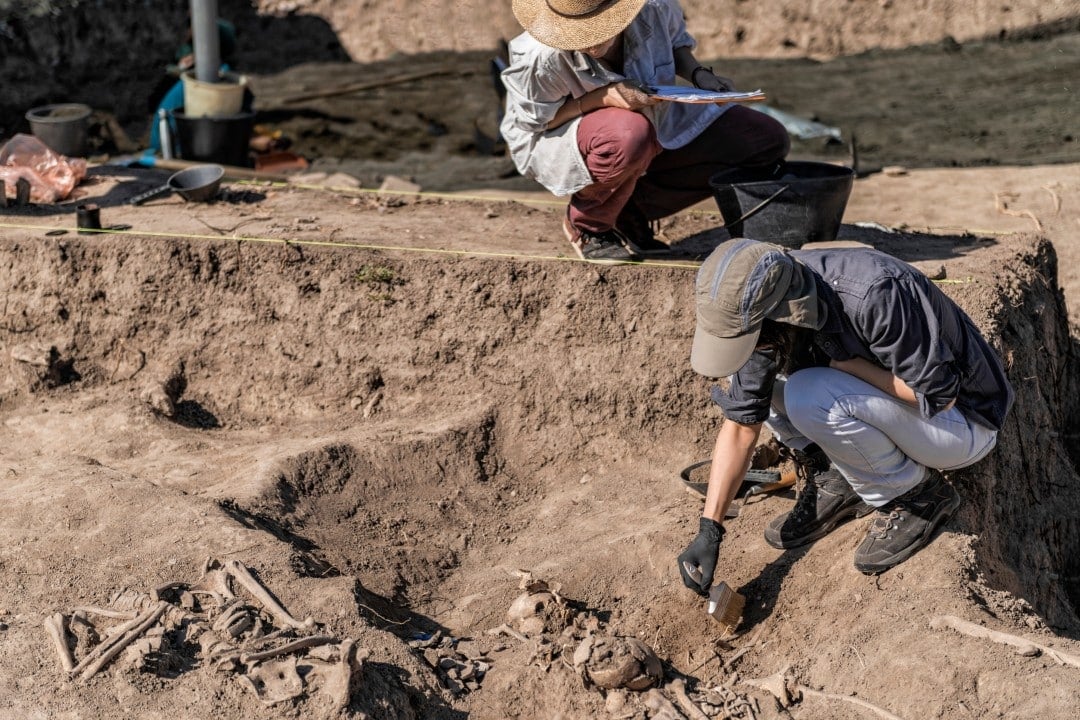
The first section of the Niuheliang site is recognized as the largest and one of the most significant. Archaeologists have already mapped nine large platforms and related installations, covering a total area of more than 100,000 square meters.
Archaeological studies indicate that the vast ceremonial architectural complex was erected on a large scale, in a relatively brief period, approximately 5,800 years ago. Researchers classify the construction as a monumental engineering project for the time, providing crucial data for understanding the emergence of the first civilizations in ancient China.
Furthermore, the site revealed evidence of ritual practices and a hierarchical structure in society at the time.
Goddess Temple and ancestral veneration in Niuheliang
The Niuheliang “Temple of the Goddess”, found at the site, is said to be the oldest shrine in China. It is particularly famous for the head sculpture believed to represent a Hongshan deity. Chinese archaeologists consider it the oldest remains associated with ancestor worship discovered in the country.
Another relevant discovery occurred in the second area of the site, where archaeologists identified three concentric circular platforms, which were possibly used in sky worship rituals.
The largest of the circular platforms has a diameter of around 22 meters. Researchers hypothesized that the three concentric circles would align, respectively, with the winter solstice, the spring and autumn equinoxes, and the summer solstice, thus mirroring the annual solar motion as seen from Earth.
Jia stated that the origin of fundamental concepts such as “reverence for heaven, respect for earth, and honor for ancestors” can be traced back to Niuheliang.
He described the site as a crucial example in the early days of Chinese civilization, and said his findings prove the continuity of ritual traditions for more than five millennia, which solidifies the understanding of Chinese culture and history.
The Niuheliang site also revealed a vast amount of ceramic and jade artifacts. Experts point out that jade objects, which include dragons, phoenixes, cloud-shaped pendants and various figures, stand out for the variety and complexity of their manufacture. The presence of these pieces in different arrangements in tombs with different status demonstrates the early development of a jade-based ritual system in ancient China.
As excavations and archaeological research continue in Niuheliang, new discoveries are expected to bring more evidence about the origins and evolution of Chinese civilization.