

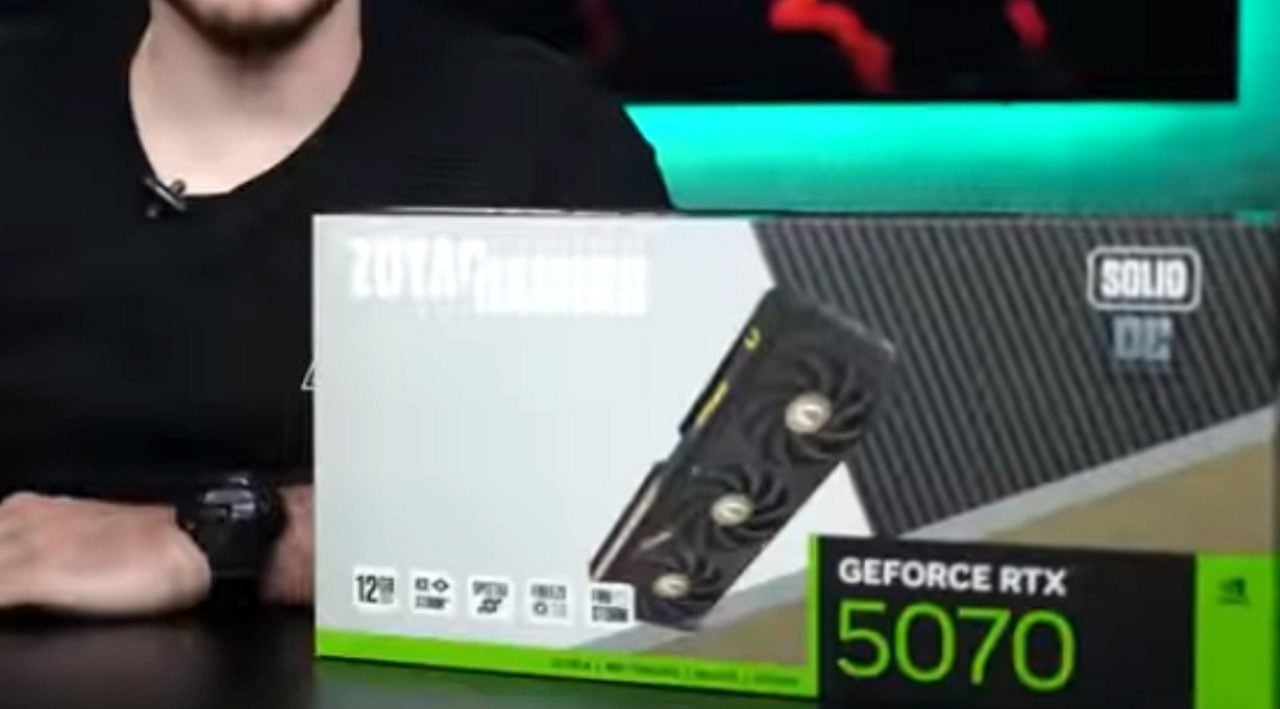
The most recent hardware survey released by the Steam platform, referring to July 2026, showed a significant change in the behavior of technology consumers. The Nvidia GeForce RTX 5070 graphics card emerged as the component with the highest adoption rate in the period, registering a jump of 0.33% in just thirty days. With this advance, the hardware now represents 3.62% of all machines registered in the service, guaranteeing fourth position in the global ranking and matching the most popular models in the segment.
The impact of cost-benefit on choosing the ideal computer hardware
When assembling or updating a computer, the public has prioritized equipment that delivers high capacity without compromising the budget. Official Steam Hardware Survey numbers confirm that the desktop edition of the GeForce RTX 5070 is leading the current growth rate. By reaching a market share of 3.62%, the component consolidates itself just behind the podium of the three most used cards in the world, a space that historically requires years of consistent sales to reach.

More on this story: Nintendo releases update 21.2.0 for Switch 2 with system improvements and new music
The modernization trend also boosted other models in the same family. The GeForce RTX 5060 version secured second place in terms of monthly expansion, adding 0.22% of new users and reaching 3.03% of global presence. Soon after, the RTX 5060 Ti variant closed the growth podium with an increase of 0.14%, which increased its total share to 2.40% among users of the virtual store.
The rapid acceptance of this trio of graphics processors from the 5000 line signals a mass transition movement on the part of consumers, who have finally decided to abandon outdated architectures. This scenario proves that the community was waiting for a substantial technological leap that would justify the financial investment, opting for high-performance intermediate solutions instead of spending fortunes on the most expensive options in the catalog.
Learn more: Return of the Steam Controller in 2026 brings innovations and restrictions on PC
Technical specifications and energy efficiency of Nvidia’s new generation
The commercial success of the RTX 5070 is directly supported by its technical data sheet, designed to meet the demands of the current generation of software. Based on the modern Blackwell architecture, the piece comes equipped with 12 GB of video memory in the GDDR7 standard. This configuration guarantees an immensely higher bandwidth than the previous family, allowing the system to load textures in very high resolution with extreme speed and without choking.
Another decisive factor for mass adoption is the energy efficiency design, which limited the component’s thermal consumption to 250 W. In practice, this means that the card can be installed in the vast majority of conventional cases, saving the user from the obligation to purchase a very high power power supply just to support the system update.
| RTX 4070 | RTX 5070 | RTX 5080 | |
|---|---|---|---|
| Architecture | Ada Lovelace | Blackwell | Blackwell |
| VRAM memory | 12GB GDDR6X | 12GB GDDR7 | 16GB GDDR7 |
| Power consumption (TDP) | 200W | 250W | 320W |
| Recommended use | 1440p/Ray Tracing | 1440p Ultra/4K DLSS | 4K Native/High Refresh |
| Observed average price | BRL 3,899.99 | BRL 4,699.99 | R$ 10,499.99 |
Aggressive pricing has been the main driver of sales. While the powerful RTX 5080 hits international shelves costing more than 1,100 euros, the RTX 5070 can be found in the 650 euros range. Unlike the Ada Lovelace generation (4000 series), which suffered harsh criticism due to the high entry cost, the manufacturer’s new strategy delivers around 80% of the firepower of a premium model for half the price, justifying the sales phenomenon recorded in recent weeks.
Practical performance at high resolutions and artificial intelligence technologies
When subjected to practical tests, the card demonstrates plenty of capacity to run the industry’s heaviest releases with total fluidity. The hardware was specifically designed to master Quad HD resolution (2560 x 1440 pixels), which is currently considered the perfect balance point for those looking for detailed graphics without giving up high refresh rates on monitors.
On the same topic: OnePlus’ new cell phone features a giant battery and ultra-fast screen for gamers
Even in extremely complex virtual scenarios, such as projects developed using the Unreal Engine 5 graphics engine or titles that use ray tracing in real time, such as the demanding Cyberpunk 2077, the equipment can maintain stability. Rendering occurs without sudden drops in performance, ensuring an immersive visual experience.
The great asset for achieving impressive numbers is the presence of the new Tensor cores, which work together with artificial intelligence systems to generate additional frames on the screen, easily pushing the reproduction rate beyond 100 fps. In addition to shining at 1440p, the component has the strength to handle 4K UHD resolution on compatible screens, establishing itself as a safe and versatile investment for the coming years.
Technical limitations and direct comparison with the top of the line model
Even though the cost-benefit is unbeatable, there is a natural technical gulf when the card is placed side by side with the RTX 5080 in maximum stress scenarios. The most expensive model in the line has 16 GB of GDDR7 memory and a 256-bit bus, specifications that guarantee a raw processing margin that varies between 35% and 50% compared to its smaller sister.
The main architectural barrier of the cheapest version is precisely the limit of 12 GB of VRAM combined with a 192-bit interface. If this configuration remains in Quad HD, attempting to run games in native 4K with the Path Tracing feature activated can generate severe memory bottlenecks, requiring the use of image resizing technologies, such as DLSS, to avoid crashes.
Ultimately, the RTX 5080 remains a niche product, aimed at 3D modeling professionals or enthusiasts who have native 180 Hz monitors. For the overwhelming majority of the public, the RTX 5070 delivers exactly what is needed for everyday fun. This discrepancy in interest is evident in Steam’s own data, which recorded a timid increase of just 0.09% in the adoption of the most expensive model during the same period analyzed.