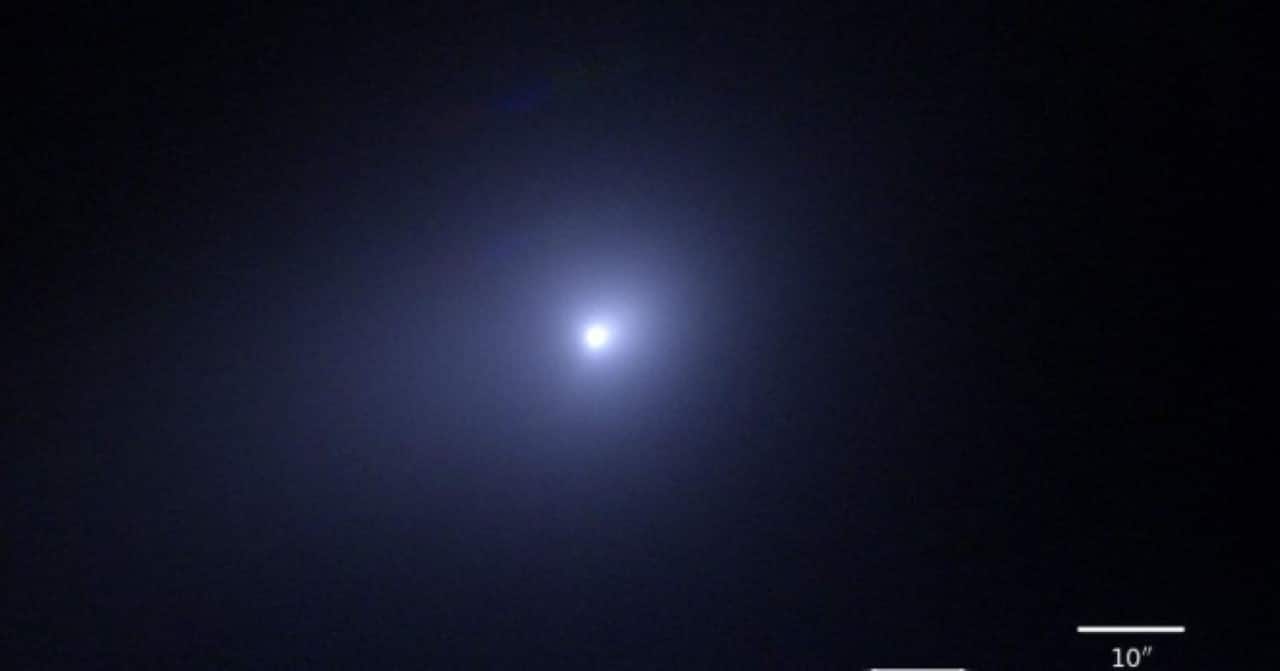
The passage of the third interstellar visitor confirmed by science has just delivered unprecedented data on the chemistry of other regions of the galaxy. Researchers identified that the celestial body named 3I/ATLAS carries concentrations of methanol considerably higher than the standards observed in icy bodies that orbit our Sun. The finding reinforces the thesis that stellar nurseries spread throughout the universe have chemical compositions that are quite different from those that gave rise to our own planetary system.
Molecular mapping was conducted using the Atacama Large Millimeter/submillimeter Array (ALMA), a radio telescope complex installed in the Chilean desert. By capturing the specific radio emissions emitted by the cold gases, the equipment allowed international astronomers to decipher the exact chemical signature of the alien object. Decoding these radio signals provides direct evidence about the temperatures and elements present in the exact location where this rock formed billions of years ago.
The role of wandering celestial bodies in understanding the distant universe
Celestial bodies that travel between the stars function as true physical samples of worlds unattainable by current human technology. Being the successor of famous objects such as ‘Oumuamua and Borisov, 3I/ATLAS preserves inside the frozen material of the protoplanetary disk where it was born. The identification of a simple alcohol in such expressive volumes helps to put together the puzzle about how the basic ingredients are distributed in the cosmic vastness.
Observing the birth of planets in remote galaxies remains a technical hurdle for modern astrophysics. Therefore, the arrival of an interstellar messenger in our cosmic backyard provides an invaluable laboratory opportunity. Scientists can examine original dust and gas from another corner of the Milky Way without having to send space probes outside our neighborhood, analyzing the material exactly as it was forged in deep space.
Monitoring technique reveals extreme proportion between organic molecules
The window of opportunity for this data collection occurred at the end of the year 2025, when the visitor’s trajectory placed it in closest proximity to our host star. The extreme heat generated by solar radiation caused the sublimation of the celestial body’s surface ice, ejecting jets of dust and volatile gases directly into the space vacuum.
This temporary cloud of ejecta, technically called a coma, acts as a light panel for radio instruments on Earth. The team focused ALMA’s receptors on two organic substances fundamental to prebiotic chemistry: hydrogen cyanide and methanol itself. The presence of both is expected in ice rocks, but the relationship between them dictates the thermal history of the environment where they condensed.
The crossing of spectral signatures delivered a statistical scenario outside the curve for terrestrial astronomical standards. The records showed that the presence of methanol exceeded that of hydrogen cyanide by a margin ranging from 70 to 120 times. This discrepancy makes 3I/ATLAS one of the most saturated bodies of this type of alcohol ever documented in the history of modern astronomy, easily surpassing the comets that were born in the Oort Cloud.
Implications of the discovery for the search for habitable planetary systems
The chemical imbalance detected indicates that the traveler’s original environment had temperatures and carbon monoxide concentrations radically different from the primordial cloud that formed the Earth. Complex organic molecules are treated by science as the fundamental building blocks for the emergence of biology. Understanding how they form in interstellar ice is the first step toward mapping where life could thrive in other corners of the universe.
Primitive ice rocks operate as cryogenic vaults that keep intact the chemical recipe of a solar system’s beginnings. By decoding the structure of an alien object, researchers obtain tangible evidence that the raw materials needed to build habitable worlds are distributed in widely varying ways across the galaxy. This exponentially expands the possible scenarios for the evolution of rocky exoplanets.
Unique features that differentiate the visitor from the local rocks
Excess methanol is not the only signature that separates this object from the traditional comets that cross Earth’s skies. The astronomical community had already been monitoring the behavior of the celestial body through different wavelengths, accumulating a dossier of chemical anomalies.
- The role of carbon dioxide: Even before closest approach, the James Webb Space Telescope had already focused its infrared lenses on the target. Preliminary readings at great distances from the Sun showed a massive emission of carbon dioxide, anticipating that the object would have atypical behavior.
- Isolation from local contamination: The fact that it is a confirmed intruder guarantees that its internal structure has not been altered by the dynamics of our system. It is a pure sample, untouched by solar winds over billions of years of travel in interstellar space.
- Improvement of theoretical models: The data extracted from this passage provides real parameters for computer simulators that try to predict the composition of atmospheres on exoplanets. With accurate numbers on the availability of carbon and oxygen, astrophysicists discard old theories and focus on more accurate models.
Continuous scrutiny of space anomalies fuels databases that rewrite the foundations of contemporary astrochemistry. Detailed tracking of molecular emissions cements the ability of Earth’s infrastructure to probe the mechanics of the cosmos at ever deeper scales. Cataloging organic elements in hyperbolic trajectories establishes a new standard of comparison for the next stray rocks that cross Earth’s orbit.