
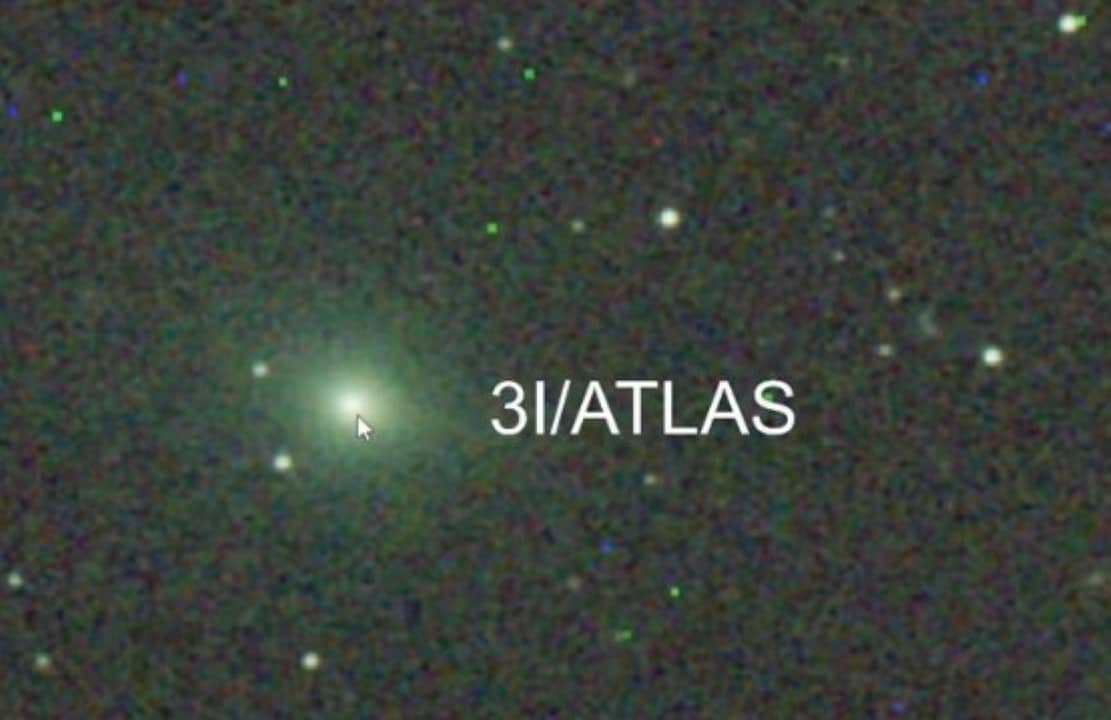
Researchers have identified a colossal load of methanol inside 3I/ATLAS, consolidating the object as the third interstellar visitor to cross the boundaries of our planetary system. Recent assessments indicate that the organic material is not restricted to the rocky core, but also escapes from frozen fragments present in its external cloud, indicating that the formation of these compounds occurred in unknown and distant regions of the Milky Way, with exclusive chemical signatures.
This surprising scenario was captured thanks to the very high precision sensors of ALMA (Atacama Large Millimeter/submillimeter Array), an astronomical complex made up of 66 radio antennas operating together at an altitude of 5,000 meters in the Atacama Desert, in Chile. During the point of closest approach to the Sun, the cosmic traveler exhibited abnormal rates of these carbon-based compounds, which reinforces its identity as an alien body sailing through our neighborhood.
Discovered in June 2026, the celestial body serves as a game-changer for astronomers seeking to understand the building blocks of other stellar systems. The data collection occurred at exactly the moment the comet came under direct thermal influence from Earth’s central star, forcing the evaporation of its internal matter and allowing scientists to track the exact profile of its elements in deep space.
Unprecedented chemical composition of the celestial body challenges current astronomical models
The trajectory of this celestial body subtly resembles the path taken by already known comets, but the main reason for astonishment is that the invasion of rocks formed outside our solar system is an extremely rare phenomenon to be recorded. Previously, the only objects to bear the title of interstellar nomads were 1I/’Oumuamua, detected in 2017, and 2I/Borisov, located in 2019, each of which presented completely different physical and dynamic characteristics.
More on this story: Radio telescope in Chile detects unprecedented heavy water on 11-billion-year-old comet 3I/ATLAS
With the emergence of 3I/ATLAS, science added a new and complex piece to this cosmic puzzle. While the previous visitor, Borisov, was considered quite similar to the celestial bodies in our territory, the current invader stands out for its massive amount of methanol, highlighting a place of origin where chemical and temperature conditions radically diverge from those that shaped the Earth and its neighboring regions.
Radio equipment in the Chilean desert records record gas emissions
ALMA’s high-sensitivity antennas identified a clear trail of both methanol and hydrogen cyanide in the object’s temporary atmosphere. Because these compounds produce specific radio waves in the submillimeter range, the astronomy team was able to mathematically calculate the exact volume of matter that was being ejected into the vacuum.
The factor that most impressed the researchers was the gigantic proportion of methanol compared to hydrogen cyanide. This chemical discrepancy indicates that the interstellar comet transformed into a celestial body loaded with these organic elements in an extremely cold environment before being cataloged, preserving ice rocks formed on the outskirts of a distant sun.
Role of prebiotic elements in structuring new worlds
When astronomers mention methanol in this scenario, the term has no relation to the substance used in everyday life on Earth. In the space environment, the element acts as a fundamental molecule for the primary reactions of life, functioning as a basic building block, which makes it a crucial target for scientists studying the emergence of complex substances in the frozen nurseries of future planets.
Learn more: Telescope in Chile detects giant methanol cloud on interstellar comet 3I/ATLAS
Molecules that carry this profile usually form on the surface of microscopic dust grains in the coldest regions of the galaxy, where a slow process over time transforms simple atoms into large organic chains. Through this formation mechanism, these compounds act as a historical record of the places they passed through, providing clear clues about the temperature and density of the exact point where the star was born.
Melting of the rock structure drives the release of organic material
The highlight of the 3I/ATLAS analysis is the finding that the release of material does not just happen from the solid core. The information collected proves that, when it begins to feel the influence of solar heat, the comet becomes surrounded by a cloud of dust and gas, generating a colossal amount of emissions from small fragments of ice spread throughout its coma.
The scientific community continues to watch this phenomenon closely, as the fragmenting ice around the main core gradually evaporates, launching even more molecules into space. Through this dynamic, the traveler’s tail becomes a true chemical factory in motion, allowing observatories on Earth to read its signals with greater clarity.
Emission patterns reveal hidden geology at the center of the celestial body
Methanol and hydrogen cyanide showed very unusually concentrated emission patterns, covering the entire observation period. The instruments showed that this specific gas is essentially released only from the central nucleus of 3I/ATLAS, a feature that completely upends the dynamics observed in comets originating in our own solar system.
The contrast of these elements being ripped from the rock proves that the matter trapped inside reacts independently when exposed to heat. Because of this, the cosmic nomad sustains a layered structure, releasing its components at specific speeds as it encounters solar radiation and reveals its true composition.
On the same topic: Telescope in Chile discovers high concentration of methanol in comet 3I/ATLAS
Previous thermal tracking already pointed out anomalies in the space traveler
Long before the Chilean observatory focused on methanol, the thermal sensors of the James Webb Space Telescope had already announced that this invader’s atmosphere was outside the norm. Preliminary analyzes detected the emission of high levels of carbon dioxide, raising the hypothesis that the formation of this rock derives from a completely new, modern scientific basis.
With the integration of data acquired by terrestrial antennas and orbital instruments, the mystery took on a new shape. With two of the world’s most advanced astronomical projects confirming the readings, the paradigm of this celestial body’s chemical identity has been shattered, determining that it is impossible to equate the mixture of unique substances with celestial bodies in our own backyard.
Frozen fragments function as time capsules of other systems
Analyzing the composition of 3I/ATLAS is equivalent to opening a mission of imagination towards a star that humans cannot visit directly. As this object was formed billions of years ago, the frozen matter at its center preserves untouched information about the chemical composition present in the primordial stellar disk that gave rise to it, acting as a true time capsule.
Science does not yet have the ability to track the exact star that expelled this rock into deep space, but the massive amount of methanol floating in the formation process indicates that the high concentration of the gas is sustained by molecular dynamics distinct from those found in our solar system. This demonstrates that its origin occurred in an environment much colder than our planetary neighborhood.
More on this story: Telescope in Chile detects record level of alcohol in interstellar comet 3I/ATLAS
Recent discoveries demand immediate revision of star formation theories
When the list of known interstellar celestial bodies lacks samples, continued research into this traveler forces a major overhaul in astronomy. With only three official records to date, each time a new substance is detected, scholars feel the absolute need to completely rethink the models that explain the accumulation of dust and gas around other stars.
In a retrospective analysis of galactic nomads, it became clear that there is a diverse and unknown nature in space.
- The very first of them, 1I/’Oumuamua, existed as a dry block that did not emit any gas, surprising the community.
- The subsequent 2I/Borisov behaved almost identically to the local ice stars, bringing a sense of relief to astronomers.
- The current 3I/ATLAS overturned previous beliefs by displaying a massive methanol cloud and an unprecedented molecular structure.
The rapid change in this object’s physical characteristics proves that the deep space traveler carries much greater complexity and geological unpredictability than researchers imagined when they began monitoring the void of space.