SpaceX rocket generates rare light trail at dawn in the United States

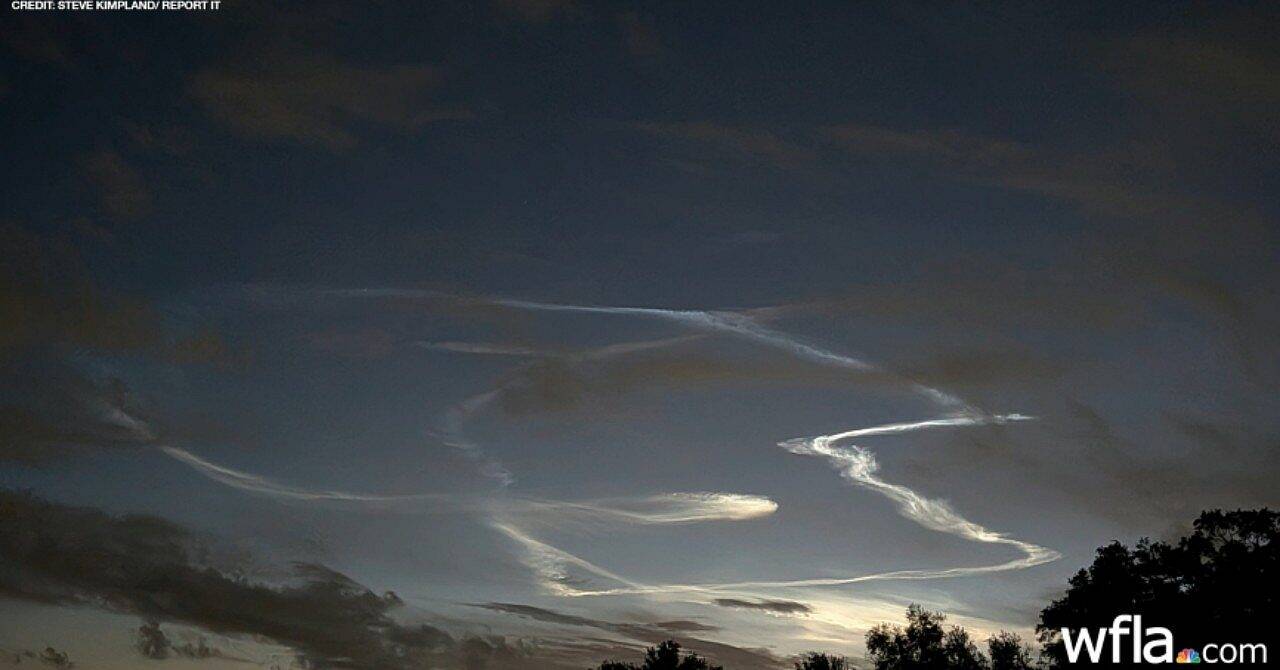
Residents of the Tampa Bay region were surprised by a breathtaking visual spectacle in the early hours of the day. The sky of the American state gained luminous contours, varying between shades of electric blue and silver, shortly after the ascension of a space vehicle belonging to Elon Musk’s company. The mission, focused on expanding the Starlink communications satellite network, left the launch pad at exactly five twenty minutes in the morning. This specific time, positioned at the transition between dawn and dawn, created the perfect geometric conditions for the smoke expelled by the thrusters to interact with sunlight in a completely atypical way.
The phenomenon was not restricted to just the west coast of the peninsula, being seen by observers in several central cities. The clarity of the night sky on the date of the event helped the gaseous structure remain visible for a long period before dissipating completely. Aerospace monitoring experts reported that the vehicle’s trajectory followed the expected pattern, but the combination of humidity and temperature in the high atmospheric layers enhanced the reflective effect.
The science behind luminous formations in Earth’s upper atmosphere
To understand what really happened over American territory, it is necessary to observe the dynamics of atmospheric physics at extreme altitudes. Meteorologist Amanda Holly detailed that the burning of kerosene and liquid oxygen during the equipment’s ascent releases a massive amount of water vapor and exhaust particles. All this material is ejected directly into the mesosphere, a layer located approximately eighty kilometers above the planet’s surface. As the launch occurred moments before the sun rose over the horizon, the ground was still immersed in total darkness.
However, due to the curvature of the Earth, the sun’s rays were already falling directly on the residue left by the engines at that monumental altitude. This early illumination turns the trail of frozen smoke into a bright mirror, generating what researchers classify as noctilucent clouds. In nature, these rare structures are formed by meteor dust and ice crystals during the polar summer, but intense contemporary aerospace activity can replicate the effect artificially and instantly at lower latitudes.
Residents transform the dawn into a large gallery of digital images
The visual impact was so intense that thousands of citizens interrupted their morning routines to record the bright trail tearing across the sky. State-of-the-art cell phone cameras and professional photography equipment pointed upward, capturing streaks of light that looked like brushstrokes of neon paint against the dark background. Digital platforms were quickly flooded with high-resolution photographs and videos, showing the evolution of the plume as strong high-altitude winds dispersed the chemical material.
Amateur astronomy groups and space exploration enthusiasts already monitor these takeoff times precisely in search of this visual aesthetic. Experienced photographers explain that the window of opportunity to capture this type of event is extremely short and requires advance preparation. The perfect contrast lasts only a few minutes, disappearing as the morning light reaches the lower layers of the air and overshadows the delicate glow of the frozen gases in the mesosphere.
Aerospace calendar points to new large-scale operation soon
The frenetic pace of activity at the space center shows no signs of slowing down in the coming weeks. The official schedule of American authorities already establishes August 30th as the date for the next major event on the east coast. This time, the historic infrastructure of Cape Canaveral will serve as the stage for the ignition of the powerful Falcon Heavy, one of the most robust and powerful transport vehicles currently in operation on the global market.
Takeoff is scheduled to take place at seven twenty-six in the morning, a time that can also generate interesting visual effects depending on the cloud cover of the day. Unlike routine flights that carry dozens of small internet satellites into low orbit, this specific operation carries monumental scientific weight. The rocket’s cargo compartment will house highly complex technological equipment ordered by the United States space agency, NASA.
Details about the advanced telescope that will investigate the mysteries of the universe
The main passenger on the next flight is the Nancy Grace Roman space observatory, a piece considered fundamental to the future of international astrophysics. Named after the scientist who served as the American agency’s first head of astronomy and pioneered the planning of Hubble, the new instrument promises to revolutionize the way humanity sees the cosmos. The infrared mapping capacity of this equipment surpasses the field of view of its predecessors by a hundred times, allowing gigantic scans of deep space in record time.
To assess the historical and scientific importance of this billion-dollar payload, researchers highlight the main work fronts that the equipment will carry out once it reaches its final orbital position:
- Detailed mapping of dark energy and dark matter, invisible components that make up most of the universe and remain the biggest enigma for modern physics.
- Active search for exoplanets located thousands of light years away, using advanced gravitational microlensing techniques to find Earth-like worlds.
- Creating an unprecedented stellar census, photographing billions of isolated galaxies to understand the structural evolution of the cosmos since the first moments after the Big Bang.
The combination between the brute force of the heavy launcher, equipped with twenty-seven engines at the base, and the sophistication of the observatory marks a crucial moment for science. While commercial flights continue to color the dawns with illuminated vapor trails, deep exploration missions ensure that terrestrial infrastructure is used to expand the frontiers of human knowledge. Expectations now turn to meteorological analyzes at the end of the month, which will dictate the final release for the next launch window.