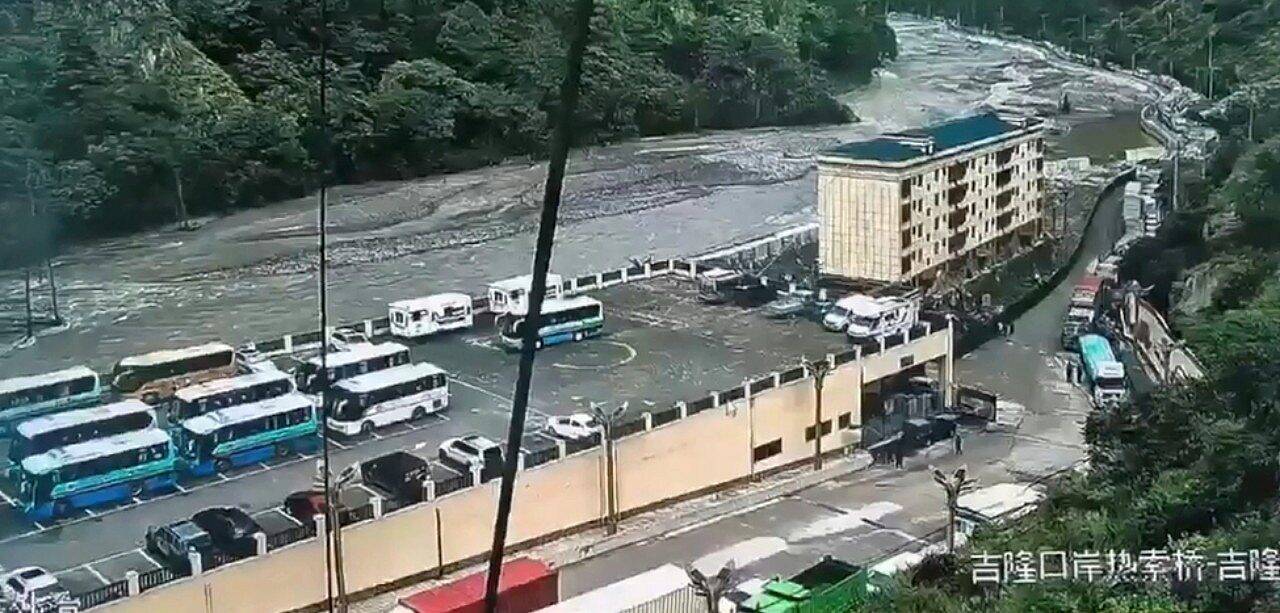
A powerful flash flood hit villages on the Nepal-China border on August 26, 2026, causing widespread devastation. Nepalese authorities confirmed the deaths of at least 17 people and warned that the number of victims could increase considerably, given the large number of missing people.
Nepal’s tourism board said around 400 travelers, including foreign nationals from countries including India, Australia, the Netherlands, South Africa, the United Kingdom and Malaysia, were missing. Furthermore, sixty employees working on a hydroelectric project under construction in the northern region of Nepal were also not located, as reported by Nepalese state media.
In Tibet, an autonomous region of China that was also affected, Chinese state media warned of the possibility of “major casualties.” A landslide hit the port of Gyirong, prompting Chinese leader Xi Jinping to call for large-scale search and rescue efforts. Aid teams in Tibet are receiving essential supplies such as tents, stoves, clothing and blankets.
Earthquake and landslide would have caused flooding in the region
Nepal’s Foreign Minister Shishir Khanal explained that the flash flood was caused by a 4.4 magnitude earthquake, which triggered a large landslide. This event blocked the Bhote Koshi river, resulting in a strong flow of water downstream. The information about the earthquake was corroborated by the United States Geological Survey, which recorded a tremor of similar magnitude in the region.
An expert from the International Center for Integrated Mountain Development (ICIMOD) in Kathmandu, Saswata Sanyal, indicated that the maximum flooding occurred in the Lhende Khola river, a tributary of the Bhote Koshi. According to the expert, the event was triggered by an avalanche of ice and rocks from a glacier on the Nepalese side, which blocked the river and released a sudden wave of water.
Rescue operations face challenges amid devastation
Rescue operations are ongoing, but helicopters are finding it difficult to land in the worst-hit areas such as Syapru Besi and Timure in northern Nepal due to high water levels. Nepalese police and military joined rescue teams, and Prime Minister Balendra Shah advised people living along the river to exercise caution and remain alert.
The Red Cross, in turn, is mobilizing an emergency team with relief supplies to the affected areas. The international organization is ready to support the response and has urged communities to remain alert and follow official safety instructions.
Rasuwa: a strategic and vulnerable region in the Himalayas
The Rasuwa municipality in Nepal stretches from the slopes of the Himalayas to the border with China, with peaks above 7,000 meters. The region, home to approximately 50,000 people, has scattered villages and is known for Langtang National Park and the sacred alpine lake of Gosaikunda. Rasuwa is also home to several hydroelectric projects that harness the power of its mighty rivers.
In 2015, Rasuwa was devastated by a 7.8 magnitude earthquake, which killed more than 9,000 people across Nepal and buried hundreds in Langtang National Park. Timure, situated on the Trishuli River, is the last settlement on the road to China, a crucial point for trade, with trucks often waiting to cross the border in search of loads of assorted goods.
History of natural disasters in the Himalayan mountain range
The Himalayan region, known as “the roof of the world”, is historically susceptible to flash floods and landslides. Experts warn that extreme weather events are becoming more frequent and intense due to the climate crisis caused by human activity.
In recent years, the region has faced several natural disasters: in August 2025, a flood devastated a mountainous village in northern India, leaving people dead and missing. In September 2024, heavy monsoon rains in Nepal caused flooding and landslides, resulting in around 200 deaths. Other notable incidents include the flooding of a glacial lake in India in October 2023, which left more than 100 people missing, and massive floods that hit India and Nepal in October 2021, killing at least 150 people.