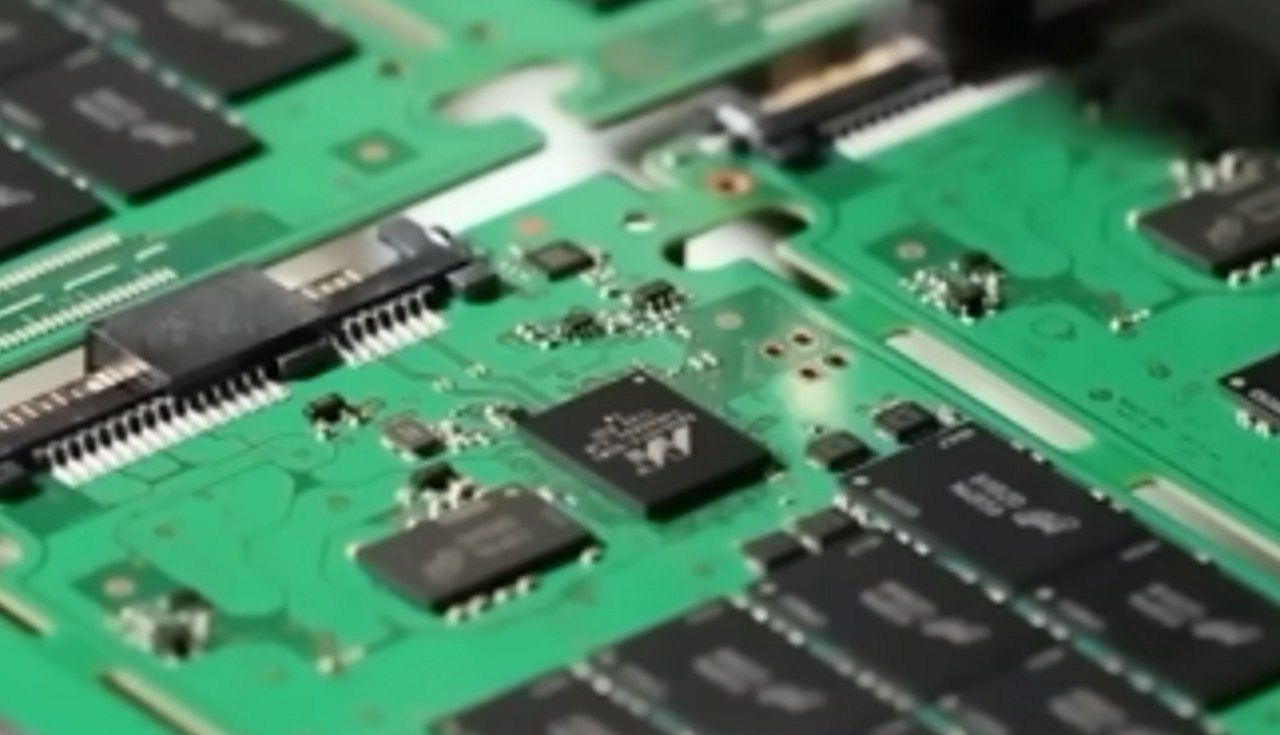
Discussing the relevance of silicon chips has become commonplace, whether due to the scarcity of new vehicles or the advancement of artificial intelligence. This small piece, intensely sought after globally, has a more accessible explanation than one might imagine. It is fundamental to the technology present in everyone’s daily lives.
Understand the composition and function of a silicon chip
A chip consists of a tiny plate, predominantly made from silicon, a chemical element abundant in beach sand. On this surface, engineers insert billions of transistors, which are microscopic switches. Each of these components has a binary function: allowing or preventing the passage of electricity, representing the “on” or “off” states. The high-speed collaboration of billions of these switches results in devices capable of performing complex calculations, displaying videos, interpreting voice commands, and even controlling vehicles.
Contemporary smartphone processors house more than 15 billion transistors in a space no larger than the size of a human fingernail. The microstructures recorded on these chips are measured in nanometers, units that represent billionths of a meter, making them incredibly thinner than a strand of hair.
https://www.youtube.com/watch?v=T5rFbBq-NX0
The characteristics of silicon that make it ideal for making chips
Silicon has a particular property: it acts as a semiconductor, which means that it does not behave like a perfect conductor, like copper, nor like a complete insulator, like rubber. It occupies an intermediate point. Through meticulously controlled chemical additions, it is possible to determine precisely when it should or should not conduct electricity, an essential characteristic for the function of a switch. This peculiarity, combined with its accessibility, abundance in the Earth’s crust and thermal resistance, explains its widespread use by industry. This context also justifies the naming of California’s technological region as Silicon Valley.
The presence of chips in everyday objects and advanced equipment
- The common perception that chips are restricted to computers is inaccurate. In reality, they integrate a wide range of items, such as:
- Cell phones, notebooks and televisions
- Contemporary vehicles, which can employ more than a thousand chips
- Household appliances such as washing machines, refrigerators and air conditioners
- Bank cards, passports and payment terminals
- Medical devices, satellites and traffic light systems
During the global production shutdown due to the Covid-19 pandemic, many automakers suspended their activities due to a lack of components that, individually, have a low cost. The crisis generated by the lack of semiconductors highlighted the extent of modern society’s dependence on these items.
The strategic role of chips in global geopolitics
Manufacturing high-tech chips represents one of the most complex industrial feats. The process demands pristine production environments, extremely pure water, unusual chemical reagents and lithography equipment valued at hundreds of millions of dollars per unit.
Consequently, advanced semiconductor production is centralized in a limited number of global regions, such as Taiwan, South Korea, and a few specific centers in the United States and Europe. This centralization elevated chips to the status of an economic tool. Countries such as the United States, China and European Union nations have implemented billion-dollar initiatives to encourage the construction of factories in their own territories.
The future of the chip industry and technological challenges
The development of artificial intelligence has further intensified the pressure on production. Training AI models requires high-cost specialized chips, and demand for these components is advancing at a pace that exceeds existing manufacturing capacity.
At the same time, the miniaturization of transistors presents increasing difficulties, as the laws of physics become limiting on extremely small scales. The industry is exploring alternatives, including overlaying chips in multiple layers, applying novel materials and developing customized processors for specific functions.
In summary, the main conclusion is clear. The silicon chip represents the discrete component that serves as a pillar for contemporary society. Control over its production confers control over a large part of the future, which explains the high value attributed to this small portion of transformed sand.