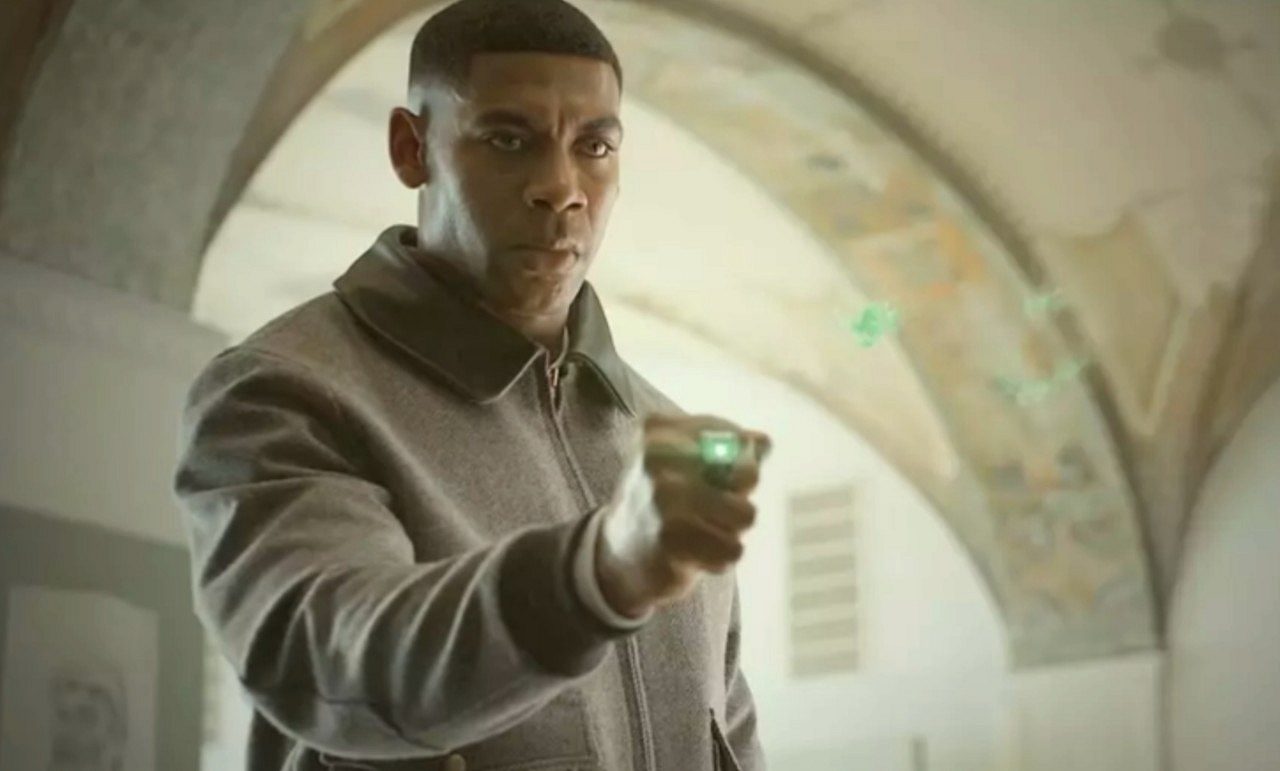
The third episode of *Lanternas* challenges the contemporary trend of quick and superficial interpretations in online discussions about films and series, inviting the public to take a deeper look. Presented on September 1, 2026, the chapter delves into John Stewart’s complex origin story, revealing layers of meaning that elude simplistic, binary conclusions. The work proposes a reflection on how narratives can be understood in different ways, depending on the perspectives of each viewer.
The complexity behind John Stewart’s story
The plot temporarily diverts from the series’ main investigation to focus on John Stewart’s childhood and the intricate relationship with his parents. The narrative explores how he was prepared throughout his life for a great purpose, yet uncertain of his own desire. The Green Lantern ring serves as a catalyst, but the heart of the episode lies in family dynamics, expectations transferred between generations and the repercussions of love, ambition, frustration and trauma within a collective life project. The series, at this point, subverts the common simplicity of superhero origins by adding emotional and social depth.
Polarized discussion versus the nuance of the series
A portion of the public misinterpreted that Hal Jordan had received the ring because he was white, while John’s father, being black, was rejected. However, the series does not affirm this premise as an absolute truth. Instead, it exposes the Stewart family’s *interpretation* of events, highlighting the distance between a character’s perception and what the work actually establishes. John’s father was considered a potential Green Lantern, but his opportunity was lost when he expressed fear, unlike Hal, who reacted differently and passed the test. For the Guardians of the Universe, the criteria applied were the same for both candidates.
- The Stewart family interpretation:They believe that the selection process was influenced by racial issues.
- The Guardians’ Perspective:They consider that they applied the same evaluation criteria to all candidates.
- The series’ challenge to the public:Offer a multifaceted vision that requires critical analysis, not literal acceptance of a single statement.
The layers of racism and racial socialization in the narrative
John’s mother questions the fairness of the selection process, asking if the Guardians truly understand the injustice of questioning a black man in the United States about fear. This speech does not suggest a conspiracy to benefit Hal, but rather exposes the limitations of a system that, despite considering itself neutral, fails to understand the country’s deep racial experiences. The Guardians, although they know countless worlds, admit they do not have a full understanding of Earth’s complex cultural relationships, failing to realize that the same question can have different weights and meanings for individuals shaped by unequal realities. This element of value highlights the difficulty of universalist systems in dealing with social specificities.
This is not to say that Hal was chosen for his skin color, but it also does not invalidate the pertinent question raised by John’s mother. She may be correct in pointing out the Guardians’ flaws and, at the same time, mistaken in symbolizing in Hal Jordan all the opportunities denied to her husband. It is precisely this tension and ambiguity that enriches the scene, as the series refuses to offer an easy answer, preferring to present multiple views on the same event. The excessive simplification that often occurs on the internet, by reducing a character’s speech to the “opinion of the series”, erases all this narrative depth.
A parallel with notable figures and the legacy of preparation
The central function of this conversation is to illustrate how John’s family interpreted events and how this interpretation shaped their son’s upbringing. His parents came to believe that John needed to be more than just good; he should be exceptional, more prepared and resilient, as he would not have the same right to error, doubt or fragility as others. This vision echoes the experience of many black American families, marked by segregation, the struggle for civil rights, and the persistence of institutional racism. Psychology calls “racial socialization” the process by which black parents prepare their children to recognize prejudice and face obstacles that other children may never encounter, an essential context for understanding the character.
*Lanterns* elevates this phenomenon to a powerful superhero origin. John’s parents not only want him to be brave, but to become unquestionable, impossible to reject. Although there are contextual differences, this logic finds parallels in the lives of figures such as Michael Jackson, Serena Williams and Venus Williams. Joe Jackson imposed a strict routine on his children, boosting the success of the Jackson 5, but also generating trauma. Similarly, Richard Williams prepared Venus and Serena from an early age to dominate a predominantly white sport and face the racism he knew they would encounter. The common point is the parents’ conviction that their children would need to be extraordinary just to achieve opportunities that, for others, come naturally.
Why interpretation goes beyond easy answers
The depth of John’s origin lies in the difference in their experiences. Hal received the ring without having spent his entire life waiting for such a calling, while John was raised with the expectation that he would not fail when the chance finally came. Reducing this complex plot to the phrase “Hal got the ring because he’s white” is simplifying and impoverishing the episode. The series does not discredit Hal’s bravery, nor does it claim that the Guardians are inherently racist, nor does it confirm that John’s mother has the absolute truth. Her statement does not elucidate Hal’s choice, but it illuminates why John was raised the way he was, emphasizing the importance of a different understanding. Understanding this distinction is a crucial starting point for any truly engaged discussion.