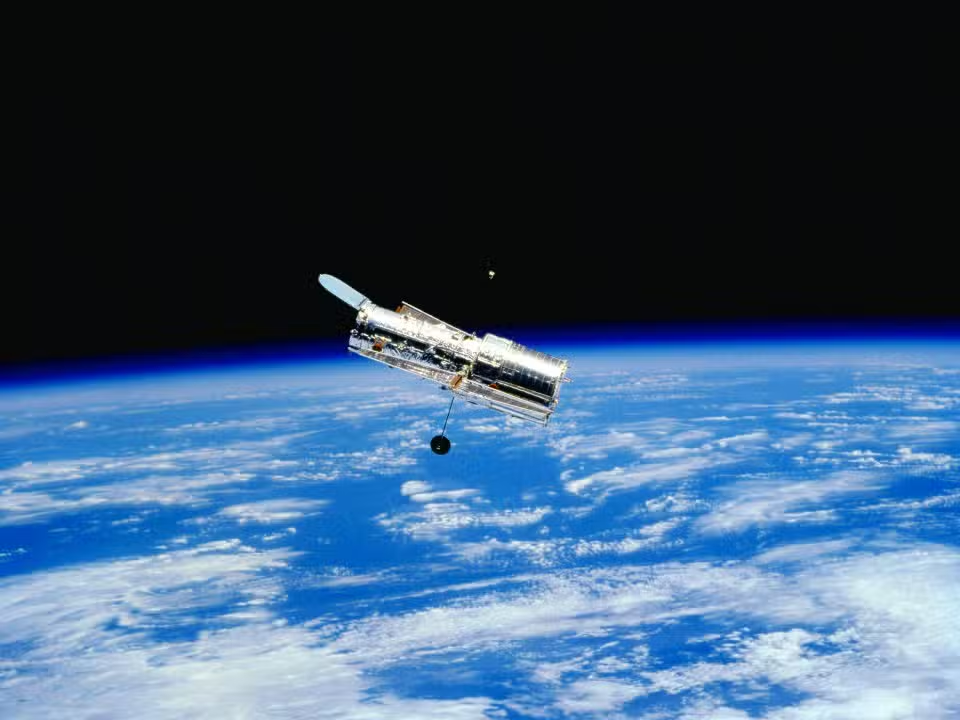
Heading to Mars and the Moon: NASA and SpaceX launch Crew-13 mission with 4 astronauts into space

The SpaceX Crew-13 mission lifted off for the International Space Station carrying four crew members on Thursday, October 1, 2026, from Space Launch Complex 40 at Cape Canaveral Space Force Station in Florida. The Falcon 9 rocket ignited its engines at 12:10 p.m. Brasília time (11:10 a.m. EDT), sending the capsule into orbit on a planned transit of roughly 7 hours and 50 minutes, the fastest journey ever scheduled for a Dragon spacecraft bound for the orbiting laboratory.
Docking with the Harmony module of the space station is scheduled for approximately 8:00 p.m. Brasília time (7:00 p.m. EDT) on Thursday. The four spacefarers are set to join Expedition 75 during an orbital stay planned for six months, conducting scientific research that agency officials anticipate will assist upcoming exploration targets on the Moon and Mars while providing diagnostic advancements for terrestrial medicine.
Read also: SpaceX Starship engine shutdown threatens NASA 2028 Moon landing
Jessica Watkins makes history as Crew-13 commander
Nasa astronaut Jessica Watkins serves as commander of the mission, becoming the first Black woman to command a crewed spaceflight in orbit. The flight also establishes Watkins as the first Nasa astronaut to launch twice aboard a SpaceX Dragon spacecraft, following her previous long-duration mission on Crew-4. She leads a flight team composed of Nasa astronaut Luke Delaney, serving as pilot, Canadian Space Agency astronaut Joshua Kutryk, serving as mission specialist, and Roscosmos cosmonaut Sergey Teteryatnikov, also serving as mission specialist.
For Delaney, Kutryk, and Teteryatnikov, the liftoff marks their first flight into space. The crew spent the morning completing pressure tests on their custom spacesuits at the Neil Armstrong Operations and Checkout Building at Kennedy Space Center, checking life support lines that supply air and electrical power before transferring to the pad. Prior to departing the staging quarters, the group took part in the agency tradition of playing a card game until the commander lost the final hand.
Reflecting on the flight number during prelaunch activities, Watkins noted that the patch and vehicle styling reflected historical resilience. “We really wanted to honor their legacy, honor their resilience and their grit, and bring a little bit of that with us,” Watkins said, referring to the emblem honoring Apollo 13. Kutryk added to the sentiment before heading out to the launch vehicle: “We feel like some of the luckiest people in the world.”
Scientific research across a six-month stay on Expedition 75
The mission represents the 13th operational commercial crew rotation flight managed by SpaceX for Nasa, as well as the 14th time a Dragon capsule has transported agency personnel to the station when including the Demo-2 test flight in 2020. During their six months living and working on the outpost, the crew will conduct biological and physical experiments within the orbiting laboratories, testing life support hardware and monitoring cellular responses in microgravity environments.
See also: SpaceX secures $946 million NASA deal for three ISS flights
Medical investigations form a substantial portion of the scientific timeline planned for the Expedition 75 increment. According to Dana Weigel, manager of the International Space Station Program at Johnson Space Center, the crew will concentrate on cellular models that can advance treatments for degenerative illnesses on Earth. “During the mission, the crew will help researchers treat heart disease and Parkinson’s disease by studying human stem-cell derived tissues that can help improve medicine, disease modeling, and pharmaceutical testing,” Weigel said.
Beyond human physiology, the researchers will oversee engineering demonstrations intended to inform hardware development for deep space infrastructure. Environmental control systems, water reclamation technology, and plant growth chambers operated aboard the outpost generate operational data that engineers examine when building life support systems for future long-duration flights beyond low Earth orbit.
Dragon Grace spacecraft milestones and operational schedule
The spacecraft flying the Crew-13 mission is the Dragon Grace, which represents the fifth and final newly manufactured Crew Dragon capsule constructed by SpaceX. The vehicle flew its maiden voyage during the Axiom Space Ax-4 private astronaut flight and underwent refurbishment ahead of its assignment to government rotation duties. The capsule experienced a three-week launch postponement while ground teams resolved a propellant valve leak before clearing the spacecraft for flight.
- Spacecraft: Dragon Grace, flying its second spaceflight after maiden operations on Ax-4
- Launch site: Space Launch Complex 40 at Cape Canaveral Space Force Station
- Launch time: 12:10 p.m. Brasília time (11:10 a.m. EDT) on Thursday, October 1, 2026
- Docking target: 8:00 p.m. Brasília time (7:00 p.m. EDT) at the ISS Harmony module
- Expected mission conclusion: approximate landing window opening around March 1, 2027
Crew reassignments and personal milestones in orbit
The flight assignment for Kutryk followed structural realignments within commercial spaceflight schedules. The Canadian Space Agency astronaut, who serves as a colonel in the Royal Canadian Air Force, was originally assigned to fly on the Boeing CST-100 Starliner-1 mission. Persistent technical reviews and schedule adjustments surrounding the Starliner program led mission managers to reassign Kutryk to the SpaceX rotation to maintain international crew commitments aboard the station.
Kutryk also approaches a rare family milestone while serving aboard the orbital outpost. His wife, Heather, is expected to give birth to their third child in late November 2026. The birth will make Kutryk the fourth astronaut in history to welcome a child while living in orbit, following previous occurrences recorded during Soviet and American space station programs.
Following their scheduled Thursday evening arrival and hatch opening, the four astronauts will be welcomed aboard by the current laboratory residents. The crew members are slated to remain in orbit until approximately March 1, 2027, when Dragon Grace will undock and begin its re-entry sequence for splashdown off the coast of Florida.