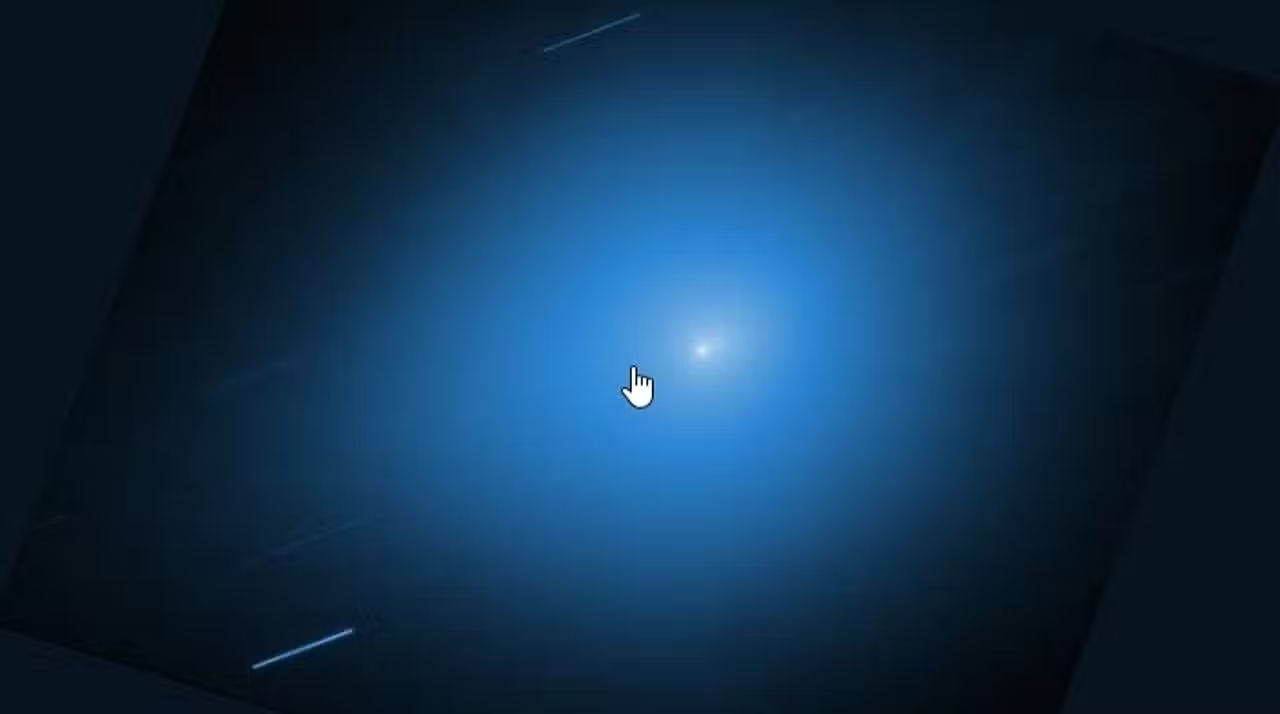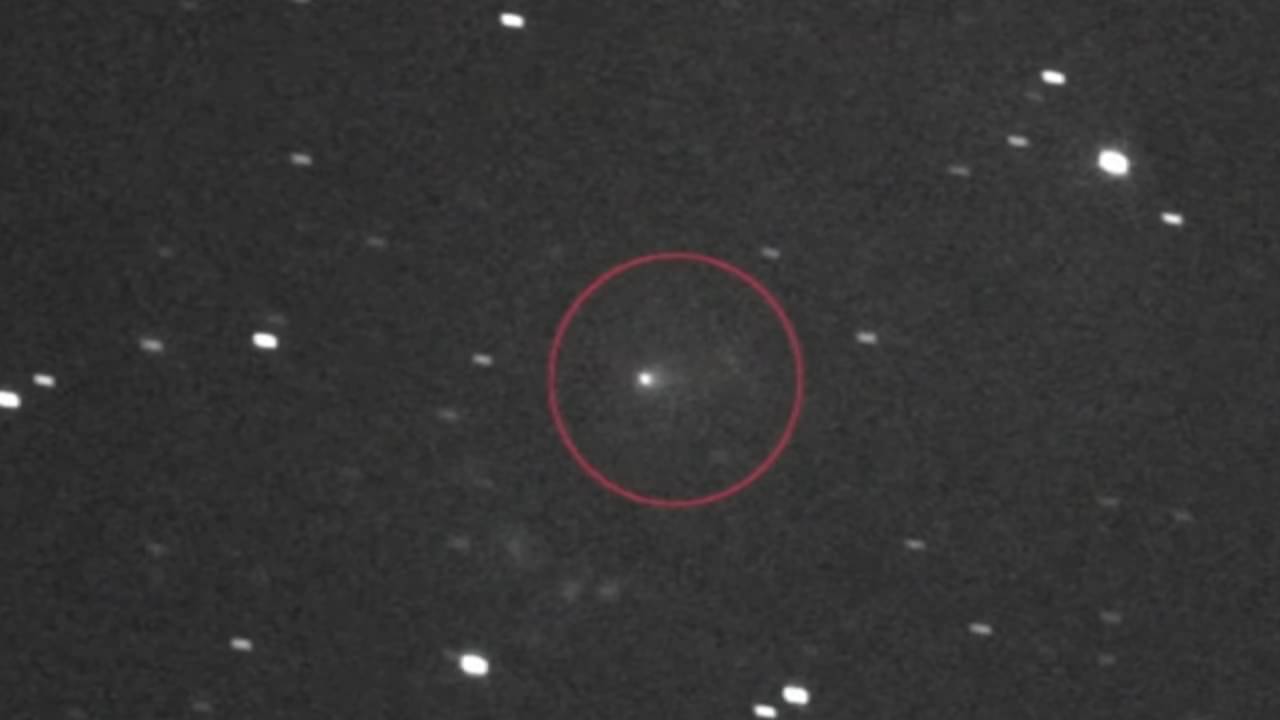
Astronomers analyzing interstellar comet 3I/ATLAS have found that the frozen wanderer vents gas at roughly half the velocity observed in typical Solar System comets. The discovery emerged from high-resolution observations conducted by researchers in Texas, who also detected unexpected heavy metal vapor embedded within the expanding cloud surrounding the nucleus.
Spectral signatures revealed distinct emission lines of neutral iron and neutral nickel drifting through the surrounding coma, two elements that generally remain trapped in solid mineral dust at cold distances. Lead researcher Anita Cochran, senior research scientist and assistant director at the McDonald Observatory at the University of Texas at Austin, noted that examining this material provides a rare look into foreign planetary nurseries. “By studying 3I/ATLAS, we hope to learn about conditions in the natal planetary system of this target and/or its long interstellar journey,” Cochran stated regarding the findings.
McDonald Observatory instruments capture extensive gas plume
The observational data was gathered using the Visible Integral-field Replicable Unit Spectrograph, known as VIRUS, mounted on the Hobby-Eberly Telescope at McDonald Observatory in Fort Davis, Texas. The instrument tracked the dispersal of volatile materials across distances exceeding 85,000 kilometers sunward from the central icy core. Along with the metallic traces, the spectrograph mapped common molecular radicals routinely monitored in cometary science, including cyanogen, tricarbon, methylidyne, and dicarbon.
The physical dispersion of these molecules did not match standard behavioral equations established for native comets orbiting the Sun. In typical comets, the outflow speed scales reliably with incoming solar radiation, but the gas envelope of 3I/ATLAS expanded at approximately 50% of that baseline rate. This sluggish expansion required astronomers to adjust their chemical distribution models to account for the slower flow.
The peer-reviewed findings were accepted and published in The Planetary Science Journal through an international research collaboration. The scientific team included investigators from the University of Texas at Austin, the University of Liège in Belgium, and Kyoto Sangyo University in Japan. Among the co-authors are Professor Hideyo Kawakita, deputy director of the Koyama Astronomical Observatory at Kyoto Sangyo University, and Gregory Zeimann, staff astronomer at the Hobby-Eberly Telescope.
Read also: Comet 3I/ATLAS speeds at 66 km/s through solar system as NASA confirms safe orbital distance
Key parameters recorded during post-perihelion measurements
The international team cataloged several observational metrics to define the path and physical state of the interstellar interloper during its outbound journey:
- Scientific name: interstellar comet 3I/ATLAS, formally indexed by the Minor Planet Center as C/2025 N1 (ATLAS)
- Discovery record: July 1, 2025, spotted by the ATLAS survey station in Río Hurtado, Chile
- Catalog rank: third confirmed macroscopic interstellar object identified traversing the Solar System
- Spectrographic session: December 9, 2025, utilizing the Hobby-Eberly Telescope
- Heliocentric position: 2.03 astronomical units from the Sun at the time of observation
- Geocentric position: 1.83 astronomical units from Earth during data acquisition
- Coma extent: volatile materials mapped outward past 85,000 kilometers from the core
- Relative outflow rate: roughly 50% of the expansion speed expected for solar comets at identical distances
Metallic signatures emerge despite frigid deep-space conditions
The clear detection of gaseous iron and nickel at this orbital position represents a major scientific puzzle for the observing team. Under standard thermodynamic circumstances, metallic atoms remain tightly bound within stony minerals and refractory grains, requiring extreme heat near a star to turn directly into gas. Because 3I/ATLAS was located more than two astronomical units from the Sun during the observations, incoming thermal radiation was far too weak to vaporize bare metallic grains.
The presence of these free metals implies that the comet preserves unusual volatile compounds formed in its native environment. Rather than direct thermal sublimation of rock, the iron and nickel atoms likely originated from the photolysis of organometallic compounds, such as metal carbonyls, which readily dissociate into gas when exposed to ultraviolet sunlight even at freezing distances.
Third known wanderer from beyond the solar neighborhood
Astronomers classify 3I/ATLAS as only the third confirmed macroscopic object originating from outside our planetary system. The first known visitor, the elongated body 1I/’Oumuamua, was identified in 2017 without an observable cometary tail. Two years later, in 2019, observers discovered 2I/Borisov, which displayed physical outgassing and composition metrics very close to native comets formed in the Solar System.
Keep reading: Comet 3I/ATLAS reveals precursors of life across the Milky Way
The ongoing analysis of 3I/ATLAS demonstrates that debris from ancient planet formation processes wanders across interstellar space for millions of years. Discovered on July 1, 2025, by the ATLAS survey facility in Chile, the object made its closest approach to the Sun in late October 2025. Unlike bound objects locked in closed elliptical circuits around the Sun, these travelers follow hyperbolic paths that cross planetary systems only once before returning to the galactic void.
Carbon dioxide density and future modeling efforts
Researchers are evaluating several mechanisms to explain why the coma expands outward at such a sluggish pace. The leading working hypothesis suggests that the outflow contains a high concentration of heavy carbon dioxide gas, which increases the average molecular weight of the expanding envelope and curbs the ejection speed of neighboring particles.
Determining the exact chemical mix will require further analysis of spectra collected during late 2025 alongside detailed photochemical modeling. These ongoing simulations aim to verify whether heavy carbon-bearing volatiles drive the dynamics and reconstruct the chemical conditions present in the distant star system where 3I/ATLAS originated.