Asteroid 1998 KY26 rules out an ice push as Georgia Tech study finds dust launches

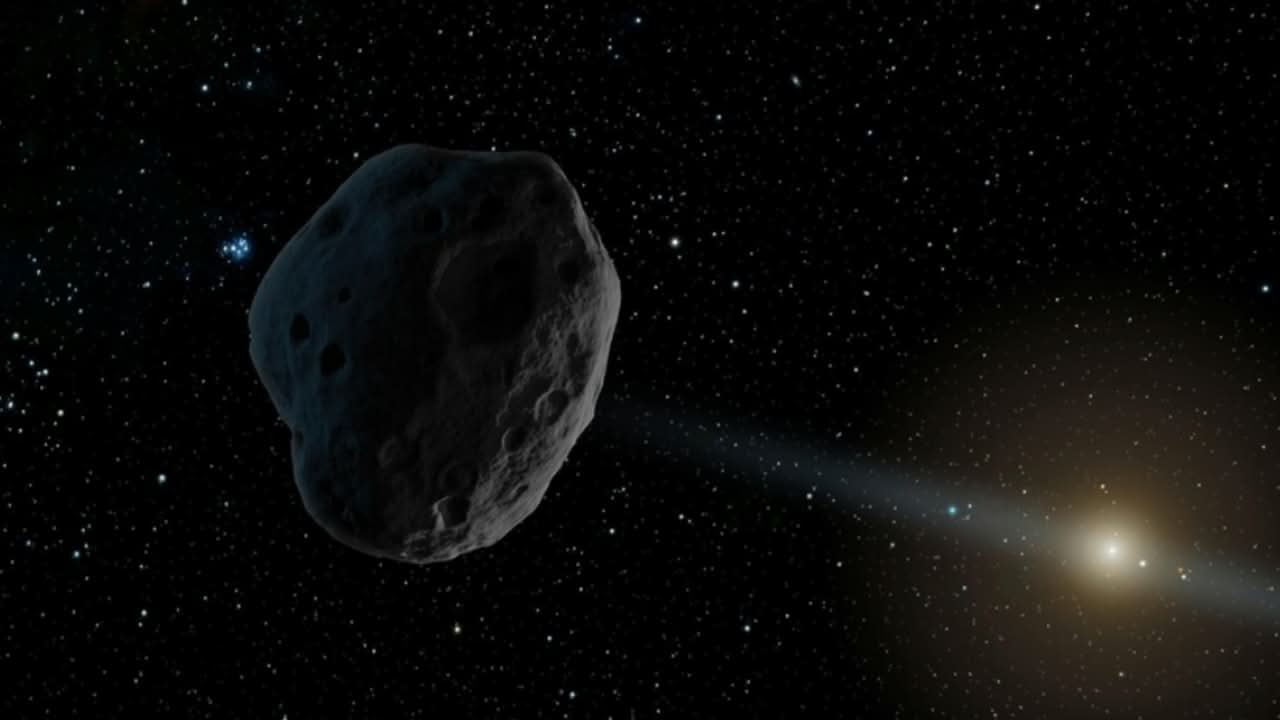
Researchers at the Georgia Institute of Technology report that the 11-meter asteroid 1998 KY26 is speeding up in a way that frozen water cannot explain. Their thermal calculations, published in the journal Icarus, indicate that the rock is too warm to keep the ice that a so-called dark comet would need to move.
A dark comet is a theoretical body rich in volatile substances that pushes itself forward by releasing gas, without the bright tail seen on ordinary comets. Telescopes on Earth cannot spot that tail. Because the object’s thrust exceeds the push produced by sunlight alone, the team now treats the loss of dust grains flung off by fast rotation as the main propulsion mechanism under investigation.
Measurements that rule out a hidden ice engine
Discovered at the University of Arizona in 1998, the small rock draws attention from astronomers because of its unusual motion and its periodic approaches to Earth’s orbit. Decades of monitoring have produced a set of numbers that describe how the body behaves in the vacuum of space.
- Average diameter: about 11 meters (36 feet)
- Rotation period: 5.35 minutes per full turn
- Coldest interior zones, averaged over the orbit: about -47°C
- Temperature below which water ice can survive in space: -128°C
- Time for the heat to vaporize 1% of ice by mass: about 2,000 years
- Time for an ice reserve to power the motion alone: 62 years
- Probable origin: inner main asteroid belt, on the warm side of the solar system’s ice line
The body spins so quickly that centrifugal force overwhelms its weak surface gravity. That imbalance lets fine sediment and tiny fragments break loose from the crust and drift away.
Heat models leave no room for ice under the surface
The Georgia Tech team estimated how much heat the surface and the subsurface absorb using physical models. The work did not require sending instruments to the rock. Instead, it relied on albedo, which is the share of sunlight a surface reflects, along with its mineral makeup and the time it spends in sunlight.
Even in areas of permanent shadow and in the coolest spots of its structure, the asteroid does not drop below -47°C in the orbit-averaged estimate. Physicists note that water ice remains stable in space only below -128°C.
If ice made up just 1% of the asteroid’s mass, the absorbed heat would turn all of it into vapor in about 2,000 years. The team also tested the gas-jet idea, and if the observed push came only from ice vapor, all the volatile material would have run out in roughly 62 years. The object has been crossing space for far longer than that, so the numbers do not fit a disguised ordinary comet. In practical terms, the rock would already be dry.
Why the asteroid probably formed without frozen water
The rock’s origin also weakens the comet hypothesis. Projections indicate it came from the main asteroid belt, the region between the orbits of Mars and Jupiter.
That zone sits on the warm side of the ice line, the boundary where volatile compounds could condense during the birth of the planets. Bodies formed there lacked the large primordial reserves of surface ice found in comets from the Kuiper belt or the Oort cloud.
Check out: Mars north pole water ice holds only 3% dust, new study reveals
From the 1998 discovery to the 2026 thermal study
Scientists’ understanding of small bodies with non-gravitational accelerations has changed in clear steps, shown in the timeline below.
- May 28, 1998: The Spacewatch project at the University of Arizona detects the object.
- 1999: Radar observations published in Science estimate a diameter of about 30 meters and a rotation period of 10.7 minutes.
- 2024: Keck and Gemini telescopes record new images and spectra as the asteroid passes close to Earth.
- 2025: A revised analysis in Nature Communications sets the diameter at 11 meters and the rotation at 5.35 minutes.
- 2026: Georgia Tech researchers show the rock is too warm to keep ice and propose that dust is ejected mechanically.
- July 2031: The Hayabusa2 spacecraft is scheduled to arrive at the asteroid.
Dust flung from the surface replaces gas as the push
Ordinary asteroids move passively under the gravity of the planets and the Sun. Their only standard thermal effect is the Yarkovsky effect, in which the rock absorbs sunlight, heats up and re-emits infrared photons with a slight rotational delay, producing a tiny recoil.
The acceleration measured for 1998 KY26 exceeds that basic estimate. With frozen gas ruled out, the researchers point to dust grains leaving the surface as the force that pushes the body forward along its path.
As the asteroid spins, loose surface material, known as regolith, loses its hold and escapes into space. The coordinated release of these particles transfers momentum to the rock, which moves forward in a way similar to gas escaping from a combustion chamber.
Hayabusa2 arrival in July 2031 may settle the question
Confirmation of the mechanical model depends on data collected close to the rock. The Japan Aerospace Exploration Agency (JAXA) spacecraft Hayabusa2 has finished its first mission, which returned samples from the asteroid Ryugu, and is now cruising toward 1998 KY26.
The agency’s schedule puts the probe at the small asteroid in July 2031. Onboard optical instruments and spectrometers are expected to record the surface texture, the actual loss of particles and the detailed mineralogy of the rock.