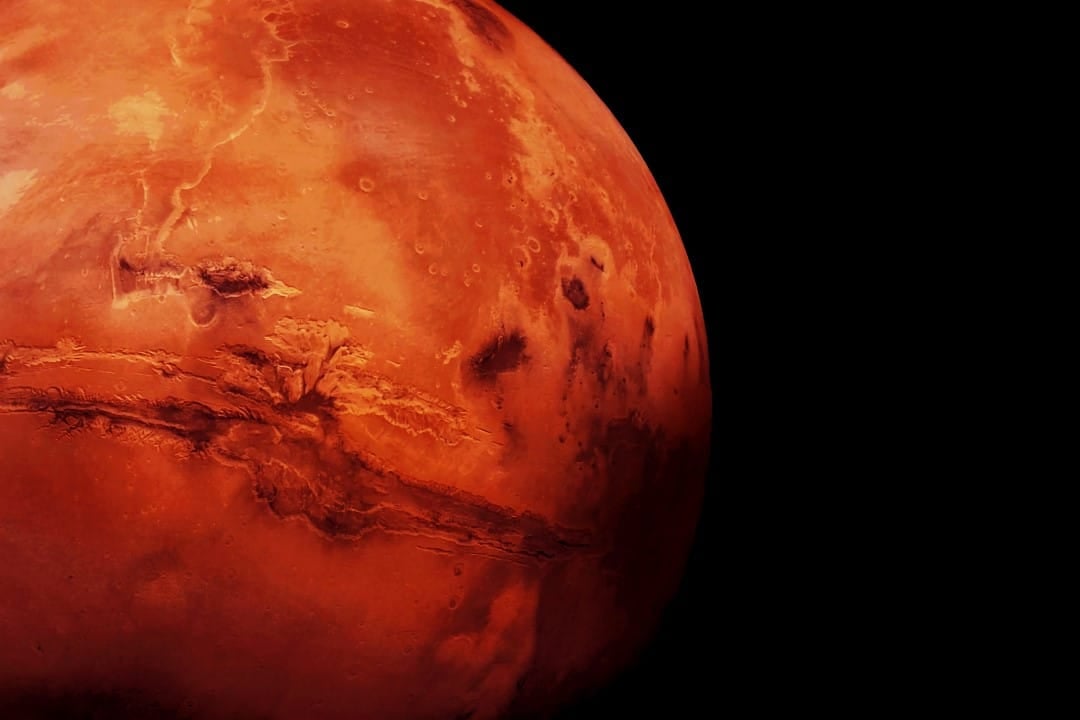
Mars north pole water ice holds approximately 3% dust by mass, according to a University of Washington study that overturns long-held scientific assumptions about the climate of the Red Planet. The recalculation replaces prior estimates that placed dust concentrations as high as 25%, demonstrating that the exposed northern polar cap is considerably cleaner, brighter, and more reflective than previously documented.
Because clean ice possesses a higher albedo, it reflects substantially more solar radiation back into space, retains less thermal energy, and reduces the volume of water vapor lost to the atmosphere through sublimation. “We know there is water ice in the area surrounding the north pole of Mars, but there has been widespread disagreement as to how dusty that ice is,” said Aditya R. Khuller, senior research scientist at the Applied Physics Laboratory and the Polar Science Center at the University of Washington. “If it is dustier, the ice will be darker. Just like a dark T-shirt in the sun makes you warmer, dusty ice gets warmer and vaporizes faster on Mars.”
See also: Oklahoma meteor impact severed from Ordovician event in new dating
Earth snow methodology applied to Martian ice caps
The revised findings stem from a fundamental shift in how planetary scientists analyze optical data collected from orbit. Previous evaluations relied on optical scatter models designed for dry lunar regolith on the Moon, a framework that produced distorted results when applied to ice-rich environments. When Aditya R. Khuller tested those lunar-derived equations against terrestrial glaciers, the math failed to describe physical reality on Earth, prompting the research team to discard that approach in favor of radiative transfer formulations developed specifically for snow and ice by Stephen Warren, professor emeritus of Earth and space sciences at the University of Washington.
Lead author Pari Mohan, who completed her undergraduate degree in geosciences at the University of Washington and continued her academic work affiliated with the University of Edinburgh, executed the recalculations alongside Khuller using Warren’s decades-old Earth standards. “His methods had been used successfully to study snow and ice on Earth for decades,” Khuller said. “So I thought it would be interesting to adapt these Earth-tested methods to Mars.” By integrating Warren’s principles with spectral data gathered by NASA’s Mars Reconnaissance Orbiter, the European Space Agency’s Mars Express, and surface measurements from the Phoenix lander, the team established that the surface ice contains a fraction of the particulate debris previously assumed.
Follow: IRAS 18293−0941 microblazar confirmed with relativistic jet facing Earth
Core measurements from the Mars polar ice evaluation
- 3% — average dust content by mass identified in the exposed north polar water ice
- 25% — previous maximum dust percentage accepted under older lunar regolith models
- 0.2% to 0.4% — recalculated dust concentration in the upper ice layer of Korolev crater, down from prior estimates of 15% to 22%
- 1 meter — approximate depth of the seasonal carbon dioxide frost layer covering the northern water ice in winter
- 1/3 — estimated fraction of the Martian surface blanketed by shallow ice sheets during past glacial maximums
Layered structure reveals seasonal carbon dioxide cycles on Mars
The Martian northern polar cap is structured like an expansive layered sandwich, where strata of relatively pure water ice alternate with darker, dust-laden bands accumulated during past atmospheric cycles and historical snowstorms. The uppermost deposit, known as the North Polar Residual Cap, rests directly above deep layered terrain that extends downward for hundreds of meters across the polar basin. Satellite instruments tracked changes in surface reflectivity across multiple Martian years to distinguish ephemeral dust from permanent glacial deposits.
Read also: Apple seeds iOS 27.2 beta 3 with redesigned Health app and new Siri AI features
During the Martian winter, frigid atmospheric temperatures cause carbon dioxide to freeze directly out of the thin air, forming a seasonal frost blanket approximately 1 meter deep over the northern cap. This winter frost traps airborne particulates and temporarily darkens the region. When spring and summer arrive, the carbon dioxide layer sublimates back into gas, exposing the underlying permanent water ice. “By looking at how the brightness changed over time, we figured out that there is a frost that forms in the winter and it’s more dusty,” Khuller said. “In the Martian summer it goes away, exposing cleaner, older ice.”
Six northern polar regions reanalyzed across Mars
- Phoenix lander touchdown site: surface spectral readings reexamined from the May 25, 2008 mission
- Korolev crater: an isolated northern impact basin containing an upper ice sheet with only 0.2% to 0.4% dust
- Louth crater: a low-latitude northern depression hosting a perennial water-ice mound
- Chasma Boreale: a massive canyon carving through stratified polar deposits, exposing distinct vertical ice layers
- North Polar Residual Cap site one: high-latitude perennial ice tested for summer albedo variations
- North Polar Residual Cap site two: reference plateau showing uniform reflectivity after carbon dioxide sublimation
Check out: GIMLI lunar mission selected by NASA to inspect Marius Hills Pit
Implications of polar dust for ancient Martian habitability
Unlike Earth, which maintains a stable rotational tilt due to the gravitational anchor of a large Moon, Mars experiences extreme axial oscillations over millions of years because its small moons, Phobos and Deimos, provide negligible stabilization. When the tilt of Mars shifts dramatically, polar glaciers become unstable, redistributing water ice across up to one-third of the planet’s surface during severe glacial epochs. The proportion of dust trapped in those migrating sheets directly dictated how long ice could persist on the surface before vaporizing into space.
The presence of dust also governed potential biological niches in the Martian past. In epochs when dirtier ice layers were exposed directly to sunlight, dark mineral particles would have absorbed solar heat, melting surrounding ice to generate localized subsurface pockets of liquid water enriched with mineral nutrients. On Earth, comparable cryoconite holes and dusty melt pools harbor active microbial ecosystems that freeze during winter and revive during summer melt cycles. “The fact that Mars and Earth both have these similar layers of water ice and dust is interesting,” Khuller said. “Why does one planet have life and the other doesn’t?”
Keep reading: GrayKey Preserve defeats Apple 72-hour iPhone timer to keep police access
Whether transient melt pockets ever supported biological activity remains unproven, as no direct evidence of past or present life has been detected on Mars. The peer-reviewed research was published on Tuesday, September 8, 2026, in the academic journal npj Space Exploration, followed by a detailed technical briefing released by the University of Washington on Tuesday, September 29, 2026.