

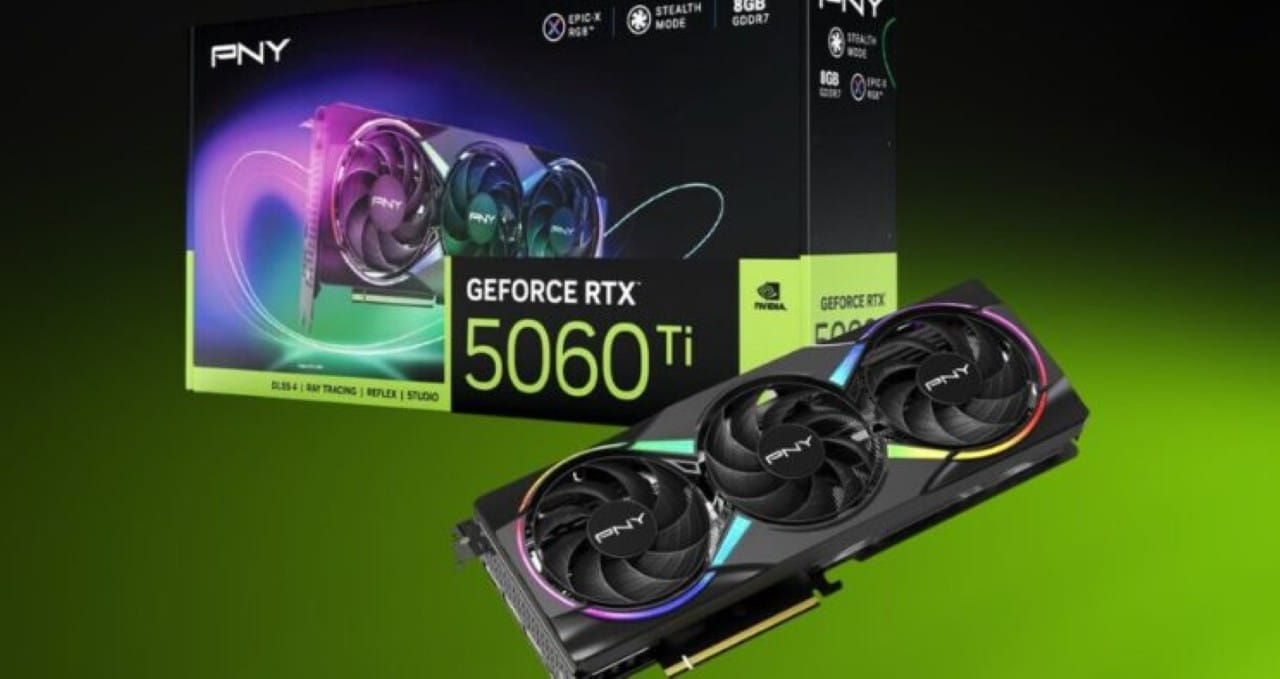
NVIDIA announced on April 15 a new lineup of graphics cards set to redefine performance and visual quality for gamers and tech enthusiasts. The GeForce RTX 5060 family, powered by the advanced Blackwell architecture, hits the market with the GeForce RTX 5060 Ti available from April 16, followed by the standard RTX 5060 in May. Priced from $299, these GPUs introduce support for DLSS 4 with Multi-Frame Generation, full ray tracing, and other innovations that double the performance of the previous generation. Additionally, new games like Black Myth: Wukong and EXFIL already support these technologies, delivering more immersive visual experiences.
The GeForce RTX 5060 Ti comes in two variants: 8 GB for $379 and 16 GB for $429. These models target gamers seeking robust performance at resolutions like 1080p and 1440p, capable of running demanding titles at maximum settings. The standard RTX 5060, with 8 GB of memory, focuses on the entry-level segment, offering a balance of cost and performance for those looking to leverage NVIDIA’s latest innovations without breaking the bank.
Built on the Blackwell architecture, the new GPU family incorporates 5th-generation Tensor Cores and 4th-generation RT Cores. These enhancements boost efficiency in AI processing and ray tracing, resulting in more realistic graphics and higher frame rates. DLSS 4, the centerpiece of the lineup, uses transformer-based AI models to generate up to three additional frames per rendered frame, multiplying performance by up to 8 times compared to traditional rendering.
- DLSS 4 Multi-Frame Generation: Generates up to three extra frames, enhancing smoothness in games.
- Full ray tracing: Delivers realistic lighting, shadows, and reflections in real time.
- NVIDIA Reflex: Reduces latency, improving responsiveness in competitive games.
- Neural rendering: Enhances visual quality with advanced AI techniques.
Blackwell architecture: the core of RTX 5060
The Blackwell architecture marks a significant leap over its predecessor, Ada Lovelace. Designed to optimize neural rendering, it integrates artificial intelligence into graphics processing. The 5th-generation Tensor Cores deliver up to 2.5 times better performance in AI tasks, while the 4th-generation RT Cores accelerate ray tracing, enabling smoother gameplay in graphics-intensive titles.
With the inclusion of Flip Metering hardware, Blackwell improves frame synchronization, ensuring a smoother experience. Unlike DLSS 3, which relied on CPU-based synchronization, the new system leverages the GPU’s display engine, reducing inconsistencies and latency. The display engine has also been upgraded, doubling pixel processing capacity to support higher resolutions and refresh rates, such as 4K at 480 Hz or 8K at 165 Hz.
The GeForce RTX 5060 Ti, for instance, uses the GB206 chip, featuring 4,608 CUDA Cores, 36 SMs, 24 TFLOPs of shading performance, and 759 TOPs of AI performance. Its GDDR7 memory, with speeds of 28 Gbps and a bandwidth of 448 GB/s, offers a 55.5% increase over the RTX 4060 Ti. These specifications ensure the card can handle the demands of modern games, particularly those using ray tracing and high-resolution textures.
DLSS 4: a rendering revolution
The standout feature of the RTX 5060 family is DLSS 4, which introduces Multi-Frame Generation. This technology allows the GPU to generate up to three additional frames for each traditionally rendered frame, significantly boosting frame rates. In games like Cyberpunk 2077, NVIDIA claims performance can increase by up to 8 times in ray-tracing scenarios, while maintaining near-native visual quality.
DLSS 4 also incorporates transformer-based AI models, a first in the graphics industry. These models enhance temporal stability, reduce visual artifacts like ghosting, and improve detail in fast-moving scenes. In Warhammer 40,000: Darktide, for example, DLSS that 4 reduced memory usage by 400 MB and boosted frame rates by 10% at 4K with maximum settings.
The technology further enhances Super Resolution, Ray Reconstruction, and DLAA (Deep Learning Anti-Aliasing). Super Resolution uses AI to reconstruct higher-resolution images with lower computational cost, while Ray Reconstruction improves ray-tracing quality, making reflections and shadows more accurate. DLAA provides advanced anti-aliasing, ideal for native resolutions.
Games supporting DLSS 4 Multi-Frame Generation
DLSS 4 adoption has been swift, with over 100 games and applications supporting the technology since its debut in January 2025. At the RTX 5060 launch, NVIDIA highlighted four new titles leveraging Multi-Frame Generation for superior performance and visual quality.
- Black Myth: Wukong: An action RPG with stunning visuals, optimized for ray tracing and DLSS 4, delivering over 100 FPS at 1440p.
- EXFIL: A tactical shooter using DLSS 4 to enhance smoothness in dynamic scenarios with heavy particle effects.
- No More Room In Hell 2: A survival game with ray-tracing support, where DLSS 4 ensures stable performance in dense environments.
- SQUAD: A team-based shooter benefiting from NVIDIA Reflex’s low latency and Multi-Frame Generation’s FPS boost.
Other titles, including Alan Wake 2, Cyberpunk 2077, and Hogwarts Legacy, have received DLSS 4 updates, while upcoming games like DOOM: The Dark Ages and Half-Life 2 RTX will feature native Multi-Frame Generation support. NVIDIA’s App also offers an override feature, enabling DLSS 3 games to automatically adopt DLSS 4 improvements, expanding compatibility.
Performance and target audience
The GeForce RTX 5060 Ti targets gamers seeking top-tier performance at 1440p and, in some cases, 4K. NVIDIA’s internal tests show the RTX 5060 Ti 16 GB is up to 20% faster than the RTX 4060 Ti in rasterized rendering, but the real gains come with DLSS 4. In Hogwarts Legacy, the card achieves 61 FPS at 1440p without Frame Generation, compared to 34 FPS for the RTX 3060 Ti, and with Multi-Frame Generation, performance can double.
The standard RTX 5060, priced at $299, is ideal for 1080p gamers seeking an affordable GPU with modern features. Though limited to 8 GB of memory, it significantly outperforms the RTX 4060, especially in DLSS 4-enabled games. In Black Myth: Wukong, the RTX 5060 delivers over 80 FPS at 1080p with high settings, making it a compelling choice for budget-conscious gamers.
NVIDIA notes that over 50 million gamers still use GPUs from the 10, 20, and 30 series (Pascal, Turing, and Ampere). For these users, the RTX 5060 offers a substantial upgrade, bringing full ray tracing, DLSS 4, and support for higher resolutions at a competitive price.
Availability and models
The GeForce RTX 5060 Ti will be available from April 16 in 8 GB and 16 GB variants, manufactured by partners like ASUS, MSI, GIGABYTE, PNY, and ZOTAC. Factory-overclocked and custom-designed models will also be offered, catering to diverse preferences and budgets. The standard RTX 5060 arrives in May, exclusively in an 8 GB configuration, starting at $299.
Laptops equipped with the RTX 5060 will also launch in May, with prices starting at $1,099. These machines promise up to twice the performance of their predecessors, supporting DLSS 4 and NVIDIA Reflex for ray-traced gaming at over 100 FPS and competitive titles exceeding 300 FPS.
NVIDIA recommends installing the new Game Ready Driver to maximize RTX 5060 performance. Optimized for DLSS 4, ray tracing, and Blackwell architecture, the driver ensures compatibility with the latest games.
Impact on the GPU market
The RTX 5060 family launch comes amid high demand for GPUs, with competitors like AMD and Intel also introducing new solutions. AMD’s Radeon RX 9070 and Intel’s Arc B580 and B570 have faced stock challenges, while NVIDIA’s RTX 50 series, including the RTX 5090 and RTX 5070, sold out quickly at launch. NVIDIA expects the RTX 5060, with its accessible price, to appeal to a broad consumer base, from casual gamers to enthusiasts.
NVIDIA’s focus on AI-driven technologies like DLSS 4 strengthens its market position. Neural rendering, blending AI with traditional graphics, is becoming a competitive edge, enabling RTX GPUs to deliver visuals previously exclusive to high-end hardware. With over 700 RTX-compatible games and applications, NVIDIA continues to expand its ecosystem.
Upcoming games and updates
Beyond the four games announced with DLSS 4 Multi-Frame Generation support, NVIDIA revealed additional titles receiving updates soon. Enotria: The Last Song, THE FINALS, and Wild Assault joined the DLSS 4 lineup on April 7, while Half-Life 2 RTX, a community remaster, has supported the technology since March. These releases underscore NVIDIA’s commitment to integrating its innovations into popular games.
The NVIDIA App simplifies game optimization for DLSS 4. Its override feature allows players to enable Multi-Frame Generation in titles lacking official updates, broadening the technology’s reach. In Enotria: The Last Song, DLSS 4 boosts frame rates by up to 5 times at 4K, enabling gameplay above 230 FPS.
Looking ahead, games like FBC: Firebreak from Remedy Entertainment and KARMA: The Dark World will feature native DLSS 4 support, with releases slated for summer 2025. NVIDIA also plans to extend support to new genres, including indie games and virtual reality titles, ensuring the technology reaches diverse audiences.
Detailed technical specifications
The RTX 5060 Ti uses the GB206 chip with 21.9 billion transistors across a 181 mm² area. It features 48 ROPs, 144 TMUs, and consumes 180W, improving energy efficiency over its predecessor. The PCIe Gen5 x8 interface ensures higher bandwidth, while support for 4K at 480 Hz or 8K at 165 Hz meets the needs of gamers and content creators.
The RTX 5060, though less powerful, remains competitive for its price range. With 8 GB of GDDR7 memory and 448 GB/s bandwidth, it handles modern games at 1080p with high settings, particularly with DLSS 4. NVIDIA has not disclosed the exact CUDA Core count for the RTX 5060, but it likely uses a scaled-down GB206 chip.
Comparison with the previous generation
Compared to the RTX 4060 Ti, the RTX 5060 Ti offers significant improvements. Beyond a 20% boost in rasterized performance, the new GPU shines with DLSS 4, unavailable on the 40 series. In Cyberpunk 2077, the RTX 5060 Ti delivers double the frame rates of the RTX 4060 Ti with Multi-Frame Generation, while latency is halved thanks to NVIDIA Reflex.
The RTX 5060 outperforms the RTX 4060 in DLSS 4 scenarios, offering performance close to higher-tier GPUs from the previous generation, like the RTX 3060 Ti, at a lower price. This blend of affordability and advanced features makes the RTX 5060 appealing for budget upgrades.
Launch timeline
NVIDIA has strategically planned the RTX 5060 family rollout to meet market demand. Key dates include:
- April 16, 2025: Launch of GeForce RTX 5060 Ti (8 GB and 16 GB).
- May 2025: Launch of GeForce RTX 5060 (8 GB) and RTX 5060 laptops.
- Summer 2025: Release of DLSS 4-supported games like FBC: Firebreak and KARMA: The Dark World.
- Second half of 2025: Expanded DLSS 4 support for titles like DOOM: The Dark Ages.
Benefits for diverse audiences
The RTX 5060 family isn’t just for gamers. Content creators, such as video editors and 3D designers, benefit from neural rendering and AI performance. Software like Blender and Adobe Premiere Pro leverages Tensor Cores to accelerate rendering and media upscaling. Support for 8K resolutions also makes these GPUs ideal for professional workflows.
For competitive gamers, NVIDIA Reflex is a game-changer. In THE FINALS, latency dropped from 27 ms to 14 ms with Reflex 2, ensuring greater precision in online matches. Combined with Multi-Frame Generation, this allows high frame rates without compromising visuals.
NVIDIA also targets the laptop market, where the RTX 5060 aims to redefine portable gaming. With DLSS 4, these devices run ray-traced games at high settings, a feat previously limited to high-end desktops. Starting at $1,099, RTX 5060 laptops are accessible to students and professionals needing mobility.
2025 market context
The GPU market in 2025 is fiercely competitive, with NVIDIA facing stock challenges similar to its rivals. High demand for RTX 50 GPUs, particularly the RTX 5090, suggests the RTX 5060 may face availability issues at launch. NVIDIA is collaborating with partners to ensure large-scale production, but consumers should monitor retailer stock.
AMD’s Radeon RX 9070 and Intel’s Arc B580 offer alternatives in the entry and mid-range segments, but NVIDIA’s RTX ecosystem remains a standout. Support for over 700 games and applications, paired with DLSS 4 and Reflex, creates a compelling value proposition. Rapid DLSS 4 adoption by developers further cements NVIDIA’s market relevance.
Advances in AI and neural rendering
Neural rendering, a cornerstone of the Blackwell architecture, blends AI with traditional graphics for more realistic visuals. In Alan Wake 2, neural rendering enhances dynamic lighting and shadow effects, while DLSS 4 ensures performance remains uncompromised. This approach is reshaping game development, enabling studios to create immersive worlds without requiring top-tier hardware.
NVIDIA’s RTX Remix tool empowers modders to modernize classic games with technologies like DLSS 4 and ray tracing. Half-Life 2 RTX, for instance, reimagines the 2004 classic with contemporary graphics. Such initiatives highlight NVIDIA’s dedication to keeping its technology relevant for both new and legacy titles.
Future outlook
The RTX 5060 family is just the beginning of NVIDIA’s next chapter. With Blackwell and DLSS 4, the company sets a high bar for graphics performance. Throughout 2025, more games are expected to adopt Multi-Frame Generation, while NVIDIA expands support to new categories like augmented reality and AI applications.
Integration of technologies like NVIDIA ACE, which creates interactive digital characters, points to a future where AI plays a central role in gaming. In demos, ACE enabled lifelike NPCs that respond to voice commands and dynamically interact with players. While early-stage, this technology could leverage RTX 5060 GPUs, particularly in laptops and entry-level systems.
NVIDIA also addresses budget-conscious gamers. The $299 RTX 5060 responds to demand for affordable GPUs with cutting-edge features, potentially attracting new users in emerging markets where cost is critical.
In-depth specifications and performance
The RTX 5060 Ti, with 4,608 CUDA Cores and 759 TOPs of AI performance, is among the most powerful mid-range GPUs. Its 28 Gbps GDDR7 memory ensures sufficient bandwidth for modern games, while 180W consumption suits compact systems. PCIe Gen5 support, though not fully utilized by most systems, future-proofs the card.
The RTX 5060, with 8 GB of GDDR7 and 448 GB/s bandwidth, handles 1080p gaming with high settings, especially with DLSS 4. Its CUDA Core count remains undisclosed but is expected to be a scaled-down GB206 variant. In Black Myth: Wukong, the RTX 5060 Ti 16 GB hits 120 FPS at 1440p with ray tracing and DLSS 4, compared to 60 FPS for the RTX 4060 Ti, while the RTX 5060 achieves 90 FPS at 1080p.
Lasting impact of RTX 5060
The GeForce RTX 5060 family democratizes advanced technologies like DLSS 4 and full ray tracing. With affordable pricing and up to twice the performance of the previous generation, the RTX 5060 and RTX 5060 Ti appeal to gamers and creators alike. Rapid DLSS 4 adoption, with over 100 supported games, ensures immediate market impact.
The April 16 (RTX 5060 Ti) and May (RTX 5060 and laptops) launches mark a pivotal moment for NVIDIA, reinforcing its leadership in a competitive landscape. With Blackwell and Multi-Frame Generation, NVIDIA redefines graphical possibilities, delivering a blend of performance, visual quality, and affordability.