

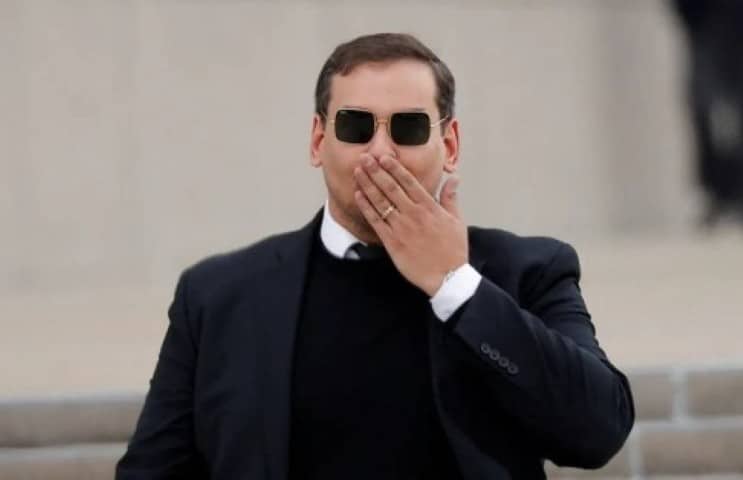
George Santos, the former Republican congressman from New York, was sentenced to 87 months in prison for a series of financial fraud and identity theft crimes, marking the culmination of a scandal-ridden political career defined by lies and deceit. The ruling, handed down on April 25, 2025, in the Federal District Court in Central Islip, Long Island, also ordered Santos to pay approximately $373,750 in restitution and serve two years of supervised release after his sentence. Judge Joanna Seybert, presiding over the case, labeled Santos an “arrogant fraudster” who deceived voters, donors, and colleagues with a carefully woven network of falsehoods that fueled his rapid rise and equally dramatic fall. Visibly emotional during the sentencing, Santos was ordered to report to prison by July 25.
Santos’ tenure in the U.S. House of Representatives lasted a mere 11 months, ending with his expulsion in December 2023, a rare event in American political history. He became the first congressman expelled without a prior conviction since the Civil War, a decision driven by a damning House Ethics Committee report that uncovered evidence of serious violations of federal law. Even before taking office in January 2023, cracks in Santos’ fabricated persona began to surface, revealing that much of his personal and professional history was a lie. His case quickly became a national spectacle, cementing his reputation as a symbol of political dishonesty.
The crimes for which Santos was convicted spanned his 2020 and 2022 election campaigns. In a plea deal reached in August 2024, he admitted to inflating fundraising figures, falsifying donations, and stealing financial information from donors, including elderly individuals and those with cognitive impairments. Additionally, he misled the electorate by lying about his education, professional experience, and even his heritage, falsely claiming his family had fled the Holocaust—a claim later debunked. These actions not only violated federal law but also eroded public trust in the electoral process.
Meteoric rise built on brazen lies
Santos first gained prominence in 2022 when he won a congressional seat representing parts of Queens and Long Island, helping Republicans secure a crucial seat in the House. Born to Brazilian immigrants, he presented himself as a unique figure: a young, openly gay supporter of Donald Trump with an impressive resume. His campaign touted credentials such as a successful Wall Street career and connections to national tragedies like 9/11. However, investigative journalism soon exposed these claims as fabrications, unraveling the myth Santos had constructed.
He claimed to have worked at prestigious investment banks like Goldman Sachs and Citigroup, but neither institution could verify his employment. He also stated he graduated from New York University, another falsehood. His assertions about his Jewish heritage and alleged ties to Holocaust survivors were similarly disproven, prompting him to quip that he was merely “Jew-ish,” a play on the word “Jewish.” These revelations shattered his credibility before he even took office, yet Santos initially refused to resign, adopting a defiant stance.
Mounting legal troubles intensified the pressure on Santos. In May 2023, federal prosecutors filed 23 criminal charges against him, including money laundering, wire fraud, and theft of unemployment benefits during the Covid-19 pandemic. Despite these allegations, Santos remained in the public eye, making provocative statements and even monetizing his notoriety by selling personalized videos on the Cameo platform for up to $500 each.
Financial schemes and harm to victims
Court documents laid bare the extent of Santos’ “brazen web of deceit,” as described by prosecutors. During his campaigns, he manipulated Federal Election Commission (FEC) reports to inflate fundraising totals, fabricating donations from relatives and nonexistent loans. These falsifications enabled his campaign to meet the $250,000 threshold required to join the Republican National Committee’s “Young Guns” program, securing critical party support.
Santos also stole financial information from donors, including credit card details from vulnerable individuals, to fund lavish personal expenses. Records show he spent tens of thousands of dollars on luxury items, such as clothing from Hermès and Ferragamo, cosmetic treatments like Botox, and subscriptions to OnlyFans. These expenditures, made with misappropriated campaign funds, shocked the public and reinforced the image of a politician driven by personal enrichment.
- Campaign fraud: Santos fabricated contributions, including from nonexistent donors.
- Identity theft: He misused financial data from nearly a dozen people, including relatives, to divert funds.
- Unlawful benefits: During the pandemic, he collected unemployment benefits while employed, totaling thousands of dollars.
- Personal spending: Campaign funds were used for luxury purchases, travel, and personal services, violating election laws.
These actions not only harmed donors but also undermined confidence in the electoral system, prosecutors argued. Judge Seybert emphasized Santos’ “arrogance” and lack of genuine remorse as justification for the harsh sentence, rejecting defense requests for a minimum two-year term.
Timeline of key events
Santos’ journey from political hopeful to convicted felon unfolded rapidly. Below is a chronology of pivotal moments:
- 2020: Santos runs for Congress but loses, already engaging in fraudulent fundraising practices.
- 2022: He wins election to the House, representing Queens and Long Island, with a campaign built on lies.
- December 2022: Media reports expose inconsistencies in his resume, triggering investigations into his background.
- May 2023: Santos faces 23 criminal charges, including fraud and money laundering, but pleads not guilty.
- December 2023: Expelled from the House, becoming the first congressman removed without a conviction since the Civil War.
- August 2024: Santos pleads guilty to wire fraud and identity theft, avoiding a trial.
- April 2025: Sentenced to 87 months in prison, ordered to pay $373,750 in restitution.
This timeline underscores the speed of Santos’ downfall, transforming him from a Republican rising star to a cautionary tale.
Public reaction and political fallout
Santos’ expulsion from Congress in 2023 was a historic moment, but it also sparked debates about the integrity of the electoral system. His seat was reclaimed by Democrat Tom Suozzi in a February 2024 special election, reversing the Republican gain of 2022. The loss weakened the GOP’s slim House majority, highlighting the broader political consequences of Santos’ actions.
On social media, Santos remained a polarizing figure. Even after his guilty plea, he posted messages portraying himself as a “scapegoat” and made baseless accusations against the Justice Department, calling it a “cabal of pedophiles.” Prosecutors cited these posts as evidence of his lack of remorse, influencing the judge’s decision for a longer sentence. His defense, meanwhile, argued he had accepted responsibility and pledged to repay nearly $580,000 in restitution and forfeiture.
The sentencing elicited varied responses from the public and analysts. For many in Long Island, Santos’ imprisonment brought relief but also frustration over the delayed justice. Local groups like Concerned Citizens NY-03 voiced anger that he remained free for over a year post-expulsion. Media coverage underscored the case’s uniqueness, with commentators noting that Santos’ saga exposed gaps in the vetting of political candidates.
The price of notoriety
Before his sentencing, Santos sought to profit from his infamy. After his expulsion, he gained traction on Cameo, charging hundreds of dollars for custom videos. He also appeared on TV shows and podcasts, maintaining a public presence many deemed provocative. As his sentencing date neared, however, his tone shifted, and he expressed resignation about his impending imprisonment.
In a phone interview days before the ruling, Santos said he was “fully resigned” to serving over seven years in prison. He lamented that his life had been reduced to “one bad moment,” but failed to convince Judge Seybert of his sincerity. The judge criticized his tendency to blame others, asking, “Where is your remorse? Where do I see it?” Santos’ tearful response did little to mitigate the maximum recommended sentence.
The case also raised questions about campaign finance regulation in the U.S. Experts noted that inadequate candidate vetting allowed someone with a history of deception to reach Congress. The misuse of campaign funds for personal expenses highlighted loopholes in election laws, fueling calls for reform.
Sentencing details and next steps
The 87-month sentence includes two years of supervised release, during which Santos will be monitored by authorities. He was ordered to immediately pay $373,750 in restitution, a sum reflecting only a portion of the funds he misappropriated from donors and public benefits. Judge Seybert stressed that the sentence was necessary to protect the public from future fraud, given Santos’ pattern of behavior.
While his guilty plea spared him a trial, Santos’ continued controversial public statements undermined his defense. Prosecutors pointed to his social media activity as proof of his lack of contrition, contrasting with his courtroom expressions of regret. His defense countered that he was attempting to rebuild his life, citing his podcast appearances as a means to raise funds for his debts.
- Restitution: Santos must pay $373,750 immediately, plus $205,002.97 in forfeiture.
- Supervised release: He will be monitored for two years post-incarceration.
- Reporting date: Santos must surrender to prison by July 25, 2025.
- Financial impact: The restitution covers only part of the damage to donors and public systems.
Lessons from a political scandal
The George Santos case transcends the story of a dishonest politician, serving as a warning about vulnerabilities in the U.S. political system. His ability to deceive voters, donors, and his own party exposed flaws in candidate screening and campaign oversight. The ease with which he manipulated financial reports and siphoned funds underscored the need for greater transparency in election financing, a topic still under debate in Washington.
For Long Island voters, Santos’ saga left a sense of betrayal. Many who backed his 2022 campaign felt misled by his promises and persona. Tom Suozzi’s 2024 special election victory was seen as an effort to restore trust in local representation, but Santos’ actions continue to resonate in the region.
The case also reignited discussions about political polarization and the media’s role in holding public figures accountable. While some criticized the intense focus on Santos’ personal life, others argued that the press was instrumental in uncovering his lies. The saga highlighted the value of investigative journalism in an era of rampant misinformation.
Santos’ future and lasting legacy
At 36, Santos faces an uncertain future, with most of the next decade to be spent behind bars—a stark contrast to the high-profile life he once sought. His attempts to reinvent himself as a media figure, through Cameo videos or podcast appearances, were cut short by the severity of his crimes. Even after serving his sentence, he will likely struggle to rebuild his life, given the stigma of his conviction.
Santos’ legacy extends beyond his personal story. He has become a symbol of the consequences of political dishonesty in an age of growing distrust in institutions. His rise and fall serve as a case study in how unchecked ambition and ethical lapses can erode public confidence. For Republicans, the case was an embarrassing reminder of the need for rigorous candidate vetting, while Democrats seized the opportunity to advocate for greater transparency.
The sentencing of Santos closes a tumultuous chapter in American politics, but its repercussions will linger. As he prepares to serve his sentence, the debate over preventing similar cases continues, with lawmakers and analysts calling for reforms to strengthen electoral integrity. For Santos, the cost of his lies was steep, but for society, the price of his actions may be even higher.