
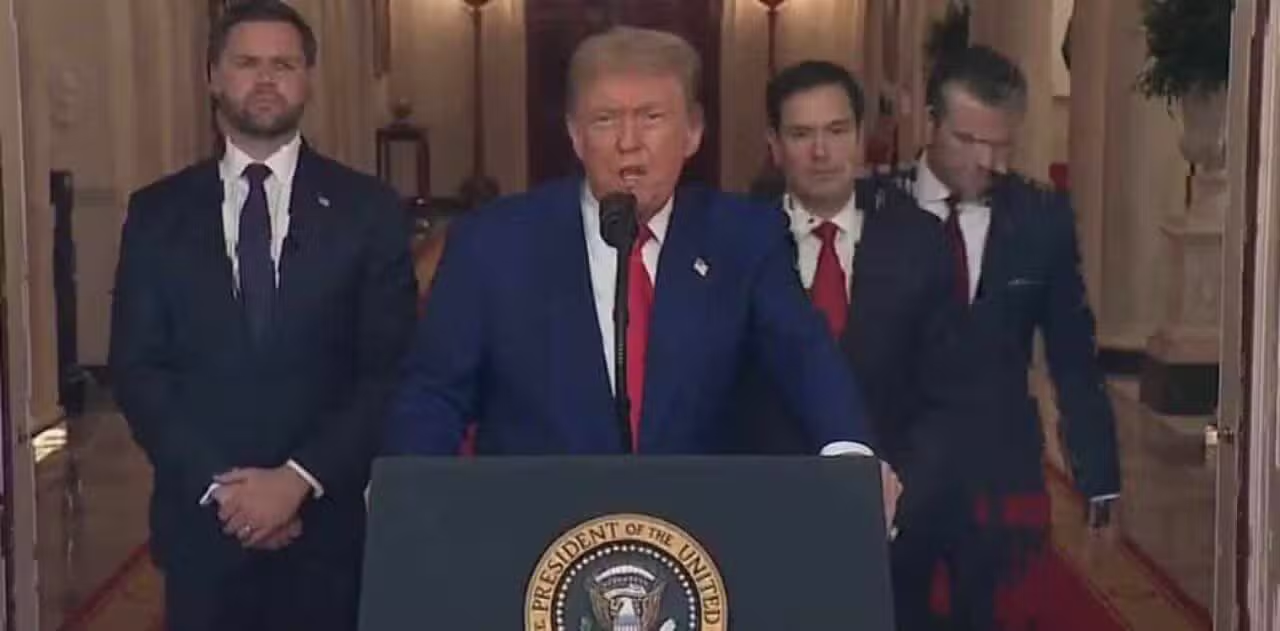
In a speech on Saturday night, June 21, 2025, U.S. President Donald Trump announced a high-precision strike on three of Iran’s main nuclear facilities: Fordow, Natanz, and Isfahan. The offensive, carried out with B-2 bombers, aimed to neutralize Iran’s nuclear capabilities, which Trump labeled a global threat. Conducted jointly with Israel, the attack marked the ninth day of intense regional conflicts. According to the president, the operation seeks to force Iran to accept peace, but he warned that without a ceasefire, further military actions are inevitable. The escalation, which has already killed hundreds, reignites fears of a devastating regional war.
Trump’s address, broadcast live, emphasized collaboration with Israeli Prime Minister Benjamin Netanyahu and the performance of U.S. and Israeli forces. He stressed that the strikes were planned to eliminate Iran’s uranium enrichment infrastructure, which, according to reports from the International Atomic Energy Agency (IAEA), was close to achieving weapons-grade capacity. The president also noted that the operation was a direct response to decades of Iranian hostility toward the U.S. and Israel.
The offensive comes amid heightened tensions in the Middle East, following a week of tit-for-tat attacks between Israel and Iran. Since June 13, when Israel launched “Operation Rising Lion,” over 600 people have died in Iran and about 24 in Israel, according to local authorities and independent organizations. The direct U.S. involvement in the conflict raises the risk of further escalation, with potential global economic impacts, particularly in the oil market.
Immediate consequences: Airspace closures and heightened regional tensions.
Operation targets: The Natanz, Fordow, and Isfahan plants, central to Iran’s nuclear program.
Forces involved: U.S. B-2 bombers and Israeli intelligence support.
Stated goal: Prevent Iran from developing nuclear weapons and push for peace talks.

What prompted the U.S. strike
The U.S. decision to directly attack Iran followed months of rising tensions. IAEA reports indicated Iran had enriched uranium to 60%, a level close to weapons-grade. In March 2025, the agency censured Tehran for non-cooperation with inspectors, escalating Western concerns. Additionally, Israel’s offensive, launched on June 13, which destroyed parts of Iran’s nuclear infrastructure and killed military leaders, weakened Tehran’s response capacity, creating an opportunity for U.S. action.
Trump, in his speech, emphasized that the operation was planned with precision to avoid significant collateral damage, such as radioactive leaks. The IAEA confirmed no increase in radiation levels post-strike but warned of risks from targeting nuclear facilities. The choice of targets reflects a priority to dismantle Iran’s uranium enrichment capacity, critical for any military nuclear ambitions.
The president also highlighted Israel’s role, which, he said, provided crucial intelligence to pinpoint strategic targets. The U.S.-Israel collaboration was described as a joint effort to “erase the Iranian threat.” However, Trump’s aggressive rhetoric, including demands that Iran “cease attacks” or face “tragedy,” drew mixed reactions. While Western allies offered cautious support, countries like China and Russia condemned the operation, urging restraint.
International reactions to the strike
The global community responded with concern to the U.S. entry into the conflict. China’s Foreign Ministry spokesperson, Lin Jian, stated that the strikes violate Iran’s sovereignty and could have “serious consequences.” Russia offered to mediate talks, with President Vladimir Putin engaging leaders on both sides. UN Secretary-General António Guterres called for an immediate end to escalation, warning of the risks of a regional war.
In Iran, Supreme Leader Ayatollah Ali Khamenei vowed retaliation, stating the strikes would not weaken the country’s resolve. In a series of posts on the social media platform X, he called Trump’s surrender demands “absurd” and assured that Iran “will never bow.” Iran’s Revolutionary Guard announced preparations for a new wave of attacks on Israel, including the use of Fattah-01 ballistic missiles, capable of bypassing defenses like the Iron Dome.
- China: Condemned the strikes and called for respect for Iran’s sovereignty.
- Russia: Proposed mediation and criticized violations of international law.
- UN: Urged de-escalation and warned of risks to nuclear facilities.
- Iran: Vowed retaliation and bolstered military preparations.
Regional and global impacts
The U.S. strikes intensified the Middle East crisis, already unstable due to Israel-Iran clashes. Airspace closures in countries like Iran, Israel, and Jordan disrupted regional air traffic. In Iran, reports indicate Tehran residents are fleeing the city, fearing further bombings. In Israel, air raid sirens sounded in cities like Tel Aviv and Jerusalem, with residents urged to stay in shelters.
The oil market felt immediate effects, with barrel prices rising due to fears of disruptions in the Strait of Hormuz, through which about 20% of global oil passes. Prior attacks on Iranian facilities had already reduced the country’s gas output, and the new offensive may worsen the situation. Gulf nations like Saudi Arabia and the UAE heightened security around energy infrastructure, fearing Iranian reprisals.
The U.S. entry also raised concerns about broader involvement. Iran threatened to target U.S. bases in the region if the offensive continues, potentially drawing countries like Iraq and Syria into the conflict. Iran-backed groups, such as the Houthis in Yemen, escalated attacks on Red Sea shipping, further complicating commercial navigation.
U.S. military strategy
The U.S. operation showcased advanced technology. B-2 bombers, known for penetrating air defenses, were escorted by F-35 fighters, ensuring precision. Military sources reported significant damage to the Fordow, Natanz, and Isfahan facilities, with Natanz’s electrical infrastructure and backup generators completely destroyed.
The Pentagon announced that Defense Secretary General Kane will hold a press conference on June 22 to detail the operation’s outcomes. Military experts suggest the target selection reflects a “decapitation” strategy, focusing on critical nuclear infrastructure while avoiding civilian areas. However, the lack of transparency on casualties raises questions about the humanitarian impact.
- Technology used: B-2 bombers and F-35 fighters.
- Primary targets: Electrical infrastructure and backup generators.
- Strategy: Neutralize nuclear capacity without hitting residential areas.
- Next steps: Pentagon press conference to assess damage.
Israel’s role in the operation
Israel played a central role in intelligence and planning. The Mossad, according to sources, identified the locations of nuclear facilities and Iranian military leaders, enabling surgical strikes. Israel’s “Operation Rising Lion,” launched on June 13, had already weakened Iran’s air defenses, facilitating U.S. bomber entry.
Prime Minister Benjamin Netanyahu, praised by Trump, stated the joint operation is a step toward “ensuring Israel’s survival.” He claimed Iran was “45 minutes from the second half” in building a nuclear bomb, justifying the urgency. The U.S.-Israel collaboration strengthens their strategic alliance but fuels perceptions that Israel seeks regime change in Tehran.
Future scenario and tensions
Trump’s rhetoric, oscillating between peace offers and threats of further strikes, reflects the moment’s complexity. While expressing hope that Iran will negotiate, he made clear his readiness to escalate. Iran’s refusal to yield, coupled with its military mobilization, suggests the conflict is far from resolution.
The international community, including U.S. allies, presses for diplomacy. However, nuclear talks scheduled in Oman were halted after the strikes began. The lack of dialogue raises risks of miscalculations and unintended escalation. Meanwhile, populations in both countries face fear of further bombings, with damage to critical infrastructure disrupting daily life.