
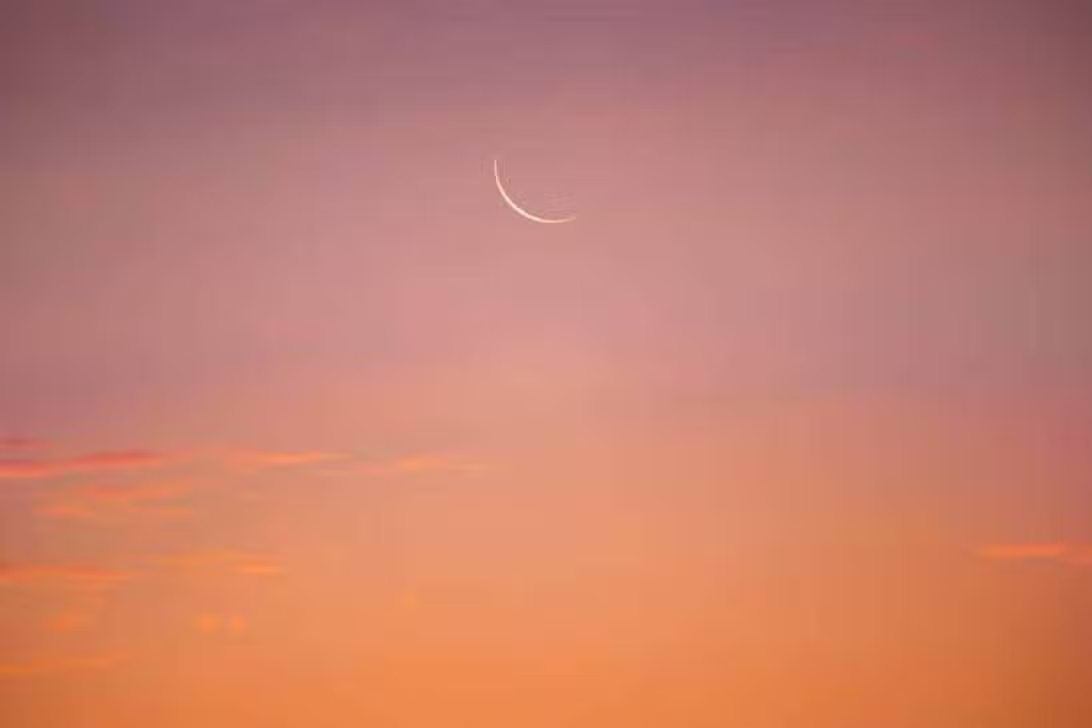
On Tuesday, August 26, 2025, the Moon is in its new phase, a moment when Earth’s natural satellite positions itself between the Sun and the planet, becoming nearly invisible in the night sky. This event marks a key point in August’s lunar cycle, which began with the crescent moon on the 1st and will conclude with another crescent moon on the 31st. The new moon, occurring since August 23 at 03:06 AM, is one of the four stages of the lunar cycle, each with unique characteristics that influence visibility and even cultural and astronomical aspects. The new moon is especially significant for sky observers, amateur astronomers, and traditional practices like planting in some cultures. The next phase, the crescent moon, is just five days away, promising a gradual increase in the satellite’s brightness. This phenomenon, occurring every 29.5 days on average, captivates with its precision and the beauty of its transformations.
The lunar cycle, or lunation, is a continuous process reflecting the gravitational interaction between Earth, the Moon, and the Sun. Each phase—new, crescent, full, and waning—lasts about seven days, creating a celestial spectacle observable with the naked eye. August 2025 features a dynamic lunar calendar with well-defined transitions that attract both enthusiasts and experts. The new moon, in particular, is a moment of renewal, often associated with new beginnings in cultural traditions.
- New moon: Invisible in the sky, occurs when aligned with the Sun.
- Crescent moon: Appears on August 31, shaped like a “C” in the Southern Hemisphere.
- Full moon: Occurred on August 9, with maximum visibility.
- Waning moon: Recorded on August 16, resembling the letter “D”.
What defines the new moon phase
The new moon phase, observed this Tuesday, August 26, is marked by its unique position in the sky. At this moment, the Moon aligns with the Sun relative to Earth, meaning the illuminated side of the satellite is not visible from our planet. This occurs because sunlight shines directly on the Moon’s opposite side, rendering it nearly invisible at night. For astronomers, this is an ideal time to observe stars and galaxies, as the absence of lunar light reduces natural light pollution.
The new moon lasts an average of two to three days, but its influence extends throughout the lunar cycle. In August, the new moon began on the 23rd and sets the stage for the transition to the crescent moon by the end of the month. This phase is often used by farmers in traditional practices, associating the new moon with planting crops that grow underground, like roots and tubers. Additionally, the new moon is a milestone in cultural and religious calendars, symbolizing renewal and introspection.
- Visibility: None at night, ideal for stargazing.
- Duration: Approximately two to three days in the lunar cycle.
- Cultural significance: Linked to new beginnings and planning.
- Astronomical impact: Reduces light interference for telescopes.
How the lunar cycle works
The lunar cycle, or lunation, is the period between two new moons, lasting an average of 29.5 days. This process results from the Moon’s orbit around Earth and its gravitational interaction with the Sun. Each phase—new, crescent, full, and waning—reflects a change in the Moon’s illumination angle relative to Earth. In August 2025, the cycle began with the crescent moon on August 1 at 09:41 AM, followed by the full moon on August 9 at 04:55 AM. The waning moon occurred on August 16 at 02:12 AM, and the new moon, currently ongoing, started on August 23 at 03:06 AM.
The lunar cycle’s regularity is remarkable, with minimal variations in duration. Each phase has distinct characteristics that affect not only visibility but also human activities, such as maritime navigation due to tides and even agriculture in some regions. The Moon’s average distance from Earth, about 399,877 km, also influences how the phases appear, especially when the satellite is at perigee (closest) or apogee (farthest).

Differences between moon phases
The Moon’s four phases—new, crescent, full, and waning—are defined by the amount of sunlight reflected toward Earth. The new moon, as seen today, is the least visible, while the full moon, which occurred earlier this month, is the brightest. The crescent moon, returning on the 31st, shows a gradual increase in illuminated area, and the waning moon, seen on the 16th, displays a progressive decrease in reflected light.
In the Southern Hemisphere, the Moon’s appearance differs from the Northern Hemisphere due to the observer’s perspective. For instance, in the crescent phase, the “C” shape is typical in the Southern Hemisphere, while in the Northern Hemisphere, it resembles a “D”. This inversion is an optical phenomenon caused by the observer’s orientation relative to the equator. Additionally, the Moon always shows the same face to Earth, due to the synchronization of its rotation and orbit.
- New moon: Invisible, aligned with the Sun.
- Crescent moon: “C” shape in the Southern Hemisphere, appearing on August 31.
- Full moon: Fully illuminated, visible on August 9.
- Waning moon: “D” shape, recorded on August 16.
- Curiosity: The same lunar face is always visible from Earth.
Why the new moon is special
The new moon, as seen this Tuesday, plays a unique role in the lunar cycle. Besides being the least visible phase, it marks the start of a new lunation cycle, often associated with renewal in various cultures. For astronomers, it’s an opportunity to observe distant celestial bodies, as the lack of lunar light aids in viewing stars and galaxies. Practically, the new moon also influences tides, with stronger syzygy tides due to the Sun, Moon, and Earth alignment.
Culturally, the new moon is seen as a time for introspection and planning. In some agricultural traditions, it’s ideal for planting crops that grow underground, like carrots and potatoes, due to the belief that lunar energy favors root development. Scientifically, the new moon is studied to better understand the Moon’s orbital dynamics and its interaction with Earth and the Sun.
Curiosities about the moon in August
August 2025’s lunar calendar is rich in astronomical events. Beyond the regular phases, the month has no lunar eclipses or supermoons, but the lunar cycle’s regularity is enough to captivate observers. The Moon’s average distance from Earth, about 399,877 km, varies slightly during the month, affecting its appearance in the sky. The absence of eclipses in August makes the lunar cycle even more accessible for naked-eye observation.
- Lunar cycle: Lasts about 29.5 days, with four distinct phases.
- Moon’s distance: Average of 399,877 km, varying at perigee and apogee.
- Ideal observation: New moon facilitates stargazing.
- Cultural traditions: New moon linked to new beginnings and planting.